Written by The Frogfather | UK dart frog keeper, breeder and bioactive vivarium specialist | Last reviewed: 2 September 2026
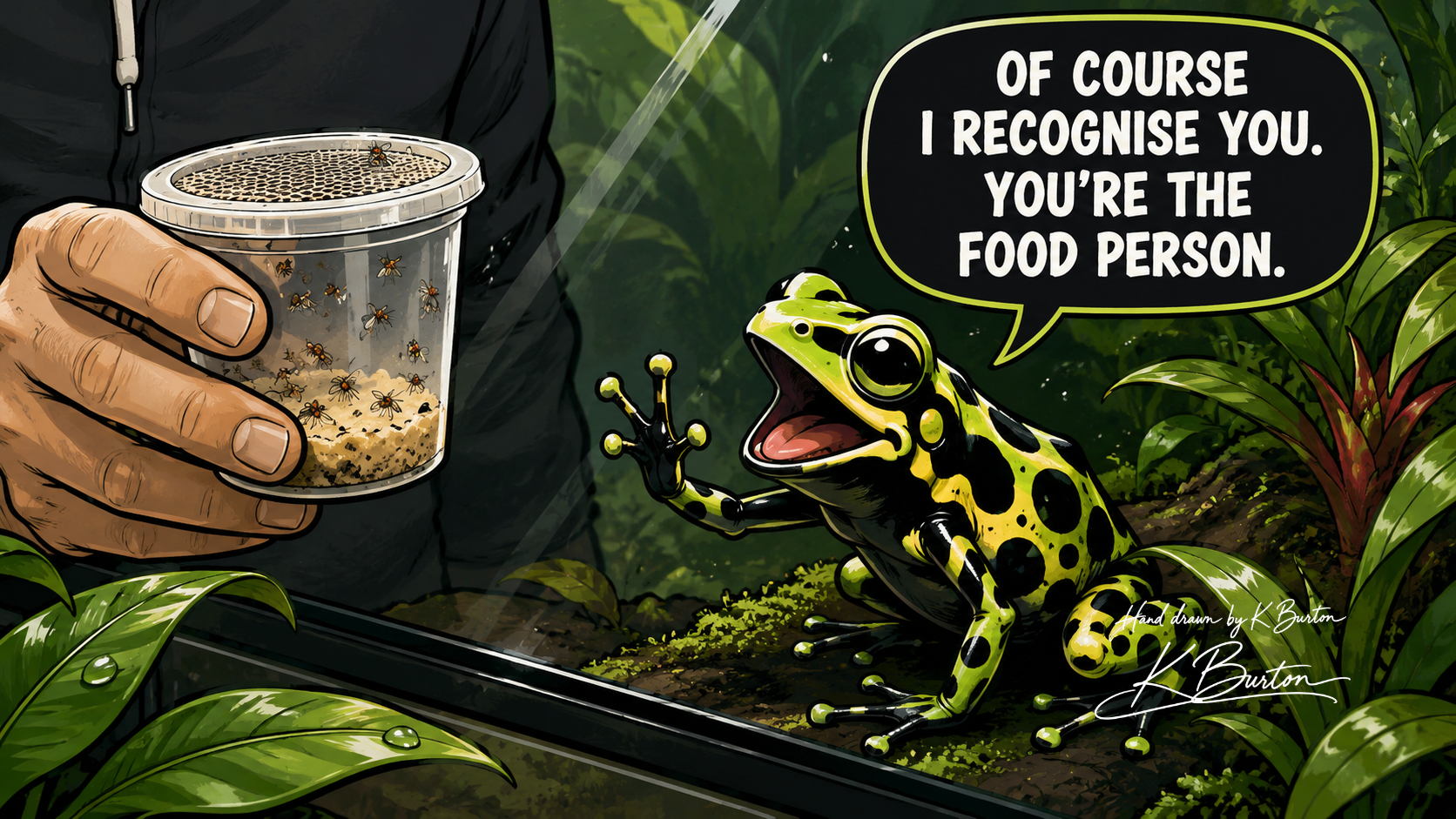
You walk into the frog room and a dart frog appears at the front glass. It watches you, follows your movement and positions itself exactly where the fruit flies normally arrive. Another person enters and the same frog stays beneath a leaf.
It is tempting to conclude that the frog knows you personally. Perhaps it recognises your face, trusts you or has formed a bond. The less romantic answer is that it has learned the timetable and the sequence of cues that predict food.
The honest answer sits between those extremes. Poison frogs are not simple reflex machines. Research shows impressive visual learning, flexible decision-making and spatial memory. However, there is currently no controlled evidence demonstrating that captive dart frogs recognise an individual human face or form an owner-directed emotional attachment comparable with a dog, parrot or social mammal.
Your frog may still distinguish familiar from unfamiliar situations—and possibly familiar combinations of human cues. We simply need to describe that ability accurately.
What would it mean for a dart frog to recognise its keeper?
“My frog recognises me” can describe several different claims:
- the frog detects that a large animal is outside the vivarium;
- it distinguishes familiar movement from unfamiliar disturbance;
- it recognises the place, time and objects associated with feeding;
- it identifies one person using their face, shape, smell, voice or behaviour;
- it remembers previous interactions with that person; or
- it has an emotional social bond with the individual.
These are not equivalent. Demonstrating one does not prove the next.
A frog moving towards the front when a person lifts a culture cup clearly shows perception and prediction. To prove individual human recognition, an experiment would need to separate the person from their clothes, location, timing, equipment, movement and food. To demonstrate an emotional bond would require stronger evidence again.
Most home observations cannot control those variables. That does not make them worthless; it means they support a narrower conclusion: the frog has learned a reliable association.
Recognition is not the same as affection
An animal may distinguish individuals without loving them. It may also show reduced fear around a predictable caretaker without identifying their face. Familiarity, habituation, associative learning and attachment are different processes.
Using careful language is not an attempt to diminish dart frogs. Their actual abilities are fascinating enough without giving them mammalian motives they may not possess.
How intelligent are dart frogs?
Older accounts often treated amphibian behaviour as a limited collection of fixed responses. Modern work with poison frogs shows something much richer.
In a 2016 study, captive Dendrobates auratus learned a visual spatial-discrimination task and adapted when the rewarded choice changed repeatedly. Across reversals, the frogs improved by using a win-stay/lose-shift-type strategy—behavioural flexibility previously associated mainly with birds and mammals.
A later study trained D. auratus to locate a hidden platform using a configuration of visual cues. The frogs took direct routes from different starting points, consistent with use of a cognitive map. Further research found that the species can use enclosure geometry and feature cues, preferring the more reliable feature when cues conflict.
Wild poison frogs also solve demanding navigation problems. Territorial Allobates femoralis males displaced within familiar areas oriented home and returned by direct routes, while unfamiliar surroundings disrupted orientation. Experience with the local landscape mattered.
These studies demonstrate:
- visual cue learning;
- spatial memory;
- landmark and geometric navigation;
- adjustment when reward rules change; and
- use of experience rather than instinct alone.
None tested human faces. We can reasonably conclude that dart frogs possess the learning capacity to associate keeper-related cues with outcomes. We cannot leap from that capacity to proof of personal recognition.
Why would poison frogs need sophisticated learning?
In the wild, many poison frogs defend territories, locate mates, remember calling and egg sites, transport tadpoles and revisit scattered water bodies. A parent may need to move through a complex rainforest floor and return successfully.
Learning the route from a favoured shelter to a feeding point in a vivarium is modest compared with those natural demands. The surprise should not be that they learn a captive routine; it should be how quickly keepers once assumed they could not.
How does a dart frog learn the feeding routine?
Associative learning occurs when one event predicts another. In a frog room, feeding is surrounded by repeatable signals:
- lights have been on for a familiar period;
- the keeper enters at a similar time;
- culture tubs or dusting equipment move;
- a particular door opens;
- the keeper stands in a familiar position;
- the vivarium door or feeding port makes a sound; and
- moving prey appears at a predictable location.
Each repetition strengthens the predictive value of those cues. Eventually the frog may approach before the flies appear. That is not begging in the human sense; it is anticipatory behaviour.
The Frogfather morning frog-room routine illustrates why a repeated sequence becomes so informative. From the keeper’s perspective it is a health check. From the frog’s perspective it is a chain of environmental events with consequences.
Why does the frog wait in one exact place?
The feeding station itself can become a learned spatial cue. If flies are always released onto the same leaf or near the same door, a frog that waits there reaches prey first. In a group, that advantage reinforces the behaviour quickly.
This is why the feeding guide recommends spreading prey appropriately when social competition is possible. One confident animal monopolising the learned release point can create the illusion that only it recognises the keeper; it may simply control the best feeding location.
Can a routine become too predictable?
Consistency helps monitoring and reduces uncertainty, but feeding in exactly one spot can concentrate competition and reduce foraging. Retain a broadly predictable husbandry routine while varying prey distribution within the usable enclosure.
A healthy frog should hunt and explore, not spend the entire day parked beneath a hatch waiting for room service.
Which human-related cues might a dart frog recognise?
A dart frog does not need a human concept of identity to distinguish situations. It can combine several sensory signals into one familiar pattern.
| Possible cue | What the frog may learn | Why it does not prove face recognition |
|---|---|---|
| Time and light cycle | Food usually arrives during this daily window | The response may occur before any person is identified |
| Movement and silhouette | This familiar approach usually predicts feeding | Clothing, speed and direction may matter more than identity |
| Keeper’s position | Food enters from this side of the enclosure | The frog may be recognising location |
| Culture or dusting cup | This object predicts moving prey | Object recognition is not human recognition |
| Door vibration or sound | This sequence precedes food | The keeper may be invisible when the cue occurs |
| Voice or room noise | A familiar sound pattern accompanies routine activity | Direct evidence for individual voice recognition is absent |
| Combined cue package | The entire familiar event predicts a reward | No single component has been isolated experimentally |
Can dart frogs see your face?
They can see a large figure and respond to visual information outside the glass. Dart frogs use colour, contrast, motion and visual landmarks in important natural behaviours. Whether their visual system extracts and remembers the fine configuration of an individual human face has not been demonstrated.
The scale difference is enormous. From inside a planted enclosure, your face may be farther away and less relevant than the movement of your hands, the shape of a cup or the opening door.
Can they recognise your smell?
Amphibians use chemical information, but a closed planted vivarium, room airflow and the absence of direct safe contact make human scent difficult to interpret. There is no good evidence that dart frogs identify their keeper by personal scent.
Do not offer fingers for investigation. Human skin carries salts, oils, cosmetics and residues, while contact transfers heat rapidly to a tiny amphibian. Recognition should be observed through ordinary husbandry, not tested by unnecessary handling.
Why does my frog hide from visitors but approach me?
This observation is plausible without proving personal recognition. You probably move differently from a visitor. You know where the vivarium is, approach at a predictable speed and avoid sudden gestures. A guest may lean close, point, cast a new shadow or arrive at an unusual time.
Repeated harmless exposure can produce habituation: the frog reduces its response to a familiar stimulus that repeatedly proves irrelevant or safe. A familiar keeper may therefore generate less avoidance than a novel human silhouette.
Captive observations support caution. A project involving blue dart frogs and golden mantellas found that observer and visitor presence changed activity and enclosure use. Human presence is therefore not neutral merely because a frog remains visible.
The article on why some dart frogs become bold explains how species, individual history, enclosure security and predictable disturbance interact. A bold frog may learn keeper routines quickly; a naturally cautious individual may understand the same routine and still wait beneath cover.
Does staying visible mean the frog trusts you?
“Trust” can be useful shorthand if it means the frog no longer treats your routine presence as an immediate threat. It should not be taken to mean conscious interpersonal trust identical to ours.
The most objective description is: the frog has become habituated to familiar low-threat activity and continues normal behaviour in its presence.
Do dart frogs bond with their owners?
There is no evidence that dart frogs form human-directed attachment bonds comparable with domesticated mammals. Their natural social world involves mates, rivals, offspring and territorial neighbours—not human caretakers.
That does not make the keeper-frog relationship meaningless. A good keeper learns each animal’s baseline, supplies a stable environment and becomes a predictable part of its daily surroundings. The frog may respond with reduced avoidance, confident feeding and normal activity.
The relationship is real in its consequences even if it is not reciprocal affection. Your knowledge and decisions protect the frog; its behaviour gives you information about whether those decisions are working.
Can dart frogs enjoy seeing their keeper?
We cannot measure “enjoyment” from an approach response. The frog may be anticipating prey rather than seeking social contact. If you enter without feeding and it returns to foraging after a short inspection, that fits a learned food prediction.
Do not repeatedly feed simply because the frog approaches. Anticipation is not proof of nutritional need. Follow body condition and a suitable schedule; the dart frog feeding-quantity guide explains why enthusiasm and requirement are different.
Can you test whether your dart frog recognises the routine?
You cannot prove human identity recognition casually, but you can observe which cues trigger anticipation. Keep the exercise non-invasive and never withhold necessary food to make a point.
- Establish a baseline. For several normal feeds, note when the frog appears: when you enter, lift the culture, open the door or release prey.
- Record rather than remember. Use short video from a fixed position and note the time, lighting and last feed.
- Change one harmless cue. For example, stand briefly at the usual position without holding the culture. Do not open or disturb the enclosure.
- Test the object separately. At the normal time, move the closed culture cup within view while remaining farther away.
- Compare another familiar caretaker. If somebody already feeds the frogs safely, compare the response without introducing a stranger solely for an experiment.
- Repeat sparingly. One response proves little; repeated patterns are more informative.
- Stop if behaviour changes negatively. Hiding, frantic jumping or persistent disruption is not worth satisfying curiosity.
How should you interpret the result?
| Result | Reasonable interpretation | What it does not prove |
|---|---|---|
| Frog approaches before the keeper appears | Time or lighting predicts food | Recognition of a person |
| Frog responds to the culture cup | Object has become a food cue | Recognition of the holder |
| Frog approaches only during the full usual sequence | It has learned a combined cue package | Which individual cue matters |
| Frog remains visible for its regular keeper | Habituation to predictable movement | Affection or facial recognition |
| Frog hides from a visitor | Novel movement or disturbance causes caution | That the frog consciously dislikes that person |
A proper recognition experiment would randomise people, conceal food cues, control clothing, position, timing and movement, and test responses blind. Home observation is better used to improve husbandry than to make a grand cognitive claim.
What does approaching the keeper tell you about welfare?
A confident approach can be reassuring when it occurs alongside normal posture, accurate hunting, healthy body condition and broad enclosure use. It suggests that the frog is active, visually responsive and sufficiently secure to remain exposed.
It is not a complete welfare test. A hungry frog may become unusually bold. A dominant frog may control the feeding station while a subordinate animal disappears. A conditioned response may persist even when another aspect of husbandry is poor.
Use the Frogfather guide to assessing whether dart frogs are thriving for the broader picture. Combine routine response with:
- stable body condition;
- consistent feeding and prey capture;
- normal posture and coordination;
- appropriate calling, courtship or territorial behaviour;
- use of multiple enclosure zones;
- healthy skin and shedding; and
- absence of chronic social exclusion.
What if a frog stops greeting you?
One missed appearance is not a diagnosis. The frog may have fed on microfauna, moved to a different resting place, changed its daily pattern or be responding to temperature, shedding, breeding or disturbance.
A persistent change deserves observation. Check whether it still feeds, moves normally and maintains condition. The normal behaviour versus warning-sign guide helps distinguish a routine shift from a wider pattern, while the body-condition monitoring guide provides a repeatable record.
Common mistakes when interpreting keeper recognition
“It comes to the glass, so it loves me”
Approach is most parsimoniously explained by learned feeding cues. Enjoy the interaction, but do not convert food anticipation into proof of affection.
“It hides from everyone else, so it knows my face”
Familiar movement, timing, clothing, position and disturbance level all differ. Habituation to your routine is enough to explain reduced fear.
“It is watching me because it wants handling”
Dart frogs are display animals. Watching a moving object outside the glass is not consent to touch. Handling risks heat transfer, skin contamination, escape and stress and should be reserved for genuine husbandry or veterinary needs.
“It is always waiting, so I should feed every time”
Conditioned animals respond when a cue predicts reward, even when they do not require another meal. Overfeeding can distort body condition and leave excess flies in the enclosure.
“The shy frog is less intelligent”
Visibility reflects species, sex, individual temperament, enclosure structure, social status and history. A cautious frog may have learned the routine perfectly and chosen a lower-risk strategy.
“Recognition means the frog needs companionship from me”
Human social contact is not a dart frog requirement. Provide species-appropriate housing, security, stimulation through natural foraging and suitable social arrangements—not attention through the glass for its own sake.
What can we conclude from the evidence?
The evidence establishes that poison frogs can learn sophisticated visual and spatial relationships. D. auratus can adapt to reversed reward contingencies, use configurations of visual cues, navigate with features and geometry and form map-like spatial representations. Wild poison frogs use experience to navigate familiar landscapes.
Evidence also shows that the presence of human observers and visitors can alter captive dart frog and mantella behaviour. It is therefore reasonable that repeated, predictable keeper activity becomes familiar and that frogs learn which human-associated events predict food.
What is missing is a controlled test demonstrating that a dart frog distinguishes one human individual after other cues have been removed. There is also no evidence that an approach response represents a human-directed attachment bond.
The balanced conclusion is:
Dart frogs are capable learners that can recognise familiar routines and the cues surrounding a keeper. They may distinguish familiar from unfamiliar human activity, but individual human recognition and emotional bonding remain unproven.
Frequently asked questions
Do dart frogs recognise their owners?
Dart frogs can learn the visual, spatial and timing cues associated with their keeper’s routine, particularly feeding. However, no controlled study has yet shown that they recognise an individual human face or identity after those other cues are removed.
Why does my dart frog come to the glass when it sees me?
The frog has probably associated your approach, position, movement, feeding equipment or time of day with the arrival of prey. Coming to the glass is anticipatory behaviour and does not by itself prove affection or personal recognition.
Are dart frogs intelligent?
Yes. Research shows that poison frogs can learn visual and spatial tasks, remember locations, use environmental geometry and adjust when reward rules change. Their cognitive abilities are well suited to navigation, territorial behaviour and parental care.
Can dart frogs learn a feeding schedule?
Yes. Repeated feeding at similar times and places allows a dart frog to associate light cycles, keeper movement, culture cups, door sounds and feeding locations with prey. Some frogs begin waiting before food appears.
Do dart frogs bond with humans?
There is no evidence that dart frogs form owner-directed emotional attachment bonds comparable with domesticated mammals. They can become habituated to a predictable keeper and remain calm or feed confidently in that person’s presence.
Can dart frogs tell different people apart?
They may respond differently to people who move, dress, stand or interact with the enclosure differently. That could reflect familiarity with a bundle of cues, but individual human recognition has not been demonstrated experimentally in dart frogs.
Should I feed my dart frog every time it approaches me?
No. A learned feeding response is not proof that the frog needs another meal. Follow an appropriate feeding routine and monitor body condition, age, breeding status and how much prey remains in the vivarium.
Why has my dart frog stopped coming out for me?
A temporary change may relate to temperature, shedding, breeding, disturbance or a different resting location. Investigate if the change persists or accompanies poor feeding, weight loss, weakness, abnormal posture, damaged skin or altered behaviour elsewhere.