Husbandry & Evidence Review – 6 September 2026
This current second-hand-vivarium checklist remains appropriately risk-based. Known chemical exposure, diagnosed infectious disease, damaged seals/electrics or unremovable contaminated material can justify discarding components rather than trying to ‘sterilise’ them.
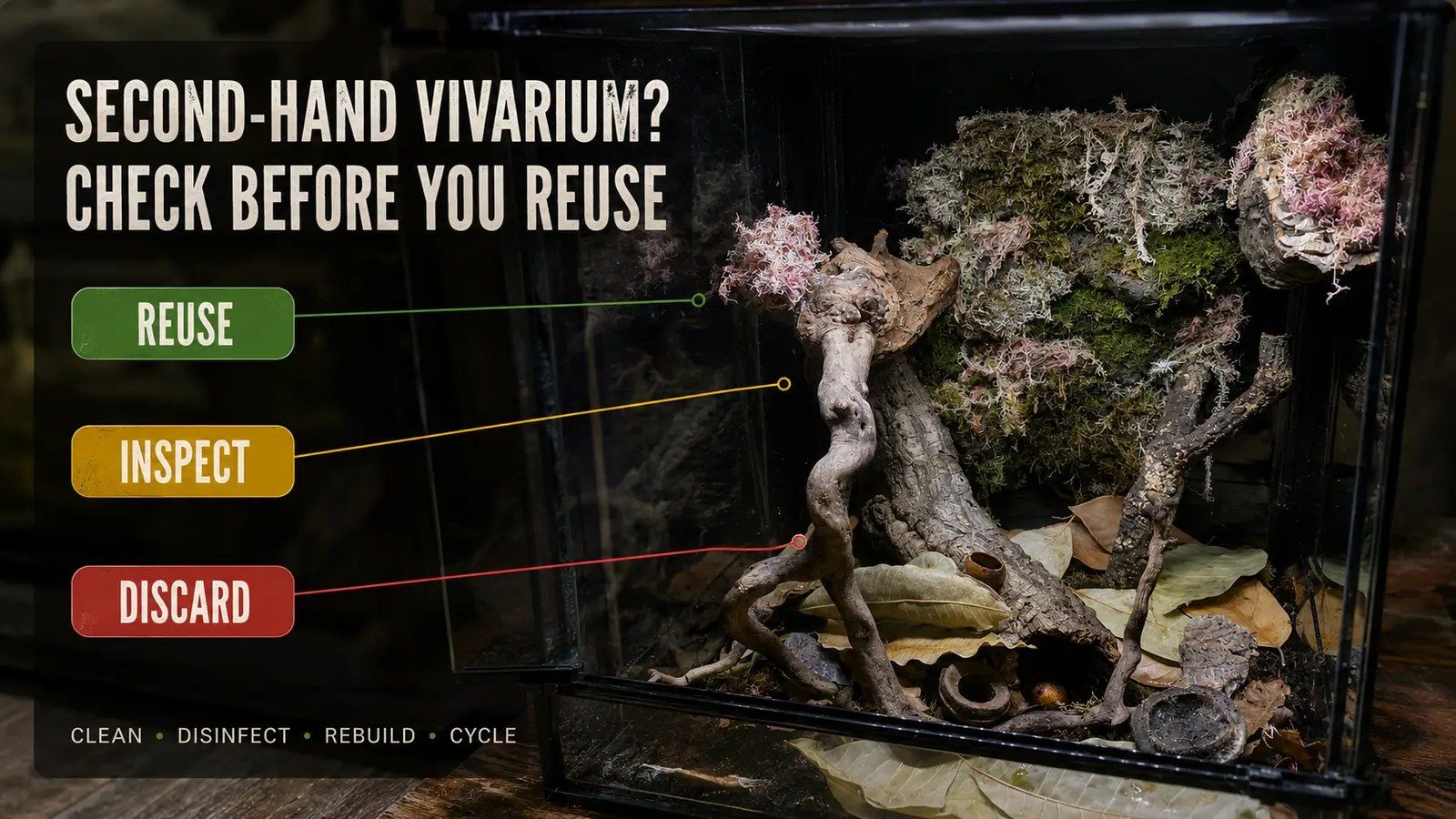
A second-hand vivarium can be a sensible way to reduce the cost of keeping dart frogs. It can also be a false economy containing old substrate, unknown chemicals, damaged silicone, blocked ventilation, hidden pests or porous materials that cannot be reliably disinfected.
The glass box may be reusable. That does not mean everything inside it is.
Whenever I assess a used enclosure, I separate the decision into three questions: is the structure sound, is the history acceptable and can every retained component be cleaned and disinfected without leaving something harmful behind? If any of those answers is uncertain, I rebuild more aggressively or walk away.
This guide explains how to inspect, strip, clean, disinfect, rebuild and test a second-hand vivarium before any dart frog enters it. It is not a promise that every used enclosure can be made safe, and it does not replace veterinary or manufacturer advice where disease or chemical contamination is suspected.
Quick answer: can you use a second-hand vivarium for dart frogs?
Yes, but treat it as an empty shell with an unknown history—not as a ready-to-use bioactive ecosystem. Confirm what previously lived in it, remove disposable and porous materials, inspect the glass, doors, vents and silicone, clean before disinfecting, rinse away all residues, rebuild with known-safe materials and cycle the completed system before introducing frogs. If the previous animal died unexpectedly, the enclosure smells of chemicals or the background cannot be removed and assessed, declining the vivarium may be the safest decision.
Contents
- Why a used vivarium is different
- Questions to ask the seller
- When to walk away
- What can be reused?
- Structural inspection
- How to strip the enclosure
- Cleaning versus disinfection
- Material-by-material guidance
- Lighting, misting and electrics
- Rebuilding the vivarium
- Cycling and testing
- Collection-day checklist
- Frequently asked questions
Why a second-hand vivarium is not an ordinary cleaning job
Routine maintenance is based on knowledge. You know which frogs live in the enclosure, what water and products have been used, whether any animal has been ill and how the drainage, substrate and background were built.
A second-hand vivarium is different because the history may be incomplete. “Only used for a gecko” does not tell you which cleaning sprays, flea products, mite treatments, fertilisers, pesticides, adhesives or disinfectants contacted the enclosure. “Bioactive” does not tell you whether the substrate is healthy. A planted background can hide saturated foam, decaying wood, snails, nematodes, mites or damaged silicone.
This is why the normal bioactive vivarium cleaning guide should not be used as permission to preserve an unknown ecosystem. That article explains how to maintain a known, established enclosure without destroying it. A used vivarium with an uncertain history should normally be stripped and rebuilt as a new system.
Professional amphibian biosecurity guidance supports this cautious distinction. Glass, metal and suitable plastics can often be cleaned and disinfected. Soil and sphagnum should be treated as disposable, while porous wood and cork are difficult to disinfect reliably.
Questions to ask before buying a used vivarium
Ask before travelling or transferring money. A careful seller should understand why an amphibian keeper needs more than the dimensions.
- What species lived in it? Record every animal group, not only the most recent occupant.
- Why is it being sold? A house move is different from an unexplained illness or repeated enclosure failure.
- Did any animal become ill or die? Ask what signs occurred, whether a vet investigated and whether a cause was identified.
- Which medicines or pest treatments were used? Include mite sprays, flea products used elsewhere in the room and treatments applied to plants.
- How was it cleaned? Ask for actual products rather than accepting “properly disinfected”.
- What is the background made from? Foam, expanding foam, cork, wood, grout, paint, resin and silicone create different decisions.
- Can the drainage layer be emptied? A sealed reservoir containing old stagnant water may require substantial dismantling.
- Does it leak? Ask about the base, bulkheads, misting fittings and door channels.
- How old are the lights and misting parts? “Included” does not necessarily mean safe, appropriate or economical.
- Has the vivarium been stored in a shed or garage? Freezing, extreme heat, pests, chemicals and impacts during storage can affect materials.
Photographs should include every pane, the base, the top, the vents, the door tracks, the silicone seams, cable holes and the area behind or beneath any background. A wide photograph of a lush enclosure is not a structural inspection.
When should you walk away from a second-hand vivarium?
A cheap tank is not cheap if it needs to be dismantled, resealed, re-ventilated and rebuilt before it can safely hold an animal. Walk away, or price it only as salvageable glass, when you find:
- cracked, chipped or badly scratched structural glass;
- loose panes, separated seams or silicone lifting away from the glass;
- a persistent chemical, perfume, smoke, mould or sewage-like smell;
- an unexplained amphibian death with no credible cleaning plan;
- a permanently fitted porous background with an unknown animal or chemical history;
- old substrate and drainage water that cannot be removed;
- swollen chipboard, corroded metal or brittle heat-damaged plastic;
- electrical equipment with damaged cables, scorched plugs or water entry;
- door gaps, failed catches or ventilation openings that cannot be made escape-proof;
- evidence that pesticides, insect foggers or unsuitable cleaners were used inside it.
Do not let mature plants or an attractive background pressure you into accepting an unmanageable risk. Dart frogs have permeable skin, and a contaminant you cannot see may matter far more than the decorative value you can.
What can normally be reused from a second-hand vivarium?
| Component | Starting decision | Reason |
|---|---|---|
| Intact glass panes | Usually assess and retain | Non-porous and normally accessible for cleaning and disinfection. |
| Sound removable plastic or metal fittings | Assess individually | May be reusable if compatible with the chosen process and free of corrosion, cracking and inaccessible cavities. |
| Silicone seams | Inspect closely | Structural condition and contamination history matter; damaged or lifting silicone needs proper replacement. |
| Mesh vents | Clean, inspect or replace | Fine debris and corrosion can remain around edges and frames. |
| LECA or loose drainage media | Usually replace | Low replacement cost rarely justifies retaining media from an unknown wet system. |
| Filter foam drainage | Replace if history is unknown | Its open structure can retain organic material and residues deep inside. |
| Soil, substrate, moss and leaf litter | Discard | They cannot be treated as clean simply because they look or smell normal. |
| Cork, wood and coir panels | Usually discard | Porous natural materials are difficult to disinfect reliably. |
| Foam, grout or fibre backgrounds | Remove where history is uncertain | Cracks, cavities and porous surfaces can conceal water, waste and contamination. |
| Plants | Quarantine separately or discard | Plants can carry pests, soil residues and material from the former enclosure. |
| Water dishes and hides | Depends on material | Smooth glass, plastic or glazed ceramic is easier to process than wood, cork or unsealed porous ceramics. |
This is a risk-based starting point, not a guarantee. Known chemical exposure or a diagnosed infectious disease may justify discarding more than the table suggests.
Inspect the empty enclosure before cleaning hides the evidence
Photograph the vivarium first. Once it is wet and stripped, stains and leak paths can become harder to trace.
Glass and doors
- Inspect every edge and corner under good light.
- Check sliding doors for smooth travel and excessive side or centre gaps.
- Confirm that catches, locks and handles work reliably.
- Look for chips where doors overlap or run in tracks.
- Do not confuse heavy limescale with scratches until the pane is cleaned.
Silicone and sealed joints
- Look for lifting edges, bubbles, tears, missing sections and visible movement.
- Press only gently; do not turn inspection into a destructive test.
- Pay particular attention to the base, drainage partitions and bulkheads.
- If resealing is necessary, use an appropriate aquarium or vivarium product and allow its full specified cure before rebuilding.
Ventilation and escape security
Dart frogs require gentle, continuous air exchange and secure fine openings. Check whether the original vents are sufficient, whether mesh has detached and whether fruit flies or froglets could escape around cables, doors or drainage fittings. The Dart Frog Ventilation Guide explains how air exchange should work after the rebuild.
Leak test
Once the enclosure is empty and structurally suitable, test the base and any drainage penetrations in a safe area where a leak cannot damage floors or electrics. Do not perform the first serious water test after substrate, plants and equipment have been installed.
How to strip a second-hand vivarium safely
- Work away from the frog room. Do not bring an unknown wet enclosure directly beside an established amphibian collection.
- Wear suitable disposable gloves. Change them before touching clean equipment or established vivariums.
- Remove electrical equipment first. Isolate it from water and assess it separately.
- Bag disposable biological material. Substrate, leaf litter and moss should not be tipped into the garden or moved into another enclosure.
- Remove accessible cork, wood and porous furniture. Do not keep attractive pieces solely because replacement would cost money.
- Dismantle removable drainage components. Empty old water without splashing it around the work area.
- Remove a suspect background carefully. Protect the glass and avoid breathing dust from grout, foam or dried biological material.
- Keep dirty tools separate. Do not return brushes, buckets or cloths to ordinary husbandry use until they have been processed appropriately.
Wastewater and biological material from captive amphibian systems should be handled responsibly and must never be used to expose wild amphibians or outdoor ponds. UK government biosecurity guidance emphasises preventing potentially contaminated equipment and waste from spreading pathogens between captive and wild populations.
Cleaning and disinfection are not the same thing
Cleaning removes soil, biofilm, algae, faecal material, old adhesive and other debris. Disinfection uses an appropriate process to reduce or inactivate particular microorganisms on a surface.
Disinfectant applied over dirt is not a shortcut. Organic material can physically shield contamination and reduce the effectiveness of a product. Clean first, rinse, then disinfect suitable exposed surfaces according to the product instructions or veterinary protocol.
A sensible sequence
- Remove all loose material.
- Physically clean accessible non-porous surfaces with dedicated tools.
- Rinse away loosened debris.
- Apply a disinfectant appropriate to the suspected risk and compatible with the enclosure material.
- Use the correct concentration, coverage and contact time stated by the manufacturer or veterinary adviser.
- Rinse as directed until no harmful residue remains.
- Allow the enclosure and components to dry and air thoroughly.
Do not improvise chemical mixtures. Never combine disinfectants or cleaning agents. More concentrated is not automatically more effective and may damage seals, corrode metal or leave dangerous residues. Amphibian veterinary guidance specifically warns that equipment contacting amphibians must be free from toxic disinfectant residue.
If the seller reports a diagnosed pathogen, unexplained deaths or a chemical exposure, ask an amphibian-experienced veterinary surgeon about the enclosure before choosing a process. The required product and contact time depend on what is being controlled; one generic recipe cannot cover every organism or material.
Material-by-material safety decisions
Glass
Intact exposed glass is the strongest candidate for reuse because it is non-porous and visually inspectable. Remove debris without cutting into silicone seams. Use tools suitable for glass and keep blades away from edges, corners and seals. The vivarium glass cleaning guide covers safe mechanical removal of stubborn deposits.
Silicone
Sound silicone may remain serviceable, but it deserves more caution than the glass around it. It can lift, split or conceal material at damaged edges. Do not smear new silicone over dirty, loose or uncured material and assume the joint is repaired. Where resealing is required, prepare the surfaces properly and follow the chosen manufacturer’s curing instructions in full.
Plastic, PVC and acrylic
These materials vary. A process suitable for glass may cloud acrylic, embrittle plastic or damage printed components. Check compatibility, inspect for cracks and discard parts with inaccessible contaminated cavities. Never assume “plastic” describes one universal material.
Metal and mesh
Inspect for rust, sharp edges, flaking coatings and trapped debris. Replace mesh that has pulled away from its frame or corroded around fixings. Dart frog and fruit-fly security depends on the edges as much as the centre of the mesh.
Cork, wood, coir, soil and sphagnum
These are valuable habitat materials in a known enclosure but poor candidates for transfer from an unknown one. Their pores, cracks and internal spaces make reliable cleaning and disinfection difficult. Replace them rather than trying to rescue them with boiling, baking, freezing or a surface spray.
Foam and sculpted backgrounds
A sealed background may look washable while containing punctures, unsealed edges, waterlogged cavities or exposed foam behind it. If its construction and history are unknown, removal is normally the clearer decision. A permanently fixed background can turn an otherwise useful enclosure into one that is not worth the risk or labour.
Plants
Plants should not move directly from the old enclosure into the rebuilt one. If they are valuable and the history does not involve serious disease or chemical concern, isolate them away from amphibians, remove unknown potting material and follow a proper plant assessment. Read why vivarium plants need quarantine before saving them.
Check second-hand lighting, misting and electrical equipment separately
An included lamp or misting system has value only if it is appropriate and safe.
Lighting
- Identify the exact unit and lamp age.
- Inspect the cable, plug, connectors, housing and mounting points.
- Look for corrosion, heat discolouration and water entry.
- Do not assume an illuminated UVB lamp still provides suitable output.
- Confirm that the fixture can be positioned safely above the rebuilt enclosure.
Misting
- Discard unknown standing water and clean the reservoir.
- Inspect tubing for deposits, discolouration, brittleness and biofilm.
- Check nozzles, bulkheads and non-return components for leakage.
- Test the complete system away from animals before installation.
- Replace cheap or questionable tubing rather than building a new vivarium around it.
Heating and control equipment
Confirm what each controller actually does, whether its probe is intact and whether the heating method is suitable for dart frogs. Unknown thermostats, damaged heat mats and improvised wiring should not be inherited simply because they came with the tank.
Use the Dart Frog Lighting Guide and Dart Frog Misting System Guide to specify the rebuilt system rather than copying the former owner’s setup.
Rebuild the second-hand vivarium as a new ecosystem
Once the shell is clean, dry, structurally sound and free from problematic residue, start again with known materials.
- Design for the intended species and group. The enclosure must suit the frogs you plan to keep, not the animal that previously occupied it.
- Correct ventilation and escape gaps. Do this before the background and planting block access.
- Build inspectable drainage. Provide a way to see and remove accumulating water.
- Add known amphibian-appropriate substrate. Do not mix a token amount of new material into the old soil.
- Use quarantined plants and safe hardscape. Secure heavy pieces before loose substrate is added.
- Seed microfauna deliberately. Springtails and suitable isopods need time, food, moisture and habitat to establish.
- Add deep loose leaf litter. Create cover and protected microclimates rather than a decorative single layer.
- Install and test lighting and misting. Watch the resulting temperature, drainage and moisture pattern.
The Dart Frog Substrate and Drainage Guide explains how to construct the floor system, while the Complete Dart Frog Care Guide UK connects the full environment.
Do not add frogs immediately after the rebuild
A clean enclosure is not a proven enclosure. The completed vivarium still needs time to reveal leaks, drainage problems, overheating, excessive drying, unstable planting and equipment faults.
Before introducing frogs, confirm that:
- all new silicone, coatings and adhesives have completed their full cure;
- no chemical or construction smell remains;
- the base, bulkheads and misting fittings remain leak-free;
- day and night temperatures are safe and repeatable;
- humidity rises after misting and falls naturally with ventilation;
- leaves are not permanently dripping;
- excess water reaches an inspectable drainage area;
- plants are rooted and stable;
- springtails have spread beyond their introduction point;
- doors, vents and cable routes remain escape-proof.
Follow the complete Cycling a Bioactive Dart Frog Vivarium checklist. Three or four weeks after all construction materials have fully cured is a sensible minimum working expectation for many fresh builds, while complex rebuilds may benefit from six to eight weeks or longer. Readiness is demonstrated by stability, not by reaching a date.
New frogs still require appropriate quarantine. A disinfected vivarium does not replace the separate observation process described in the UK Dart Frog Quarantine Guide.
Second-hand vivarium collection-day checklist
- Take measurements of the vivarium and the vehicle opening.
- Bring padding, straps and helpers appropriate to the size and weight.
- Remove loose shelves, lights, water and décor before lifting.
- Keep the enclosure upright unless its construction permits otherwise.
- Never lift a glass vivarium by doors, vents, pipework or a decorative top.
- Photograph any existing damage before loading.
- Keep contaminated wet contents sealed and separate from clean equipment.
- Do not place a recently collected unknown enclosure directly in the frog room.
- Recheck seams, doors and panes after transport.
If the cost of safe transport, stripping, replacement components and rebuilding approaches the price of a suitable new enclosure, the second-hand purchase has not saved money. Compare the complete project rather than the seller’s headline price.
Evidence and further reading
The cautious approach in this guide is based on established amphibian biosecurity principles: separate unknown systems, clean before disinfecting, avoid moving disposable substrates between enclosures, recognise that porous wood and cork are difficult to disinfect and ensure no toxic disinfectant residue can contact amphibians.
- Amphibian Ark/IUCN biosecurity and permanent-isolation guidance
- Merck Veterinary Manual: Clinical Techniques in Amphibians
- UK Government amphibian biosecurity guidance
These sources provide general biosecurity principles. They do not establish that one household process can make every unknown enclosure safe.
Frequently asked questions
Can I put dart frogs straight into a cleaned second-hand vivarium?
No. After stripping, cleaning and disinfecting suitable surfaces, the vivarium should be rebuilt with known-safe materials and cycled as a new system. All construction products must cure fully, and temperature, humidity, ventilation, drainage, planting and equipment should prove stable before frogs enter.
Can I keep the old bioactive substrate?
Not when its history is unknown. Soil, sphagnum, leaf litter and similar materials should be treated as disposable rather than transferred into a new amphibian system. Replace them with known amphibian-appropriate materials.
Can I reuse cork bark and wood from a used vivarium?
Usually not if the animal, disease or chemical history is uncertain. Cork and wood are porous and difficult to disinfect reliably. Their replacement cost is normally small compared with the risk of carrying contamination into the rebuilt vivarium.
Can I reuse the plants?
Plants should never move directly into the rebuilt enclosure. Where the history does not involve serious disease or chemical exposure, valuable plants may be isolated and assessed separately. Remove unknown soil and follow a proper plant-quarantine process before considering reuse.
What should I ask the seller?
Ask which animals lived in the vivarium, whether any became ill or died, which medicines, pesticides and cleaners were used, what the background and drainage contain, whether it leaks and how long the included electrical equipment has been in service.
Can I disinfect a foam or cork background in place?
A permanently fitted porous background with an uncertain history is a major limitation. Cracks, cavities and unsealed areas may be inaccessible. Removing the background or declining the enclosure is normally safer than relying on a surface treatment.
Is bleach safe for cleaning a frog vivarium?
Do not use a generic bleach recipe without considering the target organism, surface compatibility, concentration, contact time and rinsing requirements. Use an appropriate labelled disinfectant or veterinary protocol, never mix chemicals and ensure no toxic residue remains before the enclosure is rebuilt.
How long should a rebuilt second-hand vivarium cycle?
For many fresh builds, three to four weeks after all construction materials have fully cured is a sensible minimum working expectation. Complex rebuilds may need six to eight weeks or longer. The vivarium is ready when the complete system is biologically and mechanically stable, not merely when a date is reached.
Should I reuse old misting tubing?
Inspect it for deposits, biofilm, discolouration, brittleness and unknown standing water. Replacing inexpensive tubing is often more sensible than attempting to prove that an inaccessible internal surface is clean. Pumps, reservoirs and nozzles should be assessed and tested separately.
Is a second-hand vivarium always cheaper?
No. Include transport, stripping, waste disposal, replacement vents, silicone, drainage, background, lighting, misting, substrate, plants and the time required to rebuild. A low purchase price can become more expensive than a suitable new enclosure.
The Frogfather verdict on second-hand vivariums
A good used vivarium can provide an excellent starting shell. The mistake is paying for somebody else’s unknown ecosystem and treating it as ready for your frogs.
Buy the structure, not the story. Verify the history, discard what cannot be reliably processed, clean before disinfecting, rebuild with known materials and cycle the completed enclosure from the beginning. If the glass, seams, background or history leaves you uneasy, walk away. There will always be another tank; there may not be another chance to protect an established collection from contamination.
If this checklist helps you avoid a costly mistake, share it with another keeper. You can also browse the Frogfather Knowledge Base for the complete dart frog care and vivarium series.