
Description
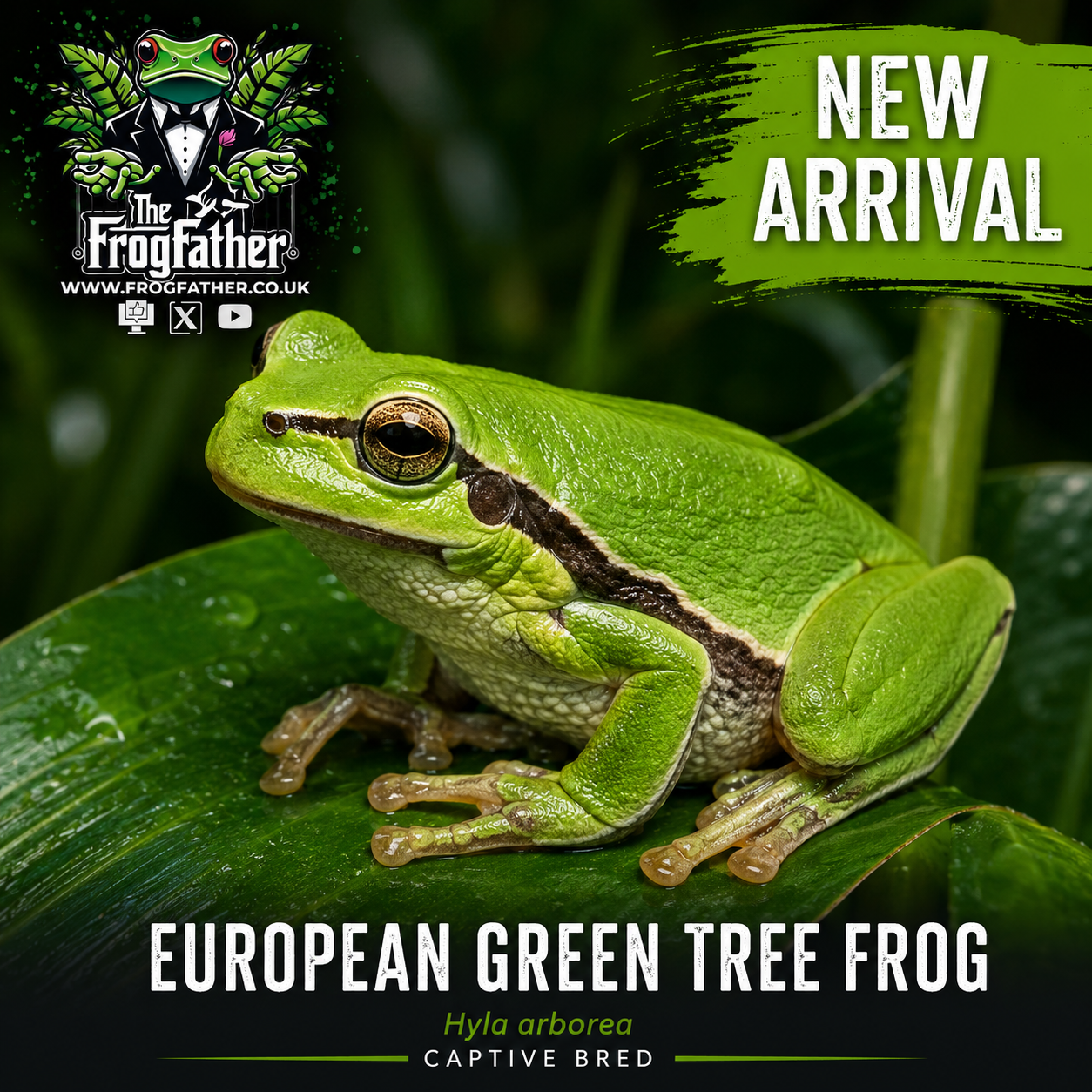
European Green Tree Frog (Hyla arborea)
The European Green Tree Frog is one of Europe’s most recognisable amphibians. Found naturally throughout parts of France, Germany, Italy, the Balkans and Eastern Europe, these small but charismatic frogs are famous for their bright emerald-green colouration and remarkable climbing ability.
Unlike many terrestrial amphibians, European Green Tree Frogs spend much of their lives elevated amongst vegetation where they use specialised toe pads to climb leaves, branches and glass surfaces with ease.
These captive-bred specimens have been raised in captivity and are feeding well on appropriately sized livefoods.
Species Information
- Scientific Name: Hyla arborea
- Common Name: European Green Tree Frog
- Origin: Captive Bred
- Adult Size: 3–5cm
- Lifespan: 8–12 years
- Temperature: 20–26°C
- Humidity: 60–80%
- Activity: Primarily nocturnal
- Difficulty: Beginner to Intermediate
Housing Requirements
This species thrives within a vertically orientated vivarium containing live plants, climbing branches and multiple elevated resting areas. Good ventilation is essential alongside regular misting to maintain suitable humidity levels.
Bioactive enclosures work exceptionally well for this species and allow natural behaviours to be displayed.
Diet
Feed a varied diet of appropriately sized crickets, fruit flies, roaches and other live insects. Calcium and vitamin supplementation should be provided regularly.
Availability
Status: New Arrival
Delivery: Specialist Courier Only
Climate & Husbandry Review
Last reviewed: 5 September 2026
Temperature, moisture and ventilation requirements are species- and life-stage-specific. Relative humidity is useful for monitoring trends but should not be treated as a universal single-number target: enclosure airflow, substrate and leaf-litter moisture, access to wet and drier microhabitats, temperature and sensor position all affect the conditions experienced by the animal.
Avoid prolonged overheating, stagnant saturated conditions and rapid environmental swings. Where additional heat is required, provide controlled gradients and monitor temperature at animal level. Frogfather’s own misting schedules are practical husbandry methods rather than universal biological requirements.
Evidence & further reading
- St Claire et al. – The husbandry and care of dendrobatid frogs
- Pough – Amphibian Biology and Husbandry




