Husbandry & Evidence Review – 6 September 2026
This article has been checked against Frogfather’s current evidence-led husbandry guidance. No high-consequence contradiction requiring a body-text rewrite was identified in the 5 September snapshot; this review note records that the post has been checked.
Let’s be honest: if you keep dart frogs in the UK, you are basically running a tiny fly farm.
Whether you love it or loathe it, mastering fruit fly cultures is one of the most important parts of keeping dart frogs healthy, active and well-fed. Frogs may be the exciting bit, but the flies are what keep the whole routine moving.
This guide explains how to start, maintain and troubleshoot Drosophila melanogaster and Drosophila hydei cultures — the two staple fruit fly species used by most UK dart frog keepers.
We’ll cover culture media, temperatures, mould, crashes, feeding schedules, backup cultures, froglets, and how products like Frogfather Fruit Fly Feast, All-in-1 Vitamin & Mineral Dust and methylparaben mould inhibitor fit into a reliable feeding system.
Why Culturing Fruit Flies Matters
Fresh flies are nearly always better than relying on random tubs that may already be past their best by the time they arrive. When you culture fruit flies at home, you control freshness, quantity, timing and nutrition.
That matters because dart frogs do not eat occasionally. They need a regular supply of small live prey. If you have froglets, juveniles or multiple vivariums, you may need flies every day.
Good fruit fly culture work gives you:
- fresh, active flies when you need them;
- backup cultures if one crashes;
- better control over feeder insect nutrition;
- less panic when shops are out of stock or deliveries are delayed;
- a more consistent feeding routine for frogs and froglets.
If you want the wider feeding picture, read our Dart Frog Feeding Guide UK.
The Two Main Fruit Fly Species for Dart Frogs
Most dart frog keepers use two main fruit fly species: Drosophila melanogaster and Drosophila hydei. Both are useful, but they are not interchangeable.
| Species | Size | Speed | Best for |
|---|---|---|---|
| Drosophila melanogaster | Small | Fast producing | Froglets, juveniles, Ranitomeya, smaller dart frogs and newly morphed frogs |
| Drosophila hydei | Larger | Slower producing | Adult tinctorius, leucomelas, auratus, terribilis and larger dart frogs |
Drosophila melanogaster
Drosophila melanogaster are small, quick to produce and ideal for froglets or smaller species. They are usually the first choice for young dart frogs because they are easier for small mouths to manage.
They also cycle quickly, which makes them useful if you need regular production and short turnaround times.
Drosophila hydei
Drosophila hydei are larger and slower to produce. They are useful for adult frogs that can handle a bigger feeder, but they need more patience because cultures take longer to get going.
Hydei are not ideal as the only food source for tiny froglets, but they are excellent for larger adult dart frogs once the culture is producing well.
What You Need to Start a Fruit Fly Culture
You do not need a complicated setup, but you do need consistency. A good fruit fly culture is a balance of food, moisture, airflow, temperature and timing.
To start a culture, you will need:
- a starter culture of D. melanogaster or D. hydei;
- a suitable fruit fly media, such as Frogfather Fruit Fly Feast;
- clean culture pots or deli cups;
- breathable lids or vented culture tops;
- coffee filters, folded paper, card or excelsior for climbing and pupation;
- clean water for mixing the media;
- optional methylparaben mould inhibitor for extra mould protection.
DIY media can work, but it is variable. Pre-made media is usually more consistent, especially if you keep multiple vivariums or need cultures to perform reliably through the year.
How to Build a Fruit Fly Culture
The exact quantities depend on your pot size and media instructions, but the basic method is simple.
- Add your fruit fly media to the culture pot.
- Mix with water until you have a thick, stable paste.
- Add a small amount of methylparaben mould inhibitor if you use it.
- Add folded coffee filters, card, paper or other climbing material.
- Tap in adult starter flies from an active culture.
- Seal with a breathable lid.
- Label the pot with the date and species.
The media should not be runny. If it is too wet, flies and larvae can become stuck and the culture may sour. If it is too dry, production can be poor and the culture may fail before it really gets going.
A good mix should be damp, stable and thick enough to hold shape while still allowing larvae to feed through it.
Fruit Fly Culture Conditions in the UK
UK homes can be awkward for fruit flies. Summer can overheat cultures, while winter can slow them down or make them crash. Consistency is the aim.
| Factor | Recommendation |
|---|---|
| Temperature | Around 21–24°C suits most cultures. Cooler rooms slow production; overheating can ruin cultures quickly. |
| Light | Normal room light is fine. Fruit fly cultures do not need UVB or vivarium lighting. |
| Moisture | Media should stay damp but not wet, sloppy or flooded. |
| Airflow | Use breathable lids. Poor airflow encourages mould and sour cultures. |
| Placement | Keep cultures away from direct sun, radiators, draughts and overheating equipment. |
Most D. melanogaster cultures start producing sooner than D. hydei. As a rough guide, melanogaster may begin producing in around 10–14 days, while hydei can take closer to 2–3 weeks depending on temperature and culture strength.
Do not rely on one culture. Always stagger cultures so you have new ones coming through before the old ones decline.
How Many Fruit Fly Cultures Do You Need?
The honest answer is: more than you think.
A single culture can crash. It can dry out, go mouldy, produce poorly, get mites, overheat or simply finish earlier than expected. If that one culture is your whole food supply, feeding day becomes stressful very quickly.
As a simple starting point:
- for one small vivarium, keep at least 2–3 cultures at different ages;
- for several vivariums, keep 4–6 or more rolling cultures;
- for froglets or breeding groups, keep extra backup cultures and springtails;
- start new cultures before you think you need them.
A good routine is to start new cultures weekly, then adjust based on how many frogs you keep and how quickly your cultures produce.
Maintaining Fruit Fly Cultures
Once your cultures are running, the job is to keep the rhythm going. Most fruit fly problems come from waiting too long, using tired cultures, or not having enough backups.
Good culture habits include:
- label every culture with the date and species;
- start fresh cultures regularly;
- do not keep using cultures that smell bad or look collapsed;
- avoid overheating cultures in summer;
- avoid keeping cultures too cold in winter;
- keep cultures clean and away from mite-heavy old pots;
- use springtails as backup micro-prey for froglets and smaller species.
For winter-specific problems, see our guide: Fruit Fly Cultures Crashing: How to Keep Drosophila Cultures Alive Through UK Winter.
Troubleshooting Common Fruit Fly Culture Problems
Mould in the culture
Mould is one of the most common problems. It can be caused by too much moisture, poor airflow, weak starter cultures, old media, low temperatures or poor hygiene.
To reduce mould:
- avoid making the media too wet;
- use breathable lids;
- do not seed fresh cultures from rotten old ones;
- keep cultures at stable room temperature;
- consider using methylparaben mould inhibitor.
Cultures crashing in winter
Cold rooms slow cultures down. If they are too cold for too long, production can become unreliable or stop completely. Many UK keepers notice this in kitchens, sheds, garages and unheated rooms.
A warm cupboard or temperature-controlled shelf can help, but avoid direct heat that cooks the culture. Heat mats should be used carefully and ideally with a thermostat.
Flies stuck in wet media
This usually means the culture is too wet, too old or collapsing. Start fresh with a slightly drier mix and make sure there is enough climbing material for flies to stay off the media surface.
Bad smell or sour culture
A strong sour smell usually means the culture has gone bad. Do not keep trying to rescue rotten cultures. Bin them, clean the area and start again with fresh media and healthier starter flies.
Low production
Low production can be caused by cold temperatures, weak starter flies, poor media, media drying out, lack of climbing material or cultures being disturbed too much. Check the basics before blaming the fly species.
Feeding Dart Frogs From Fruit Fly Cultures
When a culture is producing, tap flies into a clean tub, dust them lightly, and feed straight away.
For most dart frogs, fruit flies should be dusted with a suitable supplement. We recommend Frogfather All-in-1 Vitamin & Mineral Dust as a simple every-feed option.
The process is simple:
- Tap flies into a clean dusting tub.
- Add a small pinch of supplement dust.
- Gently swirl or tap until the flies are lightly coated.
- Feed immediately while the flies are active.
- Spread food across the vivarium if you are feeding a group.
Do not massively overfeed. Uneaten flies can annoy frogs, drown in water areas or add waste to the setup. Mature bioactive vivariums with springtails can handle small leftovers, but they should not be treated as bins.
For the full feeding routine, see our Dart Frog Feeding Guide UK.
Fruit Fly Cultures for Froglets
Froglets are where fruit fly culture problems become serious. Adults may cope with a quiet feeding day, but tiny froglets need small, regular prey and close observation.
For froglets, use:
- small D. melanogaster fruit flies;
- springtails as backup micro-prey;
- light, consistent supplementation;
- daily or near-daily feeding;
- multiple small feeds rather than flooding the tub with too many flies.
Froglets should not be forced to compete with large prey or wait for cultures that are not ready. Keep backup springtails and always have younger cultures coming through.
For more detail, read the Dart Frog Grow-Out Tub Master Guide.
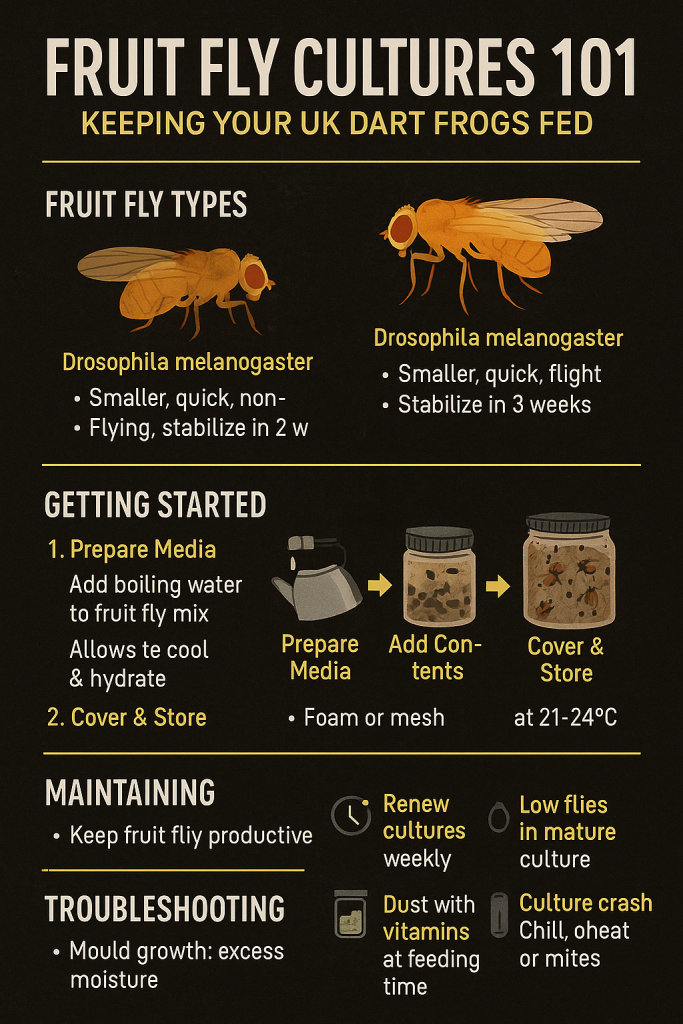
Infographic: Fruit Fly Culture Tips for UK Keepers
Buying Cultures vs Making Your Own
Buying starter cultures is useful, especially when you are new, rebuilding after a crash, or adding a different species such as hydei. A good starter culture gives you live production and flies to seed your own cultures.
Long-term, though, most dart frog keepers should learn to keep rolling cultures at home. It is cheaper, fresher and more reliable than depending on one delivery turning up exactly when you need it.
You can find our current live feeder options here: live fruit flies and feeder insects.
DIY Media vs Pre-Made Fruit Fly Media
DIY media can work. Many keepers use blends based on banana, oats, potato flakes, sugar, yeast, vinegar and other ingredients. It can be cheap and fun to experiment with.
The downside is variability. One batch may work brilliantly, while the next is too wet, too dry, too sour or too weak.
Pre-made media, such as Frogfather Fruit Fly Feast, is designed for consistency. It is easier to repeat, easier to store, and less dependent on guessing ingredient ratios every time you start a culture.
For keepers with multiple frogs, froglets or breeding groups, consistency usually matters more than saving a few pence per culture.
Fruit Flies, Springtails and the Bigger Feeding System
Fruit flies are the backbone of dart frog feeding, but they are not the only part of the system. Springtails, microfauna, leaf litter and bioactive stability all support how frogs feed and behave.
A strong feeding system can include:
- Fruit Fly Feast for culture media;
- All-in-1 Vitamin & Mineral Dust for dusting;
- live fruit fly cultures for starter cultures and feeding;
- springtails for froglets, clean-up crew and backup micro-prey;
- microfauna inside the bioactive vivarium;
- Paint-On Tropical Moss Starter for humid microhabitats;
- Dart Frog Clay Bath+ for occasional enrichment and mineral-rich contact.
That is the real secret: not one magic product, but a system that makes feeding predictable.
Frequently Asked Questions About Fruit Fly Cultures
Which fruit flies are best for dart frogs?
Drosophila melanogaster are best for froglets, juveniles and smaller species. Drosophila hydei are larger and suit many adult dart frogs, but they take longer to produce.
How often should I start new fruit fly cultures?
Many keepers start at least one new culture every week, then adjust depending on how many frogs they keep. The important thing is to keep cultures staggered so you are not relying on one pot.
Why are my fruit fly cultures going mouldy?
Mould is usually caused by excess moisture, poor airflow, cold temperatures, weak starter flies, old media or poor hygiene. Use breathable lids, avoid wet sloppy media, and consider methylparaben mould inhibitor if mould is a repeated issue.
Do fruit fly cultures need heat?
They need stable warmth rather than strong heat. Around 21–24°C is a useful range for most cultures. Heat mats can help in cold rooms, but they should be used carefully because overheating can ruin cultures quickly.
Do I still need to dust flies if I use good media?
Yes. Good media improves the feeder insect side of the routine, but it does not replace supplementation. Fruit flies should still be lightly dusted with a suitable vitamin and mineral powder before feeding.
How do I stop cultures crashing?
Use good media, keep temperatures stable, avoid cultures becoming too wet or too dry, use healthy starter flies, label dates, and start fresh cultures regularly. The best protection is having several cultures at different ages.
Final Thoughts: Fruit Flies Are Frog Fuel
If you keep dart frogs, you keep fruit flies. There is no way around it.
They can be annoying, but they are vital. With a bit of rhythm and a few backup cultures, feeding day stops being stressful and becomes routine.
Start new cultures before you need them, use a reliable media, keep mould under control, dust properly, and always think a week or two ahead.
When your frogs are hunting confidently and your cultures are producing steadily, you will be glad you got the fly farm right.