
FROGFATHER – HOW MANY DART FROGS CAN I KEEP TOGETHER? – OCTOBER 2026

There is no reliable rule saying that you can keep one dart frog for every X litres or gallons of vivarium space. How many dart frogs you can keep together depends primarily on the species, sex of the frogs, their age, individual behaviour and the usable space and structure within the enclosure. A large vivarium […]
Do Dart Frogs Have Ears? How They Hear Calls, Noise and Vibrations
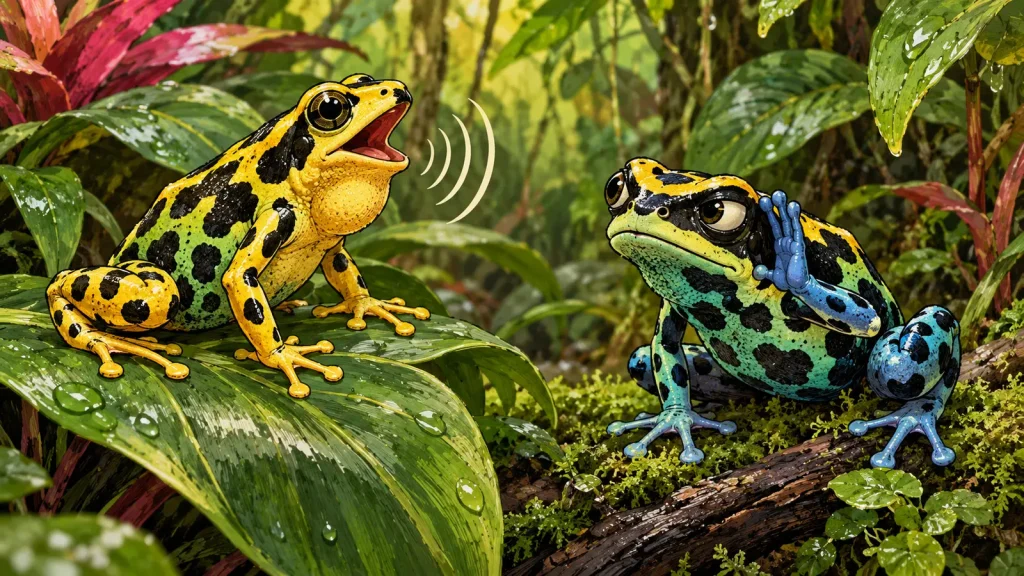
Written by The Frogfather | UK dart frog keeper, breeder and bioactive vivarium specialist | Last reviewed: 28 September 2026 Look closely at a dart frog and you will not see ears shaped like ours. There are no projecting pinnae, no furry openings and no obvious structure that looks capable of listening. Yet a male […]
How Do Dart Frogs See the World?

Quick answer: dart frogs are highly visual animals. They use vision to detect moving prey, recognise colours and contrast, navigate through complex habitats, respond to other frogs and learn visual cues. At least one well-studied poison frog, Oophaga pumilio, has been shown to possess a trichromatic daytime visual system. Their visual world is therefore much […]
What Actually Happens During Dart Frog Metamorphosis?

Quick answer: dart frog metamorphosis is far more than a tadpole simply growing legs and losing its tail. During this transition the animal’s digestive system, respiratory system, skin, skeleton, muscles, feeding behaviour and metabolism are all being reorganised. It is one of the most physiologically demanding stages in a frog’s life. Watching a dart frog […]
Why Dart Frog Tadpoles Grow at Different Rates — Even When They’re the Same Age

Quick answer: tadpoles from the same clutch do not have to grow or metamorphose at exactly the same rate. Growth and development are influenced by nutrition, temperature, competition, individual physiology and environmental conditions. A tadpole can also be larger without being further through metamorphosis, because growth and developmental stage are related but not identical processes. […]
Do Dart Frog Tadpoles Eat Each Other? Cannibalism Explained

Quick answer: yes, some dart frog tadpoles can and do eat other tadpoles. The behaviour is particularly well documented in species such as Dendrobates tinctorius, Ranitomeya variabilis and Ranitomeya ventrimaculata. It is not appropriate to assume that every dart frog tadpole is equally cannibalistic, but where cannibalism is known or suspected, individual rearing is the […]
Why Dart Frogs Choose Certain Spots in a Vivarium: Understanding Microhabitats

Quick answer: a dart frog does not experience its vivarium as one uniform environment. Different leaves, logs, roots, patches of leaf litter and shaded areas can differ in moisture, light, cover, food availability, temperature and social importance. Frogs therefore tend to use particular parts of an enclosure for particular purposes rather than moving randomly through […]
Do Dart Frog Feeding Stations Actually Help?

Quick answer: a feeding station can be useful for keeping freshly dusted fruit flies concentrated in an accessible area for longer, making feeding easier to observe and potentially shortening the time between dusting and consumption. It does not guarantee that every frog receives a particular dose of supplement, and it should complement—not replace—good feeder preparation, […]
Dart Frog Parental Care: Egg Guarding & Tadpole Transport

Quick answer: dart frogs do not all parent in the same way. In many species the male attends the terrestrial clutch and later transports tadpoles to water. In others, females take over transport or return repeatedly to feed tadpoles. A few species show unusually elaborate biparental care. Understanding those differences is an important part of […]
Can You Add a New Dart Frog to an Established Group?

Written by The Frogfather | UK dart frog keeper, breeder and bioactive vivarium specialist | Published: 16 September 2026 Can You Add a New Dart Frog to an Established Pair or Group? Your established frogs appear settled. They feed confidently, use the whole vivarium and perhaps breed regularly. Then another frog of the same species […]