Description
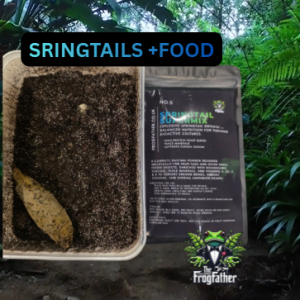
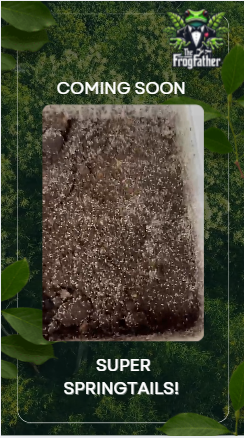
Feeder-Ready Springtail Culture Tub
A live springtail culture supplied for seeding bioactive enclosures, maintaining a separate breeding culture or harvesting small live prey for suitable froglets and other micro-predators.
What springtails can do
- Many springtails graze fungi, microbes and decomposing organic material.
- They can contribute to decomposition processes within a managed bioactive enclosure.
- They can provide occasional very small live prey for suitable animals.
We have removed the earlier claims that this culture is “far superior” to pet-shop cultures or will keep producing “indefinitely”. A well-maintained culture can reproduce for a long period, but live cultures can slow, crash or become contaminated.
Culture care
Keep the culture appropriately moist for the springtail type, feed lightly and only add more food when most of the previous feed has been consumed. Avoid flooding or heavy overfeeding. Keep a backup culture if you rely on springtails regularly.
Bioactive use
Springtails are useful decomposer microfauna, but they are not a substitute for normal enclosure maintenance. Remove excessive uneaten food and accumulated waste when needed and maintain suitable ventilation, substrate and moisture.
Read our Complete Guide to Springtails for Dart Frogs.
Microfauna & Evidence Review
Last reviewed: 5 September 2026
Springtails are part of terrestrial decomposer food webs. Many species feed on fungi, microbes and decaying organic material, and microarthropods can contribute to decomposition. Their exact diet and ecological effect vary among taxa and conditions, so Frogfather does not describe a springtail culture as a complete waste-removal system or a guarantee of a stable, self-sustaining vivarium.
Bioactive enclosures still require observation, suitable substrate and leaf litter, moisture and ventilation management, animal feeding, plant care and removal of uneaten food or accumulated waste when necessary.
Evidence & further reading
- García-Palacios et al. / microarthropod decomposition meta-analysis
- Worldwide review of trophic resources of soil microarthropods