
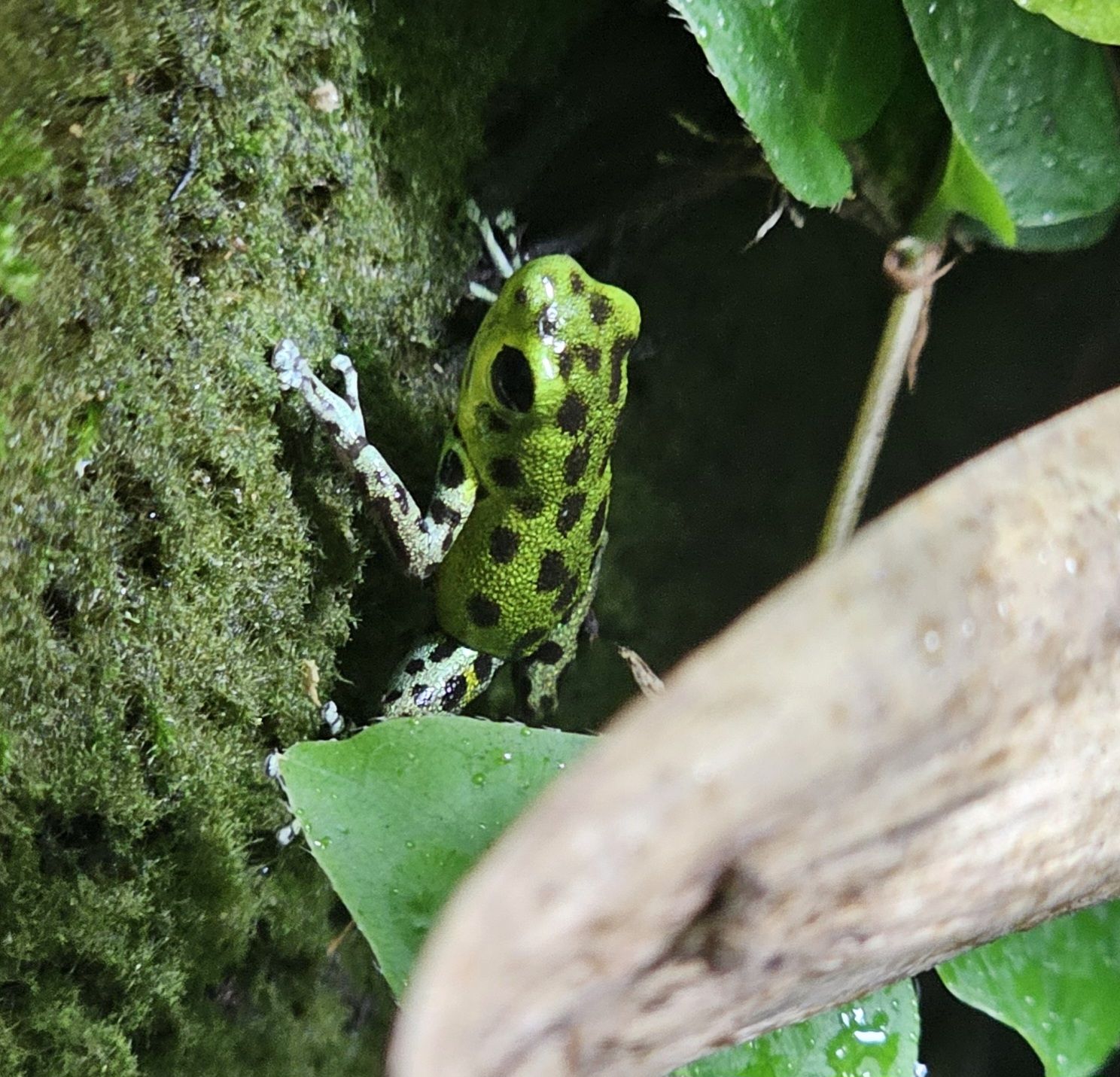
Description
Oophaga pumilio ‘Chiriqui Grande’
Captive-bred juvenile Oophaga pumilio ‘Chiriqui Grande’ for experienced keepers prepared for the territorial and reproductive biology of this species.
Environment
Provide a densely structured, well-ventilated tropical vivarium with leaf litter, climbing surfaces, plants and multiple sheltered microhabitats. Earlier copy gave 80–100% humidity as a simple requirement; we now recommend managing humidity as a changing enclosure condition alongside airflow, temperature and local moisture rather than holding the enclosure at a permanently saturated RH.
Temperature
Frogfather commonly maintains O. pumilio within moderate tropical-room temperatures, often around the low-to-mid 20s °C. Exact temperature should be adjusted to the animals and enclosure; avoid overheating and rapid swings.
Social behaviour
Oophaga pumilio can be territorial. Pair or group housing should be planned cautiously and monitored closely rather than assumed from enclosure size alone. Have an appropriate spare enclosure available if persistent aggression or exclusion develops.
Feeding
Offer appropriately sized live prey such as fruit flies and springtails together with a suitable supplementation programme. The frogs are obligate egg-feeders as parents during tadpole development, so breeding this species requires additional species-specific experience.
Live animal note: availability and transport are subject to animal condition, weather and welfare-compliant arrangements.
Live-Animal Husbandry Review
Last reviewed: 5 September 2026
Species suitability depends on adult size, behaviour, social structure, enclosure design, temperature, moisture, ventilation and the individual animals. Frogfather does not treat a fixed humidity percentage, enclosure size or group formula as a universal rule.
Mixed-species housing introduces additional risks including competition, predation, incompatible environmental needs, pathogen transfer and difficulty monitoring individual food intake. It is therefore not recommended merely because two species appear to use similar temperature or humidity ranges.


