
Dendrobates tinctorius ‘Patricia’ is a large, striking and well-established captive lineage of the Dyeing Poison Frog. Its characteristic combination of a bright yellow back, contrasting black pattern and pale blue or bluish-grey limbs makes Patricia one of the most recognisable tinctorius forms in the hobby.
Patricias are predominantly terrestrial, active during daylight and often visible once established. Their substantial size and willingness to take commonly cultured fruit flies can make them suitable for a prepared beginner.
However, adult social behaviour requires careful management. They should not be treated as communal frogs, and permanent housing should normally be planned around one individual or one compatible male–female pair.
Frogfather difficulty rating: 2/5.
Dendrobates tinctorius ‘Patricia’: Quick Facts
| Scientific name | Dendrobates tinctorius (Cuvier, 1797) |
|---|---|
| Captive-line name | Patricia |
| Family | Dendrobatidae |
| Adult size | Approximately 40–50 mm for many adults, with females generally larger and more heavily built |
| Reported origin | Suriname; the precise historical collecting locality is not publicly documented |
| Activity | Diurnal and predominantly terrestrial |
| Daytime temperature | Approximately 22–25°C |
| Night temperature | Approximately 18–21°C, reached gradually |
| Moisture | Humid retreats, useful ventilation and a normal wetting-and-partial-drying cycle |
| Practical vivarium size | 45 × 45 × 45 cm as a starting point for a compatible pair; 60 × 45 × 45 cm preferred where possible |
| Social housing | One frog or one compatible male–female pair; no permanent adult group recommended |
| Calling | No conspicuous advertisement call; effectively silent to most keepers |
| Typical clutch | Often approximately 2–6 eggs, with individual variation |
| Parental care | Male egg attendance and predominantly male tadpole transport; no trophic-egg feeding |
| Beginner suitability | Suitable for a prepared beginner who understands adult pair management |
| Difficulty rating | 2/5 |
| Species conservation status | Dendrobates tinctorius is assessed globally as Least Concern |
What Is a Patricia Dart Frog?
Patricia is not a separate species or formally recognised subspecies. It is an established captive lineage within the highly variable species Dendrobates tinctorius.
The lineage is reported to originate from Suriname and entered the international hobby during the late 1990s. The exact wild collecting locality has not been made publicly available, so Patricia should not be presented as a scientifically mapped locality.
The name is reported to honour Patricia Grueneberg, who was associated with the early importation history of the lineage.
Patricia can resemble some Powder Blue tinctorius lines. Patricia usually displays a stronger yellow dorsal area and comparatively more solid pale-blue limb colour, whereas Powder Blue animals often show more extensive dark spotting across the rear limbs. Appearance alone is not sufficient to resolve animals with uncertain provenance.
Never cross Patricia with Powder Blue, Cobalt, Azureus, Oyapock, Tumucumaque, Lorenzo or another tinctorius form.
Natural Distribution
The species Dendrobates tinctorius occurs across parts of the eastern Guiana Shield, including Suriname, French Guiana, Guyana and neighbouring areas of northern Brazil.
Patricia is associated with Suriname, but its precise historical collection location is not publicly documented. A range map for this profile should therefore highlight Suriname as the reported origin rather than marking a fictional exact locality.
Wild tinctorius inhabit humid tropical forest, particularly the forest floor, leaf litter, fallen timber, sheltered retreats and temporary treefall gaps. Frogs can climb, particularly during tadpole transport, but Patricia should be regarded as predominantly terrestrial when planning its permanent enclosure.
Adult Size and Appearance
Many adult Patricias reach approximately 40–50 mm from snout to vent. Females are generally larger, broader and more heavily built than males, although adult size varies between individuals and captive lines.
Patricias typically display:
- a bright yellow or yellow-and-black head and dorsum;
- irregular black bands or blotches;
- pale blue, blue-grey or turquoise limbs;
- darker markings on the flanks and legs; and
- an individual pattern that remains recognisable throughout adulthood.
Mature males may develop comparatively enlarged, heart-shaped finger discs. Females normally develop a broader head and body. Sex should be assessed through several characteristics rather than one photograph.
See the Frogfather dart frog sexing guide.
Are Captive-Bred Patricias Poisonous?
Wild poison frogs obtain defensive skin alkaloids from specialised natural prey. Captive-bred Patricia dart frogs eating conventional cultured fruit flies and other captive-produced feeders do not receive the same dietary alkaloids and are not expected to retain potent wild-type toxicity.
Handling should still be restricted to essential transfers. Amphibian skin is delicate and permeable. Use clean, damp, powder-free gloves and change gloves between animals.
Temperature Requirements
Maintain Patricia dart frogs at approximately 22–25°C during the day, with cooler shaded retreats available.
A gradual night-time reduction to around 18–21°C is generally suitable. There is no need to engineer a sudden or dramatic temperature drop.
Avoid sustained temperatures above approximately 26–27°C. Direct sunlight, powerful lighting, pumps and insufficient ventilation can make the enclosure warmer than the surrounding room.
Use a digital thermometer capable of recording minimum and maximum temperatures and measure conditions at frog level.
Do not position an uncontrolled heat mat beneath the vivarium. Heating the substrate can remove the cooler low-level refuge an overheating frog would otherwise seek.
Humidity, Misting and Ventilation
Patricias require humid refuges and regular access to surface moisture, but they should not be kept in permanently saturated, stagnant conditions.
A successful enclosure provides:
- substantial leaf litter with humid lower layers;
- sheltered retreats beneath plants, cork and wood;
- regular misting suited to the enclosure;
- useful passive ventilation;
- effective drainage;
- wet surfaces following misting; and
- partial surface drying between misting events.
A broad daily humidity cycle may often pass through approximately 75–95%, but the presence of humid refuges, appropriate substrate moisture and good airflow matters more than maintaining one fixed hygrometer reading.
Read the Frogfather dart frog ventilation guide.
Recommended Vivarium Size
Patricias are large-bodied and predominantly terrestrial, so useful floor space is especially valuable.
A well-designed 45 × 45 × 45 cm enclosure is a practical starting point for a compatible pair. Where room permits, a wider 60 × 45 × 45 cm enclosure provides more foraging space, more distinct retreats and a greater opportunity for each frog to move away from the other.
A 45 × 45 × 60 cm enclosure can also work, but its additional height should be turned into accessible habitat using cork, ledges, branches and broad leaves.
Read the Frogfather dart frog vivarium-size guide.
Vivarium Setup
The permanent enclosure should be mature, planted and environmentally stable before the frogs arrive.
Include:
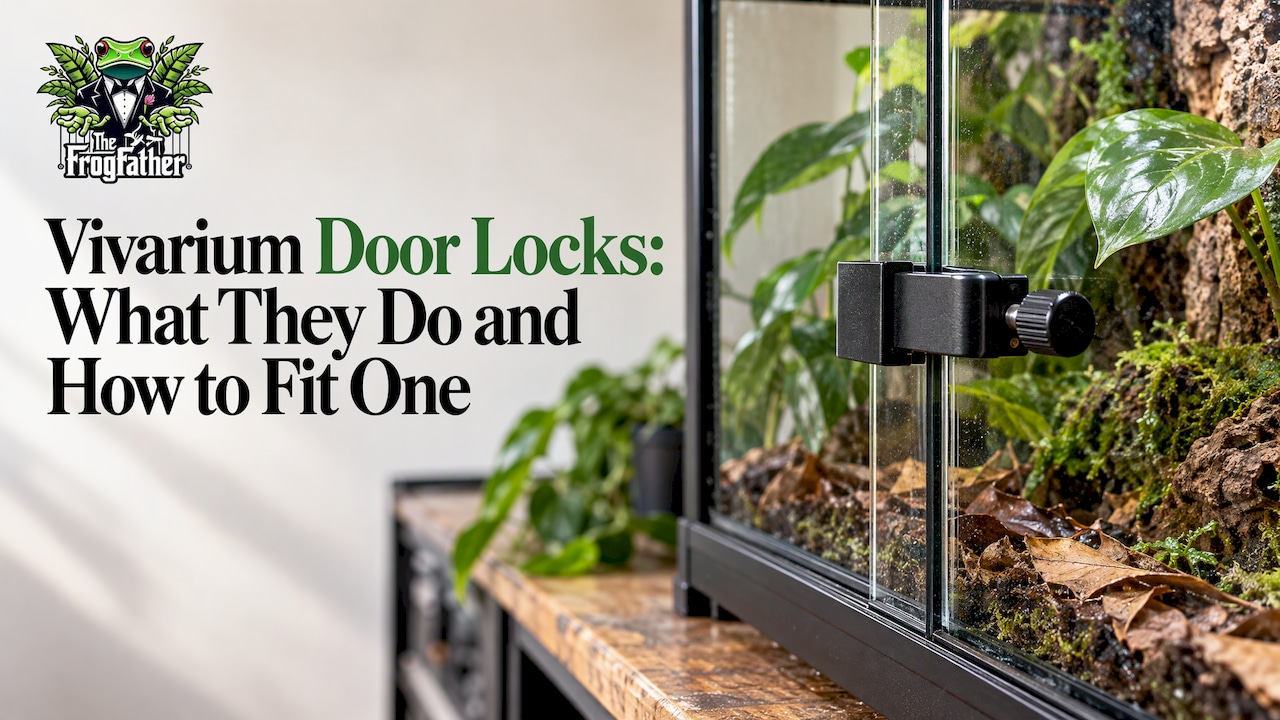
- a secure, feeder-proof front-opening vivarium;
- dependable drainage;
- a suitable bioactive substrate;
- generous clean, pesticide-free leaf litter;
- cork, roots and low branches;
- several visually separated retreats;
- multiple feeding areas;
- dense but accessible live planting;
- established springtails and suitable isopods;
- gentle ventilation; and
- several sheltered potential spawning sites.
Deep, steep-sided open water is unnecessary. The enclosure’s overall moisture system should support hydration without relying on a permanent water bowl.
Complete the Frogfather pre-frog vivarium checklist.
Diet and Feeding
Flightless Drosophila melanogaster provide a dependable staple. Full-sized Patricia adults may also take appropriately sized Drosophila hydei.
Additional suitable variety can include:
- springtails;
- bean weevils;
- safely cultured aphids; and
- other appropriately sized captive-produced invertebrates.
Feed according to age, intake and body condition rather than following one universal number of flies. Juveniles require smaller, generally more frequent meals.
When feeding a pair, distribute prey across more than one area and verify that both animals are feeding.
Read the Frogfather dart frog feeding guide.
Supplementation
Captive-cultured feeders require appropriate nutritional supplementation.
Dust live food lightly and evenly with a correctly formulated complete amphibian supplement. Avoid combining several products containing overlapping fat-soluble vitamins without understanding the total intake.
Frogfather’s All-in-One Vitamin & Mineral Dust is designed as a consistent every-feed system.
Behaviour and Visibility
Patricias are frequently confident once established and can make excellent display frogs. They forage during daylight across leaf litter, wood and lower planted areas.
Individual behaviour still varies. A newly introduced frog may remain hidden while learning the enclosure, and an animal experiencing social pressure can become progressively less visible.
Persistent hiding accompanied by reduced feeding, weight loss or repeated avoidance of another frog should be investigated rather than dismissed as normal behaviour.
Can Patricia Dart Frogs Live in Groups?
No permanent communal adult group is recommended.
Juveniles may coexist temporarily, but compatibility can change after sexual maturity. Adult female tinctorius can show serious aggression towards one another, particularly where a male or breeding sites are present.
The safest permanent arrangements are:
- one Patricia housed alone; or
- one compatible adult male with one compatible adult female.
Do not keep multiple adult females together. Do not assume that a larger enclosure will make an incompatible group safe.
Monitor for wrestling, pinning, persistent chasing, exclusion from food, repeated escape behaviour, chronic hiding and declining body condition. Keep a suitable separation enclosure available.
Read Can Dart Frogs Live in Groups?.
Do Patricia Dart Frogs Call?
Dendrobates tinctorius lacks the conspicuous advertisement call heard in many other dart frog species. Patricia dart frogs should therefore be regarded as effectively silent to most keepers.
Sex identification should rely on maturity, body structure, finger-disc development, behaviour and reproductive evidence rather than waiting for an obvious call.
Breeding and Parental Care
Courtship is quiet and involves close-range visual and tactile interaction. Eggs are deposited in a sheltered terrestrial location, such as beneath leaf litter, beneath a smooth hide, on a broad leaf or under a breeding shelter.
A clutch frequently contains approximately two to six eggs, although clutch size varies. The male normally attends the developing eggs.
After approximately two weeks, successfully developing tadpoles become ready for transport. The male normally allows one or more tadpoles to climb onto his back before carrying them to suitable water.
The tadpoles receive no continuing parental care after deposition and do not depend on trophic eggs from the female.
Raising Patricia Tadpoles
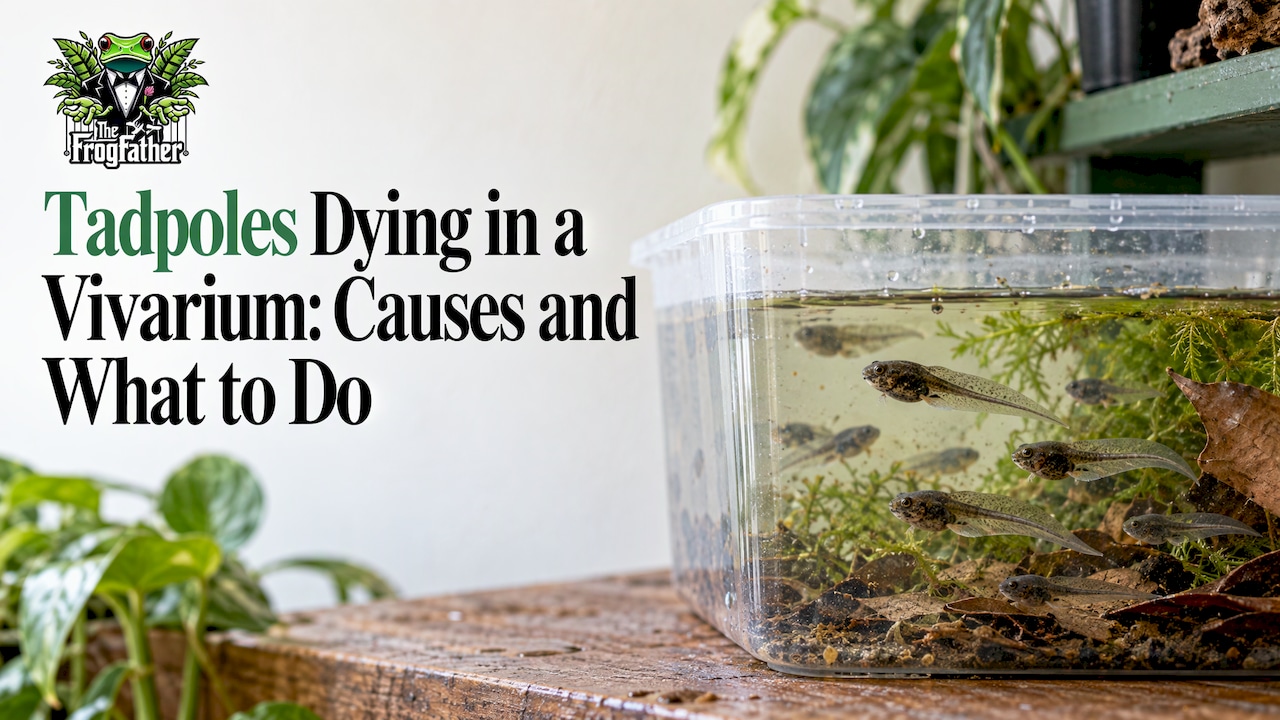
Patricia tadpoles should normally be raised individually. Separate containers make feeding, water quality, development and health easier to monitor while avoiding competition and cannibalism.
Use clean, species-appropriate water. Untreated reverse-osmosis water should not automatically be assumed ideal simply because it contains fewer dissolved substances.
Development time varies with genetics, nutrition, temperature and water conditions and should not be promised as one fixed number of weeks.
Quarantine and Lineage Integrity
Quarantine every newly acquired frog away from the established collection. Use separate tools and monitor appetite, body condition, droppings, movement, skin and behaviour.
Do not introduce a new Patricia directly to an established animal or pair. Read Can You Add a New Dart Frog to an Established Group?.
Maintain permanent breeding and transfer records. Breed Patricia only with other traceable Patricia animals. Similarity to Powder Blue does not justify mixing the two lineages.
Are Patricias Suitable for Beginners?
Yes. Patricia dart frogs are rated 2/5 for difficulty and can suit a properly prepared first-time dart frog keeper.
They are comparatively large, accept commonly cultured live foods and are frequently visible. Their main complication is adult social behaviour, so the keeper must be prepared to separate juveniles as they mature and intervene if an established pair becomes incompatible.
Begin with the Frogfather Start Here guide and the free husbandry course.
Frequently Asked Questions
Where do Patricia dart frogs come from?
The Patricia lineage is reported to originate from Suriname, but its exact historical wild collecting locality has not been publicly documented. It should therefore be described as having a reported Suriname origin.
How large do Patricia dart frogs grow?
Many adults reach approximately 40–50 mm from snout to vent. Females are generally larger, broader and more heavily built than males.
What temperature should Patricia dart frogs be kept at?
Use approximately 22–25°C during the day with cooler shaded retreats. A gradual night-time reduction to around 18–21°C is generally suitable. Avoid sustained temperatures above approximately 26–27°C.
What size vivarium does a Patricia pair need?
A well-structured 45 × 45 × 45 cm enclosure is a practical starting point for a compatible pair. A wider 60 × 45 × 45 cm vivarium provides more useful terrestrial space where possible.
Can Patricia dart frogs live in groups?
No permanent adult group is recommended. House one frog or one compatible male–female pair, avoid multiple adult females and keep suitable separation housing ready.
Do Patricia dart frogs call?
Dendrobates tinctorius does not produce a conspicuous advertisement call. Patricia dart frogs are effectively silent to most keepers, so calling should not be relied upon for sex identification.
Are captive-bred Patricia dart frogs poisonous?
Captive-bred Patricias eating conventional cultured live foods do not receive the specialised dietary alkaloids responsible for potent toxicity in wild poison frogs. Handling should still be limited because their skin is delicate and permeable.
How do Patricia dart frogs breed?
They deposit a small terrestrial clutch in a protected location. The male normally attends the eggs and later carries the hatched tadpoles to water. The tadpoles do not require trophic eggs from the female.
Can Patricia and Powder Blue dart frogs be bred together?
No. Patricia and Powder Blue should be maintained as separate captive lineages. Similar appearance is not evidence of identical origin, and uncertain or mixed animals should not be used for locality-line breeding.
Are Patricia dart frogs suitable for beginners?
Yes. Frogfather rates them 2/5 for difficulty. They can suit a prepared beginner who has a mature vivarium, dependable live-food cultures, appropriate supplementation and separation housing.
Husbandry and evidence review: November 2026. This profile provides general educational guidance and does not replace assessment by an amphibian-experienced veterinary surgeon.