
When tadpoles die in a vivarium, the cause is almost always something in the water or the setup rather than bad luck: fouled or untreated water, too little oxygen, too many tadpoles in too little space, the wrong or too much food, or a poor exit when they start to metamorphose. Work through those in order and you will usually find it. Losing the odd tadpole is part of breeding frogs, but a run of deaths means something can be changed.
This guide is for UK dart frog keepers, whether you are raising your first clutch or have bred for years. It starts with what to do today, then goes through the likely causes, then the stage-specific problems. If you want the full rearing routine alongside it, our complete guide to caring for dart frog tadpoles covers it end to end.
TL;DR
- Sudden deaths usually trace back to the water: oxygen, ammonia, chlorine or chloramine, or a contaminant. Check the water first, before blaming disease.
- Overcrowding, overfeeding and warm, stale water work together. Fewer tadpoles, smaller feeds and regular partial changes fix more problems than any additive.
- Losses that cluster when back legs appear or the tail is absorbed often point to the exit: tadpoles and new froglets need an easy way out of the water.
- Change one thing at a time and keep notes, so you know what worked.
- If tadpoles show twisting, rolling or swelling, or deaths keep going after you have corrected the water, speak to an amphibian-experienced vet.
Table of Contents
- What to do in the first hour
- Start with the water
- Crowding and food
- When it happens at a particular stage
- Disease, parasites and when to see a vet
- Keep stress low across the whole frog room
- What we would do
- Supplies for the next clutch
- FAQ
- Sources
What to do in the first hour
Do not tip everything out and start again in a panic. Calm, ordered steps work better.
- Remove the dead. Decaying bodies foul water quickly. Take them out with clean tweezers or a pipette.
- Look at the survivors. Are they hanging near the surface, swimming normally, hiding, or rolling over? Note what you see.
- Check the water. Is it clear, cloudy or smelly? Test ammonia if you have a kit. Check the temperature.
- Do a partial change with water you know is safe (more on that below), matched to the temperature of the water the tadpoles are in.
- Cut the next feed if there is uneaten food in the container.
- Write down the date, the number lost, the stage of the survivors and what you changed.
That record matters. Official amphibian hygiene guidance from New South Wales, Australia recommends keeping written health records and seeking an amphibian-experienced vet promptly if behaviour or condition changes, because clinical signs can take months to show.
Start with the water
Water is the first suspect because tadpoles live in it, breathe through it and excrete into it. In wild ponds, UK charity Froglife says tadpole deaths are often linked to a lack of oxygen, typically after an algal bloom, and that a chemical or toxic plant material in the water is a possibility when it is not green. A rearing tub is a much smaller volume, so the same problems arrive faster.
Chlorine and chloramine
UK tap water is treated, and some supplies use chloramine rather than chlorine. The Merck Veterinary Manual says amphibian water must be free of toxins such as chlorine, ammonia and nitrite, and that chlorine can be removed with carbon filtration, while chloramines must first be broken down with a dechlorinating agent such as sodium thiosulfate. Letting water stand does not deal with chloramine, so do not assume an overnight bucket is safe. We cover the options, including RO water and remineralising, in our guide to water for dart frogs and tadpoles in the UK.
Ammonia and waste
Ammonia comes from waste and rotting food, and it builds fastest in small containers. A keeper’s guide from Australia, FrogSafe, advises monitoring water clarity and ammonia, since high ammonia can kill tadpoles. Cloudy water, a sour smell or a film on the surface all say the same thing: waste is outrunning your water changes.
For a routine, the Queensland government’s code of practice for captive reptiles and amphibians suggests cleaning tadpole water at least twice a week, replacing no more than one-third at a time. Small, regular changes beat one big one, because a big swing in temperature or chemistry is a stress in its own right.
Oxygen and temperature
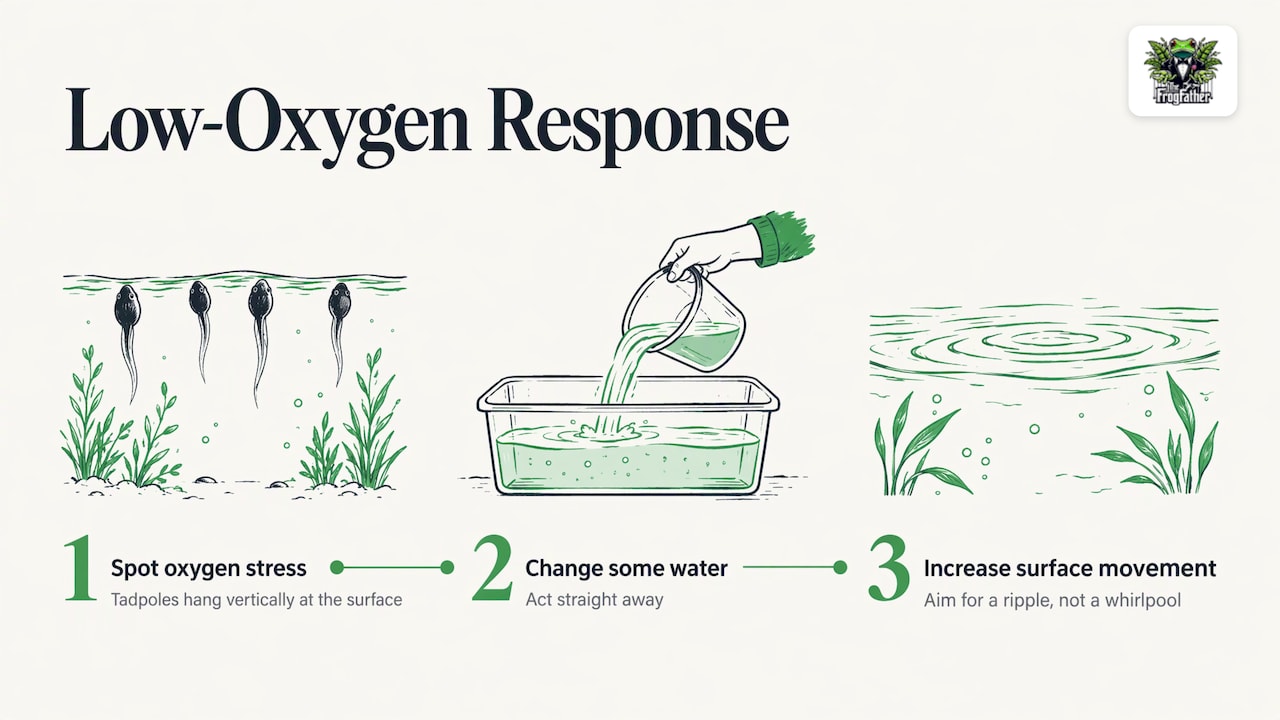
Tropical tadpoles are raised warm, and warm water holds less oxygen. The same Queensland code says heated water holds less oxygen than cool water and fouls more quickly, so it needs aeration. FrogSafe describes tadpoles hanging vertically at the surface as a sign of too little oxygen. If you see that, change some water straight away and increase surface movement gently. A strong current is as bad as none, so aim for a ripple, not a whirlpool.
Temperature stability matters as much as the number. The Merck manual notes that infectious and nutritional disease is common in tropical amphibians kept in suboptimal conditions, because their metabolism and immune function depend on a stable environment. Check your species’ requirements and keep the rearing area steady rather than letting it swing between day and night.
Contaminants in the room
FrogSafe’s checklist for sudden mass deaths asks about chemical splashes and nearby aerosols such as room fresheners, carpet cleaners and bug sprays, and whether hands went into the water within the previous 24 hours. In a frog room that means: no sprays near tubs, wash and rinse hands thoroughly with no soap or hand cream residue, and rinse anything that has held cleaning products very well before it touches tadpole water.
Crowding and food
Too many tadpoles
Overcrowding is one of the most common causes in captive-raised clutches. The Queensland code states plainly that overcrowding will kill tadpoles. Its stocking guide is for a different, larger set-up and different species, so do not copy the numbers across to dart frogs. The principle is what carries over: more tadpoles means more waste, less oxygen and more competition. Uneven growth within a container is a warning sign of crowding.
Dart frog tadpoles of many species are best reared separately or in small groups, depending on species. If you are unsure, split the group. Our guide to the secret lives of tadpoles explains why some tadpoles are far less tolerant of company than others.
Overfeeding and underfeeding
The two extremes have different results. The Australian Capital Territory code says overfeeding leads to very dirty water, while underfeeding can lead to cannibalism, since most amphibians will eat smaller individuals. Feed small amounts, see what is eaten, and remove the remainder before it rots. Mouldy or old food is also on the FrogSafe list of things to rule out.
If your tadpoles stop eating, do not add more. Check water, then temperature, then the food itself. A fresh batch from a different source is worth trying before assuming anything more complicated.
When it happens at a particular stage
Pattern is a clue. Ask when the deaths happen.
| When the deaths happen | Likely area to check |
|---|---|
| Soon after a move or water change | Temperature difference, chlorine or chloramine, a big swing in chemistry |
| Overnight, several at once | Oxygen, ammonia, a contaminant in the room |
| Steady losses of smaller or slower tadpoles | Crowding, competition for food, cannibalism |
| When back legs emerge | Diet at the leg stage, difficulty getting out of the water |
| Around tail absorption | Drowning, no easy exit, no suitable first foods |
Moving tadpoles
Sudden temperature differences are dangerous. Better Planet Education, a UK educational charity, says moving tadpoles between waters of different temperatures is likely to cause death, and advises floating the container until the temperatures equalise. Its guidance is written for native frogspawn, but the principle holds for tropical tadpoles too. Float, equalise, then transfer.
Legs, tail absorption and the way out
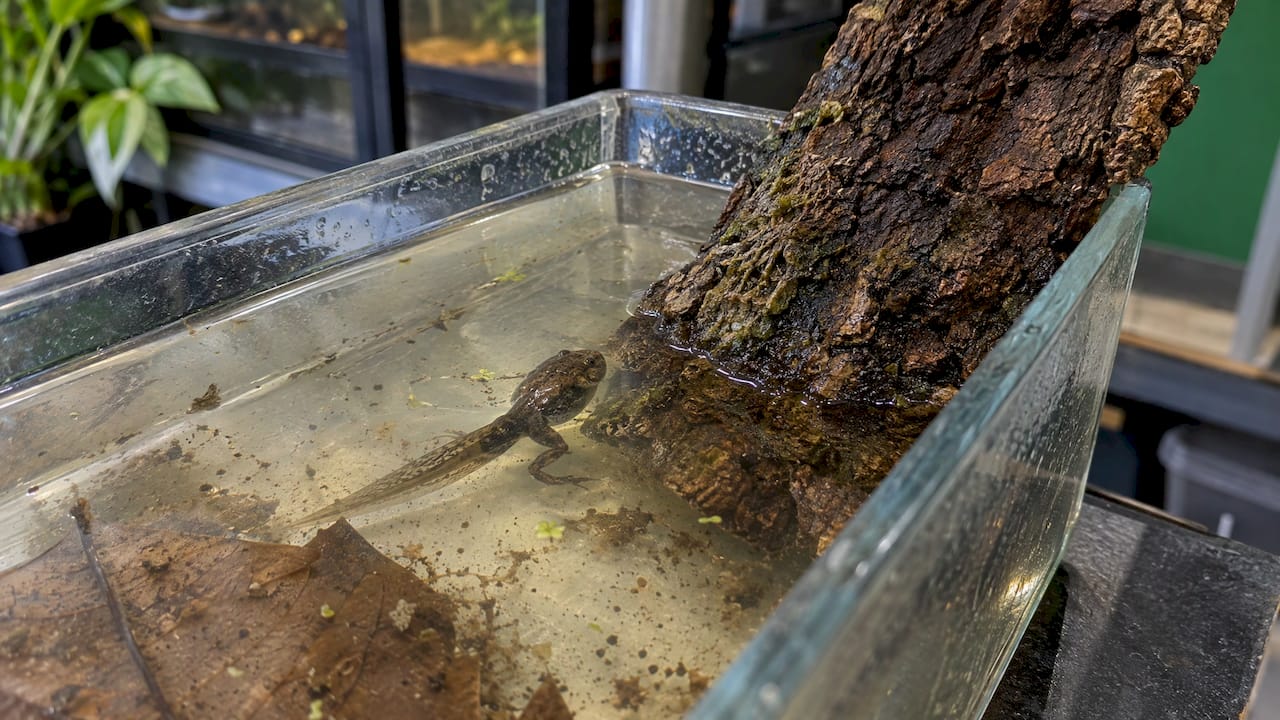
This is where otherwise healthy tadpoles are lost. The Queensland code says tadpoles approaching metamorphosis need gently sloping solid objects rising above the water so they can climb out and not drown. The Birmingham & Black Country Wildlife Trust gives the same warning for wild froglets and recommends ramps of bark, wood, moss or vegetation. In a rearing cup, that means lowering the water level and giving a damp, easily climbed surface well before the tail is gone. See what happens during dart frog metamorphosis for the stages, and our guide to raising froglets for what comes next, including feeding, because new froglets are tiny and need small prey.
That is also where microfauna earns its place. Springtails and other tiny live food suit very small froglets, which is one reason many keepers run a bioactive vivarium alongside their rearing set-up. Our microfauna deep dive explains how.
Disease, parasites and when to see a vet
Infection is possible, but it is rarely the first thing to rule in. The Wildlife Trust notes that little is understood about tadpole diseases, though some parasites and viruses are known to infect them. That is why you should clear the likelier causes first.
See an amphibian-experienced vet if you notice any of these, and do not wait for a second round of losses:
- Deformities such as crimped tails, twisted legs or air bubbles under the skin
- Tadpoles swimming in circles or rolling upside down
- Body swelling or a shrinking body
- Deaths continuing after you have corrected water quality, crowding and feeding
To reduce the chance of spreading anything, keep separate equipment for each group of tadpoles, disinfect and rinse thoroughly between uses, and avoid mixing tadpoles from different sources. The Queensland code advises against housing tadpoles from different places together to limit disease spread, such as chytridiomycosis. The Amphibian and Reptile Conservation Trust provides UK background on chytrid fungus.
If you keep non-native frogs, remember the law as well: once captive, any amphibian is protected under the Animal Welfare Act 2006, and releasing non-native amphibians is an offence, as the RSPCA explains for England and Wales. Our legal, ethical and welfare framework sets out what that means for UK dart frog keepers.
Keep stress low across the whole frog room
Tadpoles are the most visible casualties of a husbandry problem, but the adults feed the same system. Stable temperature, clean water and a reliable feeding routine reduce stress for every life stage. Live food is part of that routine, and the way it is received and stored affects what goes into your enclosures. A live food quarantine protocol is a sensible habit for any keeper who wants to cut down on avoidable stress and losses, and our own guide to receiving, reviving and storing livefood in the UK covers the practical side.
What we would do
We have spent a lot of time in our frog rooms, and the pattern is usually the same: tadpole losses are rarely one dramatic event. They are a small problem repeated, such as a feed that was a bit generous, a tub that went a day too long, or a water change that was a bit quick.
Our approach is to keep the basics boringly solid. Use water you have treated properly, change a little often, feed lightly, keep numbers sensible and give every tadpole a way out when it is ready. Resist the urge to fiddle with additives and tweaks all at once, because you will not know which one helped, and you can easily wreck the process.
Frog keeping is not effortless, and a bioactive vivarium still needs regular attention. That is why we publish free care guides and courses for UK keepers, and why we design our own 3D-printed vivarium accessories through everyday use in our frog rooms. Once froglets are on the move, a healthy bioactive set-up with live springtails and isopods gives them somewhere to feed and settle.
Frogfather
Supplies for the next clutch
Once you have found the cause, rebuild your routine and kit around it. We are a Nottingham-based UK breeder and supplier of dart frogs, bioactive vivariums, tropical plants, microfauna, live foods, supplements and enclosure supplies. Our Fruit Flies and live food range includes drosophila cultures on subscription, and our microfauna foods and supplements support the springtails and isopods that new froglets rely on.
If you are planning a new set-up for adults or froglets, browse our complete setups or visit Frogfather for the full range.
FAQ
Why are my tadpoles dying one after another?
Steady losses usually mean something ongoing, such as ammonia building up, crowding, or underfeeding that leads to cannibalism. Check your water, count how many tadpoles share each container, and look at how much food is left over. Then make one change at a time and record the result.
Can tap water kill tadpoles?
Yes, if it has not been treated properly. Chlorine and chloramine are toxic to amphibians, and chloramine does not disappear by standing. Use a suitable dechlorinating agent or another treated source, and match the temperature before adding it.
Why do tadpoles die just as they grow legs?
This is a demanding stage. Tadpoles need to get their heads above water and climb onto a damp surface, and they can drown if there is no easy exit. Add a sloping, damp ramp and lower the water level as legs appear. Make sure they have suitable food at this stage too.
Is it normal to lose some tadpoles?
Some loss is normal in amphibians. The RSPCA notes that in the wild, of around 2,000 eggs laid by each frog or toad, only five or six tadpoles survive to adulthood. In captivity you can do much better, but a sudden run of deaths still deserves a proper investigation.
When should I call a vet?
Call an amphibian-experienced vet if you see deformities, rolling or circling, swelling, or if deaths continue after you have corrected the water, space and feeding. Keep your written record to hand when you do.
Sources
- Froglife: Spawn and tadpoles, problems
- Birmingham & Black Country Wildlife Trust: Unusual Frog Mortality
- Queensland Code of Practice: Captive reptile and amphibian husbandry
- NSW Government: Hygiene and care for preventing disease in captive amphibians
- ACT Animal Welfare (Amphibians in Captivity) Code of Practice
- Merck Veterinary Manual: Environment and Husbandry for Amphibians
- FrogSafe: Raising Tadpoles in Containers and Ponds
- Better Planet Education: Caring for Frogspawn and Tadpoles
- Amphibian and Reptile Conservation Trust: Chytrid fungus
- RSPCA: Amphibians
- Practical Quarantine Live Food Protocol
Recommended
- Why Some Dart Frog Vivariums Crash After 6–12 Months
- What To Do If A Poison Dart Frog Tadpole Isn’t Eating Or Growing: Causes And Solutions
- This Tiny Tadpole Was Doomed. Here’s How I Saved It (Full UK Guide)
- Can Dart Frogs Drown? Why Even Shallow Water Can Be Dangerous