Oophaga vicentei is a small, highly variable poison frog found only in central Panama. Its combination of vivid colour, arboreal behaviour and extraordinary maternal care makes it one of the most fascinating members of the genus Oophaga.
It is not, however, a straightforward beginner’s frog. Successful long-term care requires a mature vertical vivarium, very small live food, careful social management and an understanding that its tadpoles depend upon unfertilised eggs supplied by their mother.
Oophaga vicentei at a glance
| Scientific name | Oophaga vicentei (Jungfer, Weygoldt & Juraske, 1996) |
|---|---|
| Common name | Vicente’s poison frog |
| Family | Dendrobatidae |
| Natural distribution | Central Panama, principally Veraguas and Coclé, with records extending into adjacent Colón |
| Adult size | A small species, generally below approximately 24 mm snout–vent length |
| Primary habitat | Humid lowland and premontane forest, including bromeliads, epiphytes, forest-floor rocks and leaf litter |
| Recorded elevation | From lowland forest to approximately 912 metres |
| Activity | Diurnal, agile and frequently arboreal |
| Practical temperature range | Approximately 21–24°C during the day, with a modest night-time reduction where the room permits |
| Humidity | High ambient humidity with misting peaks, humid refuges, useful ventilation and some surface drying between cycles |
| Practical vivarium starting point | 45 × 45 × 60 cm or larger for a compatible adult pair |
| Safest social arrangement | A proven compatible pair |
| Calling | Daytime male call; generally less intrusive than larger, louder dart-frog species |
| Breeding strategy | Small terrestrial or low arboreal egg clutches; maternal tadpole transport and obligate trophic-egg feeding |
| Beginner suitability | Advanced — approximately 4.5 out of 5 for difficulty |
| Conservation status | Endangered on the IUCN Red List; CITES Appendix II |
Frogfather verdict: A spectacular specialist species for an experienced keeper who already understands small live food, vertical vivarium design and dart-frog social behaviour. It is not the species we would select as somebody’s first dart frog.
Taxonomy and correct identification
Oophaga vicentei was originally described as Dendrobates vicentei in 1996. It is now placed in Oophaga, a genus characterised by specialised maternal care in which developing tadpoles receive unfertilised nutritive eggs.
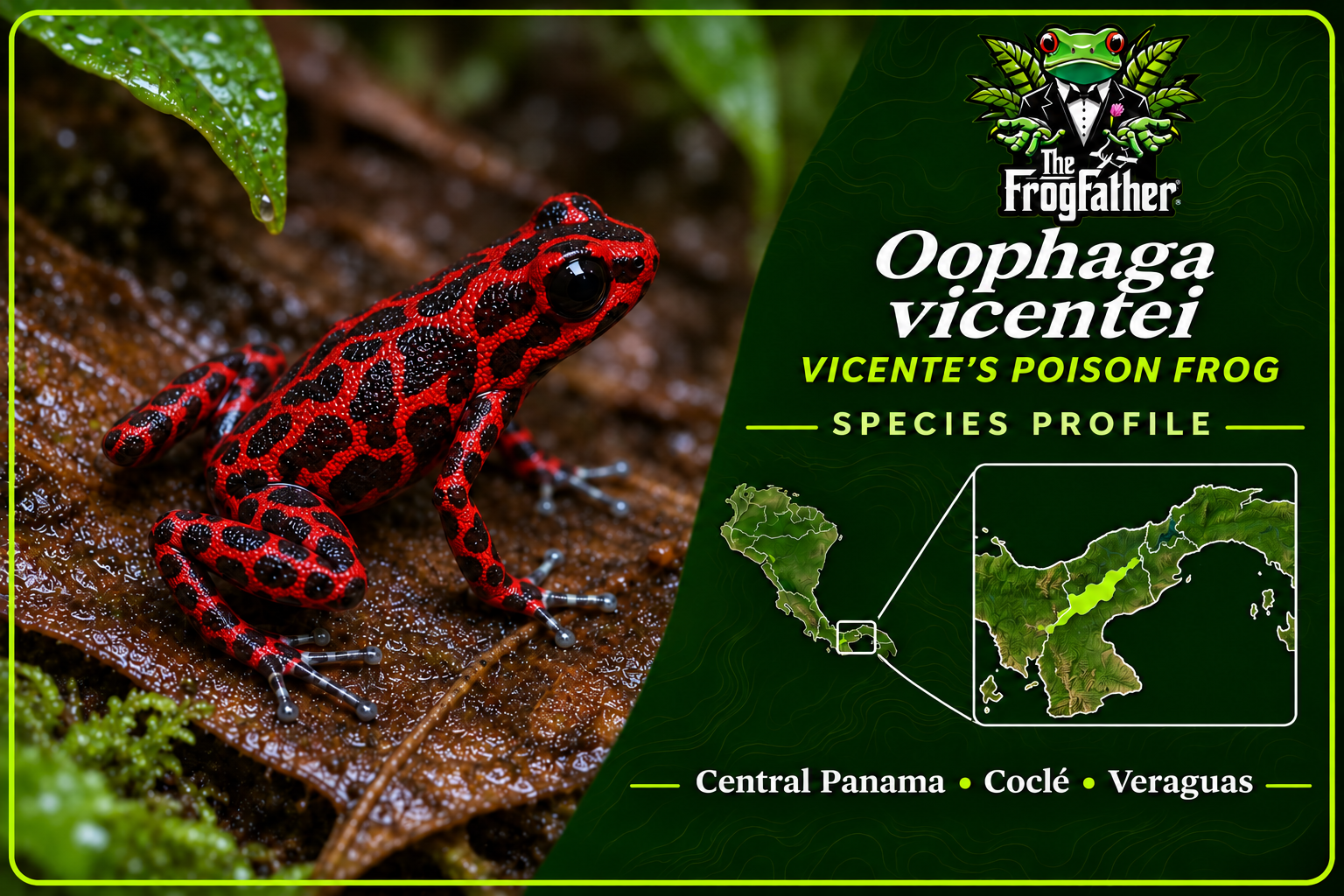
“Red” describes the appearance of particular captive animals; it is not a separate species. Wild O. vicentei display substantial colour variation, including red, yellow, green, blue-green, brown and darker forms, usually combined with black spots or reticulation.
A red frog should therefore only be sold as an Oophaga vicentei red form when its identity and captive lineage are known. Appearance alone should not be used to invent a locality or reconstruct missing provenance.
Our current captive-bred animals can be viewed on the Oophaga vicentei ‘Red’ listing.
Natural distribution
Oophaga vicentei is endemic to central Panama. Current taxonomic references place it principally on the Caribbean slopes of Veraguas and Coclé, with records around the continental divide and the upper Pacific-drainage areas of Coclé. More recent population work also discusses populations extending into adjacent Colón Province.
The type locality is near El Copé in Coclé Province, at approximately 912 metres above sea level. The species should not be described as originating from an “Isla Vicentei”; that is not its recognised natural distribution.
Genetic research has found meaningful population structure across its restricted range. That makes accurate provenance and separation of established captive lines particularly important.
Habitat and natural behaviour
This species inhabits humid tropical lowland and premontane forest. It is strongly associated with bromeliads and other water-holding vegetation but should not be described as living exclusively in the canopy. Individuals have also been recorded around leaf litter, rocks and lower forest structure.
In captivity, this translates into a need for usable vertical complexity rather than an empty tall glass enclosure. Cork, branches, broad leaves, vines, bromeliads and secure elevated retreats should connect the lower, middle and upper levels.
Read our guides to bromeliads for dart-frog vivariums and why dart frogs use bromeliads before planning the enclosure.
Appearance and colour variation
Oophaga vicentei is a small frog with considerable variation between populations and individuals. Red forms can show a rich scarlet or crimson ground colour broken by extensive black spotting or reticulation. Other populations may be predominantly green, yellow, brown or blue-green.
The black pattern commonly continues across the body and limbs. The skin has the finely granular texture expected of a small dendrobatid rather than the glossy, artificial appearance sometimes produced by heavily edited photographs.
Colour is not a reliable method of sexing this species. Body width, toe-pad development and behaviour can offer clues, but calling and breeding behaviour provide stronger evidence than colour or a single photograph.
Recommended vivarium size and layout
For a compatible adult pair, Frogfather recommends a well-structured vertical enclosure of at least approximately 45 × 45 × 60 cm. This is a practical husbandry starting point rather than a claim that one measurement is a universal biological minimum.
A larger enclosure is beneficial when it provides genuinely usable habitat. Empty height contributes little. The frogs need connected climbing routes, visual barriers, several sheltered feeding areas and multiple suitable reproductive sites.
A successful enclosure should include:
- A secure, escape-resistant enclosure with fine feeder-proof ventilation
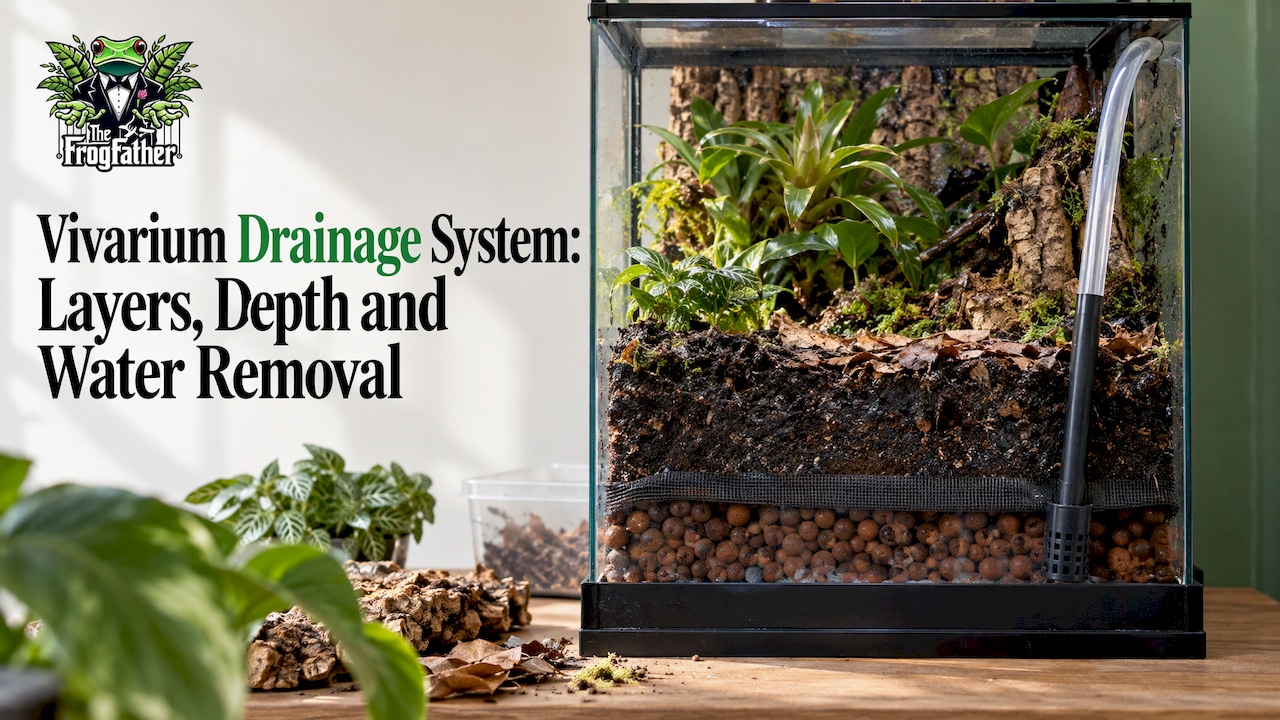
- A drainage layer that prevents the substrate remaining waterlogged
- Coarse, aerated substrate beneath a substantial leaf-litter layer
- Cork, branches and planted routes through every vertical level
- Several bromeliads or equivalent water-holding structures
- More breeding and retreat sites than there are frogs
- Dense cover without eliminating accessible feeding areas
- Gentle air exchange and natural moisture gradients
- A mature springtail population
- Separate prepared accommodation in case the pair becomes incompatible
Use the Frogfather dart-frog vivarium size guide alongside our complete bioactive vivarium guide when planning the permanent enclosure.
Temperature
A practical captive target is approximately 21–24°C during the day, with a modest reduction after lights-out where the room permits. This is a conservative husbandry range, not a claim that every wild locality experiences identical conditions.
Avoid allowing the vivarium to remain above approximately 26°C for prolonged periods. Small glass enclosures can heat rapidly under strong lighting, particularly when ventilation has been restricted to retain humidity.
Measure temperature at frog level and in elevated sites. A thermometer near the bottom of the vivarium may miss heat accumulating around the upper planting and lighting.
Humidity, misting and ventilation
Oophaga vicentei requires a humid environment, but this does not mean permanently saturated glass, waterlogged substrate or a fixed 100% relative-humidity target.
For many captive setups, readings may commonly move through approximately 70–90%, rising after misting and falling gradually as air circulates. Hygrometers are imperfect and placement changes the reading, so the enclosure’s physical condition matters as much as one number.
Maintain:
- Humid refuges at all times
- Water in appropriate tadpole-rearing structures when breeding
- Moist but aerated substrate
- Gentle, continuous air exchange
- Some drying of exposed leaves between misting cycles
- Reliable drainage beneath the living substrate
Our vivarium humidity-control guide and dart-frog ventilation guide explain how moisture and airflow should work together.
Plants and bromeliads
Strong, well-rooted bromeliads are particularly valuable because they create cover, calling positions, courtship sites and water-filled leaf axils for tadpole deposition. Several plants should be available so one dominant animal cannot control every useful site.
Choose plants capable of supporting the frog’s weight and surviving sustained humidity without remaining permanently waterlogged. Epiphytic planting can make far better use of the enclosure’s height.
Any plant entering an occupied vivarium should be identified, cleaned and quarantined. Commercial compost, fertiliser, pesticide residues, snails and other pests must not be introduced casually. See our safe plant guide for dart-frog vivariums.
Diet and feeding
Captive Oophaga vicentei require frequent access to appropriately small live prey. Suitable foods include:
- Drosophila melanogaster fruit flies
- Springtails
- Small bean weevils where individual frogs handle them confidently
- Other suitably cultured micro-feeders used as part of a controlled diet
Prey must be small enough for each frog to catch and swallow readily. Because this is a small, fast species in a complex enclosure, feed in several places and observe each identifiable individual rather than assuming food availability proves food intake.
Appropriate live prey should be dusted immediately before feeding using one coherent supplementation system. Do not combine several complete products casually, as this can duplicate calcium, vitamin D3, vitamin A and other nutrients.
Use the complete dart-frog feeding guide and supplementation guide to establish a reliable routine.
Social behaviour: pair or group?
The safest starting arrangement is a compatible adult pair. Oophaga are behaviourally complex and territorial frogs. The fact that several juveniles tolerate one another does not establish that the same group will remain stable after sexual maturity.
We do not recommend an arbitrary trio or group for a general keeper. Same-sex competition, courtship pressure and control of breeding sites may lead to chronic hiding, exclusion from food or direct aggression.
Monitor identifiable frogs for:
- Persistent pursuit or wrestling
- One frog controlling the best bromeliads or feeding sites
- A previously visible animal disappearing for long periods
- Unequal access to food
- Weight loss or declining body condition
- Repeated escape behaviour against the doors or vents
Permanent separation is a responsible outcome when two frogs are incompatible. Suitable backup housing should exist before the animals are introduced.
Calling and activity
Males call during daylight to advertise and court females. Field research has documented variation in calling activity and acoustic characteristics between populations.
The call is generally less intrusive than that of larger, more powerful callers such as some Epipedobates, Ameerega or Phyllobates. Nevertheless, an adult male may call repeatedly during suitable environmental and breeding conditions.
These are fast, agile frogs capable of using elevated planting. Maintenance should therefore be planned carefully: check the location of both frogs before opening the doors and avoid leaving unsecured gaps around cables, misting pipes or vents.
Breeding and maternal care
Breeding is one of the most remarkable aspects of this species. The male calls and guides a receptive female towards a suitable laying site, often around smooth leaves or bromeliad structure.
Published observations describe small clutches, frequently around two to six eggs, although captive observations have recorded broader variation. Egg number should not be treated as a fixed diagnostic feature.
After hatching, the female transports tadpoles individually to small water-filled plant structures, particularly bromeliad axils. She then revisits each tadpole and deposits unfertilised trophic eggs. These nutritive eggs form the essential natural diet of the developing larvae.
This has important captive implications:
- The reproductive female must remain healthy and appropriately nourished
- Several clean, suitably sized water-holding sites must be available
- Tadpoles should not be removed casually and treated like ordinary detritivorous dart-frog larvae
- Each deposition site must be monitored without repeatedly disturbing the parents
- Breeding pairs require privacy, stability and excellent nutritional management
Conservation breeding work has found that O. vicentei benefits from relatively substantial water-holding structures. Artificial bromeliad-style sites may be useful where live plants do not provide reliable pools, but their water quality and accessibility still require management.
Quarantine and health monitoring
Every new frog should complete an appropriate quarantine period before entering an established collection. Quarantine allows appetite, body condition, droppings, coordination and behaviour to be observed without exposing other amphibians.
Use separate equipment and maintain clear records. Seek advice from an amphibian-experienced veterinary professional when a frog shows persistent appetite loss, weight loss, swelling, skin changes, abnormal posture, poor coordination or altered breathing.
Read our guide to quarantining dart frogs properly. A rare or expensive frog is not exempt from quarantine; its value makes biosecurity more important.
Conservation and responsible sourcing
Oophaga vicentei is currently assessed as Endangered and is listed in CITES Appendix II. Threats include habitat loss and fragmentation, mining, infectious disease and potential collection pressure.
Recent genetic research has identified substantial structure among populations. Captive keepers should therefore preserve accurate records and avoid crossing animals of different known locality lines merely to produce novel colours.
Buy only legally sourced, captive-bred animals with the clearest provenance available. “Rare” should never be used to excuse poor documentation.
Is Oophaga vicentei suitable for beginners?
We rate this species approximately 4.5 out of 5 for difficulty and classify it as advanced.
The challenge does not come from one extreme temperature or complicated machine. It comes from the combination of:
- Small body size and tiny prey requirements
- Fast, agile behaviour
- Need for a mature, vertically structured enclosure
- Territorial social behaviour
- Specialised maternal tadpole feeding
- Conservation value and the need to preserve provenance
- Limited room for error when monitoring individual food intake
A keeper who has successfully maintained and bred another small dart-frog species may find O. vicentei exceptionally rewarding. A first-time keeper will normally have a better experience with a larger, more established species identified through our dart-frog species guide.
Frequently asked questions
Are Oophaga vicentei suitable for beginners?
No. Frogfather considers Oophaga vicentei an advanced species because of its small live-food requirements, territorial behaviour, vertical habitat needs and specialised maternal tadpole care.
How large do Oophaga vicentei grow?
They are small poison frogs, generally remaining below approximately 24 mm snout–vent length. Individual size varies and should not be used alone to determine sex.
Can Oophaga vicentei live in groups?
A compatible pair is the safest general arrangement. Juvenile tolerance does not guarantee adult compatibility, and groups can develop competition over food, territory and breeding sites.
What size vivarium does Oophaga vicentei need?
Frogfather recommends a well-structured 45 × 45 × 60 cm or larger vivarium as a practical starting point for a compatible pair. Usable vertical planting and multiple retreats are more important than empty height.
What temperature should Oophaga vicentei be kept at?
A practical captive range is approximately 21–24°C during the day with a modest night-time reduction. Prolonged overheating is a greater concern than providing tropical heat, so temperatures should be measured at several enclosure levels.
Do Oophaga vicentei need bromeliads?
They need suitable vertical cover and dependable water-holding reproductive sites. Strong live bromeliads are highly appropriate, although carefully designed artificial structures can supplement them when they safely hold sufficient clean water.
Who transports and feeds Oophaga vicentei tadpoles?
The female transports tadpoles individually to small water-filled plant structures and returns to provision them with unfertilised trophic eggs. This specialised maternal care makes breeding more demanding than raising many other dart-frog tadpoles.
Is red Oophaga vicentei a separate species?
No. Red is one expression of the species’ substantial natural colour variation. A red animal should not be assigned a locality or captive line from appearance alone.
Scientific and husbandry references
- Amphibian Species of the World: Oophaga vicentei
- Smithsonian Tropical Research Institute: Oophaga vicentei
- Panama Amphibian Rescue and Conservation Project: Vicente’s poison frog
- Flores et al.: calling activity, bioacoustics and diet
- Higgins and Ibáñez: tadpole morphology and egg-clutch observations
- Population structure and demographic history of Oophaga vicentei