
A vivarium door lock is a small key-operated catch that stops a sliding glass door being opened by anyone who doesn’t have the key. It deals with curious children, other pets and opportunistic theft. It does not seal the gaps around the glass, and for dart frogs those gaps are where escapes usually happen. Choose a lock that matches your glass, fit it carefully, then audit the rest of the enclosure. We’ll take you through all three.
TL;DR
- A lock controls who can open the door. It does nothing about the runner gap, vents, corners or cable ports.
- Measure your glass thickness and check the lock’s stated fitting range before buying. Many UK panels are 4 to 6mm.
- Tighten only until the panels cannot separate. Overtightening can crack glass.
- Small animals such as froglets and feeder flies get through gaps a lock never touches, so seal those too.
- Fit the lock with the enclosure empty, then recheck it once the vivarium is up to temperature.
Table of Contents
- What a vivarium door lock actually does
- Types of lock for sliding glass doors
- What affects the price
- How to check a lock will fit your vivarium
- Fitting a vivarium door lock safely
- Why a lock isn’t enough for dart frogs
- Making sure a lock does not harm the animals
- Do you need one at all?
- Our view
- Build the whole enclosure properly
- FAQ
- Sources
What a vivarium door lock actually does
Most vivariums and terrariums have two panes of glass sliding in plastic or aluminium runners. Left alone, the front pane can be slid across by anyone. A door lock clamps the two panes together, or locks the overlap, so neither can be moved without the key.
That is useful in a few real situations:
- Households with children. A vivarium is a glass box full of small, appealing animals. A locked door keeps small hands out.
- Other pets. Cats and dogs can nose a loose pane along its runner.
- Shared or public spaces. Classrooms, shops, shared houses and shows are where unauthorised access is most likely.
- Theft. Dart frogs are valuable and easy to carry, so a visible lock is a sensible deterrent.
What a lock cannot do is make the enclosure escape-proof. Your frogs will not be foiled by a clever hand, they will find the 3mm gap you never noticed. Keep that in mind through the rest of this guide.
Types of lock for sliding glass doors
Sliding glass doors are the most common design in UK glass vivariums, so most locks are made for them. They fall into a few types, and the difference matters when you choose.
Clamp-on glass locks
These slide over the edge of the glass where the two panes overlap, and a screw is tightened inside the enclosure to hold them. They need no drilling, so they suit most standard glass vivariums. The trade-off is that fit depends entirely on glass thickness, which is why measuring first is not optional.
Pre-drilled lock holes
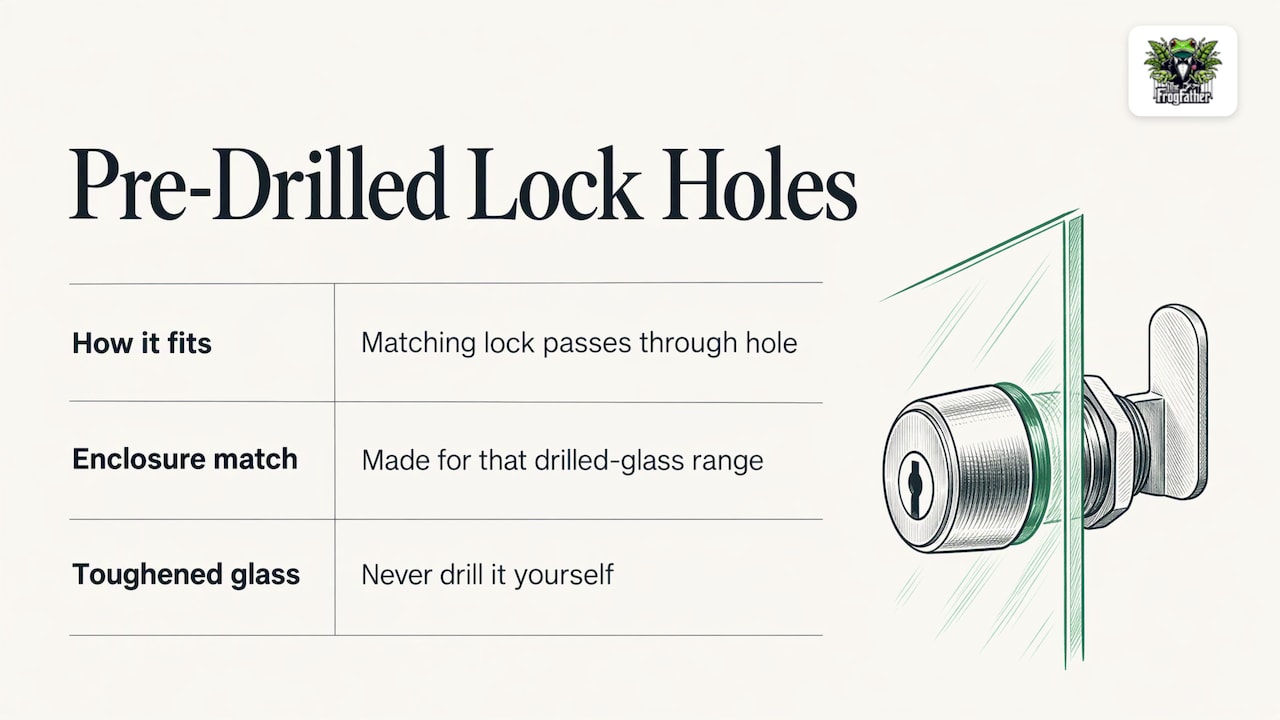
Some vivarium ranges ship with a hole already drilled in the door glass, and a matching lock passes through it. These are neat and secure, but they only work with enclosures made for them. A lock designed for one range’s drilled glass won’t suit another. Never drill toughened glass yourself: it can shatter without warning.
Inner-pane locks
Some locks sit between the panes, fitting neatly inside the overlap to hold the glass firmly in place. They are discreet from the front but rely on the clearance between your panes matching the lock’s stated range.
Keyed or keyless
Most are keyed, usually with two keys supplied. If your reason is children or theft, keyed is the sensible choice. Keep the spare key somewhere you will remember. Nothing is more annoying than a locked frog room and no key when you need to remove a sick animal.
What affects the price
Vivarium locks are generally inexpensive compared with the enclosure they protect, so price should not decide it. What changes the cost is mostly practical: the material (zinc alloy or stainless steel), the number of keys, the fitting range, and whether the lock is made for a specific brand’s drilled glass. Pay attention to the fit before the price. A cheap lock that doesn’t fit your glass thickness is worth nothing, and a forced fit risks a cracked pane that costs far more than the lock.
How to check a lock will fit your vivarium
Fit is where most people go wrong. Work through these checks before you order.
- Measure the glass thickness. Use calipers or a ruler on the edge of the pane. Many UK vivarium panels are 4 to 6mm thick, but don’t assume. Some enclosures use thinner or thicker glass.
- Read the lock’s stated fitting range. A lock listed for a given range of glass thickness or overlap will only grip properly inside it. Too thin and it rattles. Too thick and you will be tempted to force it.
- Check the door overlap. Measure how far the front pane overlaps the rear one. The lock needs enough overlap to sit on.
- Check the runner gap. Look at how much space remains in the runners above and below the glass. A lock that holds the panes together does nothing if the top pane can still be lifted out at one end.
- Confirm whether you need a drilled hole. If the lock needs a pre-drilled hole and your glass does not have one, it is not the right lock for that enclosure.
- Check for chips. Do not position a clamp near a chipped edge. Stress concentrates there and a small chip can become a crack.
If you are unsure whether your enclosure suits a lock at all, our guide to what to look for when buying a bioactive vivarium covers door design and glass before you commit.
Fitting a vivarium door lock safely
Patience beats force here. A lock takes minutes to fit, and a cracked pane takes weeks to replace.
- Empty the enclosure, or at least move the animals. Fit the lock with no frogs inside. Doors that are being slid about with animals present are how froglets slip out.
- Clean and dry the glass. Grit or film under a clamp can scratch or cause uneven pressure. A magnetic vivarium glass cleaner gets the inside surface clean without reaching in.
- Support each panel. Hold the glass steady as you work so it can’t shift in the runner.
- Position the lock away from edges. Keep it clear of chipped or damaged glass.
- Tighten gently. Turn the screw only until the panels can no longer separate, then stop. Overtightening is the commonest way to crack glass.
- Test with the key. Lock it, try to slide the door, then unlock it and check it still runs smoothly.
- Recheck at operating temperature. Glass and fittings expand as the enclosure warms, so re-check the lock once the vivarium is up to temperature. In a humid dart frog setup, also check that the screw and clamp are not building up residue or corrosion over time.
Never force a lock beyond its fitting range. If it will not grip at the stated thickness, it is the wrong lock, not a problem to solve with a bigger screwdriver.
Why a lock isn’t enough for dart frogs
Here is the part that catches keepers out. A lock keeps people out. A dart frog escape almost never involves someone opening the door.
Adult bearded dragons will ignore a 3 to 5mm gap in a runner. A tiny animal will not. The same source that makes this point notes that a gap like that may be irrelevant for a big lizard but risky for hatchlings and small invertebrates. Froglets, springtails and fruit flies are all in that second category.
A lock can leave every one of these open:
- The glass seam where the panes overlap
- The runners at the top and bottom
- The corners of the enclosure
- The lid or top frame
- Cable ports for lights and sensors
- Vents
That six-point list is a good escape audit for any enclosure. Go round it with a torch and a ruler, and look at every one from the viewpoint of an animal a centimetre long. Where you find a gap, deal with it.
For the sliding door itself, our sticky-back sliding-glass door seal is a clear strip that closes the gap between panes, which helps with both escapes and humidity. For mesh vents, which are the other big weak point on a standard glass enclosure, the Frogfather FlyLock™ Exo Terra mesh guards and our vivarium vents are designed to keep feeder flies and small animals where they belong.
If you run a budget or imported enclosure, our write-up on fly proofing a Temu or Exo Terra vivarium shows a simple gasket approach to the same problem. And if an escape has already happened, read what we did when a frog escaped.
Making sure a lock does not harm the animals
A lock itself is harmless to frogs, as it sits on the glass. The risks come from how you fit and use it:
- Ventilation. Do not let a lock, seal or guard block vents. Dart frog enclosures need airflow as well as humidity, and stagnant air causes its own problems.
- Quick access. In an emergency, such as a sick frog or a fire, you need to open the enclosure fast. Keep the key somewhere you can always find it.
- Door movement. A slightly misaligned lock can leave a pinch point in the runner. Slide the door slowly after fitting and look for any gap that narrows as it closes.
- Glass stress. An overtightened clamp stresses glass in a warm, humid enclosure. Check it again after a few days.
These checks take a minute, and they keep the lock doing the job you bought it for.
Do you need one at all?
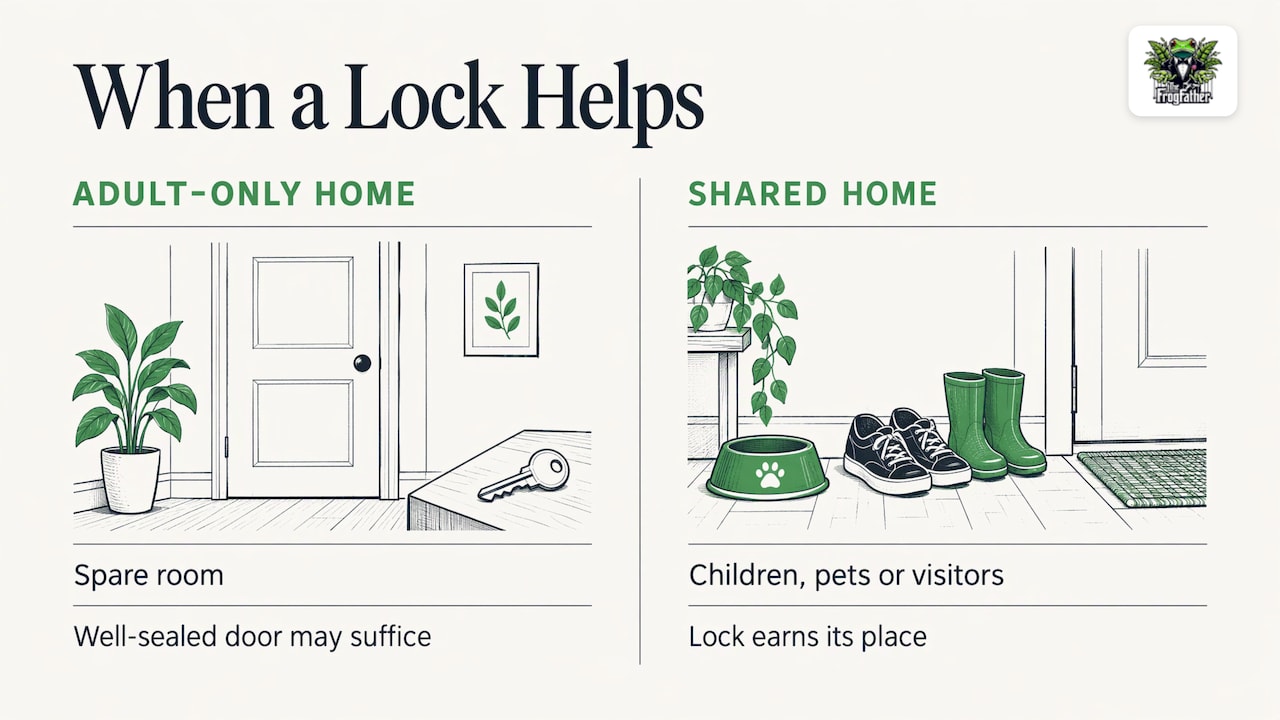
It depends on your house. A lone keeper in an adult-only home, with the vivarium in a spare room, can reasonably rely on a well-sealed door. A lock earns its place when children, other pets, visitors or a shared space are involved, or when the animals are valuable enough that theft is a worry.
What you always need, with or without a lock, is a door that closes properly and a sealed enclosure. If your glass vivarium has awkward runners or warped glass, it may be worth looking at a different build. Our comparison of CPVC versus glass vivariums covers the material trade-offs, and our 3D-printed vivariums and enclosures are another route.
Our view
We keep frogs for a living, and the escape that costs us a froglet has never been a stranger opening a door. It is a gap we did not look at properly.
That is why we design practical accessories in our own frog rooms: seals, mesh guards and vents that deal with the small gaps a lock ignores. A lock is a good, cheap layer of security. Treat it as one layer among several, and give the rest of the enclosure the same attention.
Bioactive enclosures reward steady, observant care, not shortcuts. Fit things carefully, check them regularly and fix problems when you first notice them, not after an animal has gone missing.
Frogfather
Build the whole enclosure properly
If you are setting up a first vivarium or tightening up an existing one, we can help with the whole job: UK-bred dart frogs, aged vivariums, custom bioactive builds, plants, springtails, isopods and our own 3D-printed fittings. Browse the full range at Frogfather, or start with our Bioactive Vivarium Fundamentals course.
Our vivarium vents, guards and fittings are a sensible next stop for closing the gaps your lock leaves.
FAQ
Will a vivarium door lock stop my frogs escaping?
Not on its own. A lock stops the door being opened, but froglets and feeder flies leave through runner gaps, vents, corners and cable ports. Seal those gaps as well, using a door seal and mesh guards where they suit your enclosure.
How do I know what size lock I need?
Measure the thickness of your glass and the overlap between the panes, then compare both with the lock’s stated fitting range. Many UK panels are 4 to 6mm, but measure yours. If your doors need a pre-drilled hole and yours do not have one, choose a clamp-style lock instead.
Can I fit a lock to a terrarium with a hinged door?
The sliding-glass locks described here are made for sliding doors. Hinged doors usually have a different latch or catch, so look for a lock designed for that door type, and make sure it does not block ventilation or pinch the seal.
Can a lock crack the glass?
Yes, if it is overtightened or placed near a chipped edge. Tighten only until the panels cannot separate, keep the clamp away from damage and recheck it once the enclosure is at operating temperature.
Sources
Recommended
- Sticky-Back Vivarium Sliding-Glass Door Seal – 1m Clear Strip
- Fly Proofing A Temu Or Exo Terra Vivarium – Simple DIY Gasket Trick To Stop Feeder Fly Escapes