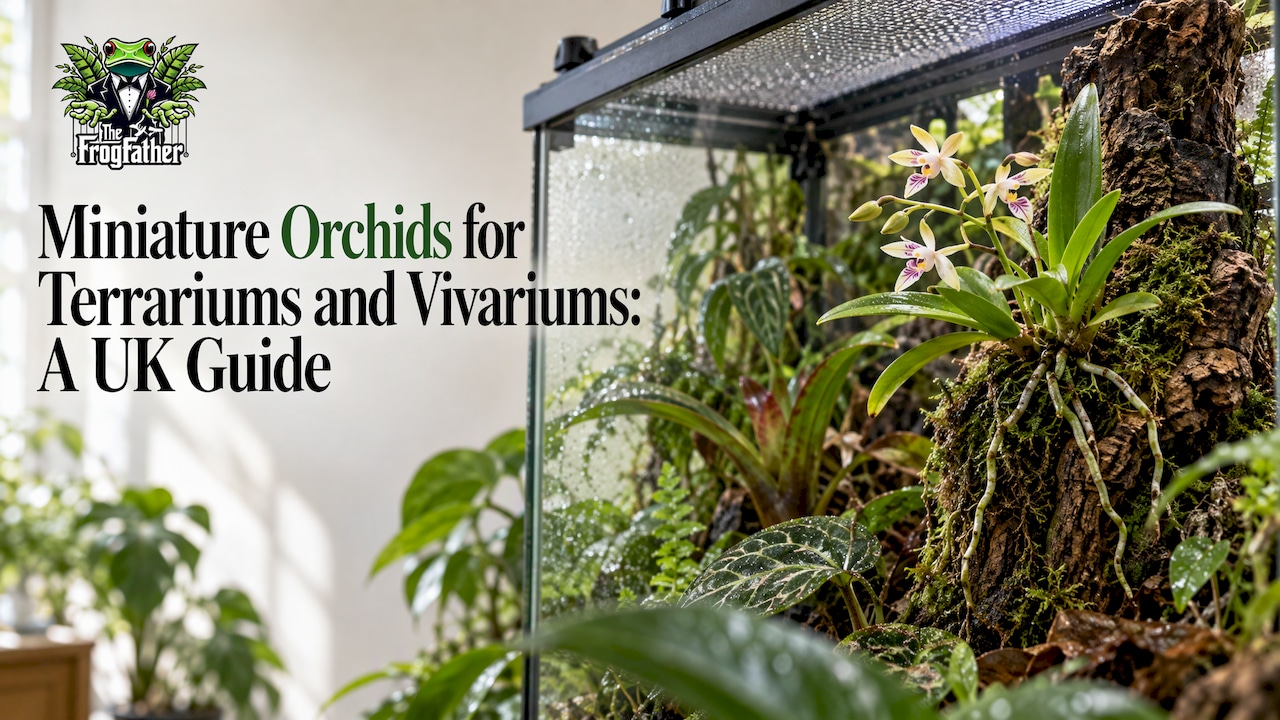
Miniature orchids can do well in a terrarium or bioactive vivarium, provided you pick small epiphytic species, mount them rather than bury them, and give them humidity with real air movement. The wrong choice is usually a supermarket orchid that wants a drier, brighter windowsill. The right choice is a small, shade-tolerant epiphyte that expects to live on a branch in a damp forest.
This guide covers which types to look at, how to fit them into a closed or ventilated enclosure, how to keep them alive alongside frogs, and what to leave out.
TL;DR
- Choose small epiphytes that like humidity and modest light, and mount them on bark or wood instead of planting them in substrate.
- Humidity is the easy part. Air movement is what stops mount-grown orchids rotting, so a sealed box is rarely ideal.
- For an amphibian vivarium, use plants free of pesticides and residues, and quarantine new arrivals before they go in.
- Avoid toxic plants and flowering plants you will need to reach in and trim often.
- Orchids are a slow, observant addition, not a hands-off one. Bioactive setups still need regular maintenance.
Table of Contents
- Why orchids suit a terrarium, and where they struggle
- Which miniature orchids to look at
- How to mount, plant and water them
- Light, temperature and humidity in practice
- Keeping orchids safe around frogs
- Common mistakes
- Our perspective
- Build it with us
- FAQ
- Sources
Why orchids suit a terrarium, and where they struggle
The RHS describes closed terrariums as ideal for small, slow-growing tropical plants that enjoy humid conditions. That describes many miniature orchids well. They stay small, they grow slowly, and the humidity that your frogs or isopods need is exactly what they want.
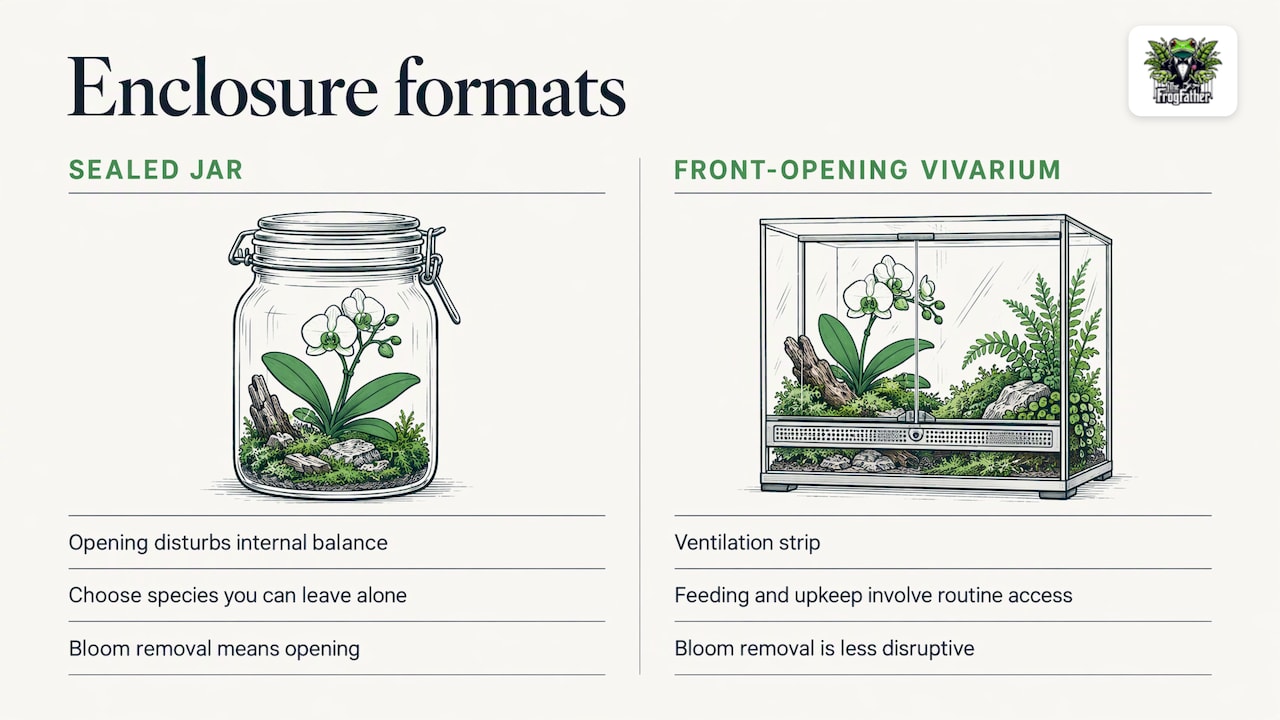
The same RHS page advises against flowering plants in a closed terrarium, because opening it to remove faded blooms disturbs the balance inside. That matters for orchids. If you choose a sealed glass jar, pick species you can leave alone, or accept that you will be opening it on a routine. In a front-opening vivarium with a ventilation strip, this is much less of an issue, because you are already reaching in for feeding and maintenance.
The other pressure point is air. The Orchid Study Group notes that most small, mini and micro orchids need high humidity and good air movement, but not high light levels or strong sunshine. Stagnant, saturated air with no gaps is where roots and new growths start to fail. If you are building or modifying an enclosure, our guide to vents for vivariums and terrariums explains how to get airflow without drying everything out.
Which miniature orchids to look at
No single species is “the” terrarium orchid. Instead, think in groups, and check the specific plant’s needs with whoever supplies it.
Small Dendrobiums
The RHS notes that dendrobiums grow well in bark-based orchid compost in pots, baskets or terrariums, and that some species can be grown pot-free, mounted on bark in a high-humidity spot such as a houseplant terrarium. It gives a range of 15 to 30 °C for warm-growing dendrobiums, which fits a typical heated UK room or a vivarium kept in the low to mid twenties.
One small species that comes up often for terrariums is Dendrobium tentaculatum. Kew’s Plants of the World Online lists it as an accepted species, a pseudobulbous epiphyte from Papua New Guinea that grows in the wet tropical biome. That origin tells you what to offer it: warmth, humidity and a perch, not a pot of wet compost.
Moth orchids (Phalaenopsis), including minis
Mini Phalaenopsis are easy to find and often suggested for small terrariums. The RHS advises that moth orchids like consistently warm conditions of 19 to 30 °C by day and 16 to 19 °C at night, should be kept out of direct summer sun, and should never be left sitting in water. They suit a bright, ventilated enclosure better than a dark, dripping frog tank, and they are a better fit for a plant-only terrarium than for a heavily misted amphibian setup where water pools around the crown.
Pleurothallids and other humidity lovers
For a dart frog vivarium specifically, small pleurothallid orchids are the group that keepers most often mention. Reptiles Magazine describes a Pleurothallis as an orchid that grows well inside a dart frog vivarium and suggests mounting such epiphytes on the background or on terrarium wood in good light. Other genera that come up in keeper discussions include small Bulbophyllum, Angraecum and Aerangis, but availability, size and temperature needs differ a lot by species. Ask for the plant’s origin and its temperature range before you buy.
Quick comparison
| Type | Where it sits best | Main point to manage |
|---|---|---|
| Small Dendrobium | Mounted on bark or wood, bright shade | Warmth, airflow, drying between soakings |
| Mini Phalaenopsis | Upper, well-ventilated part of the enclosure | Keep water out of the crown, avoid direct sun |
| Pleurothallids | Mounted on background or branch, shaded | Steady humidity, no hot spots |
| Small warm-growing epiphytes (various) | Mounted, with moss at the roots | Check temperature range for the species |
How to mount, plant and water them
Mounting is the part most beginners get wrong, because it feels less secure than potting. Epiphytes in nature cling to branches and rely on rain, quick drying and moving air. You are recreating that.
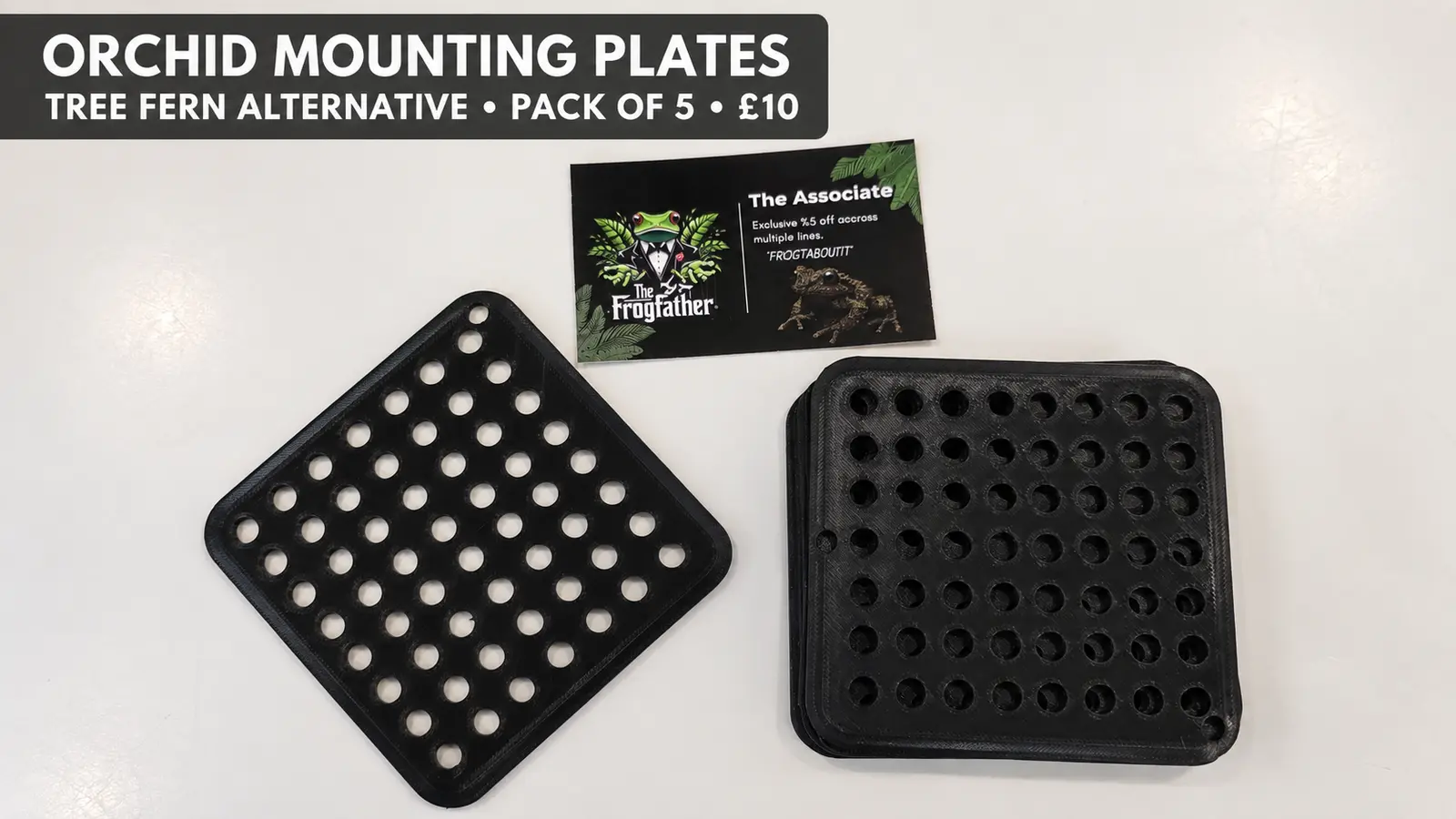
- Pick the surface. Cork bark, a branch or a textured background panel all work. If you are planning a background, our piece on alternatives to tree fern panels covers surfaces that epiphytes can grip.
- Position it high enough. Mount above the substrate, where air moves and splashes from the floor do not sit on the roots. Think about light first, because the plant cannot be moved easily once its roots have attached.
- Attach loosely but firmly. Use soft plant tie or fishing line. The plant must not wobble, since new roots will not grip a moving plant. Remove the tie once roots have attached.
- Add a thin pad of moss if needed. A small amount under the roots helps in a drier room. Too much stays wet and defeats the point of mounting.
- Water by misting and soaking. In a vivarium, regular misting or an automatic system wets the roots. In a plant-only terrarium, remove the mount occasionally for a soak and let it drain fully before it goes back. Watch the roots: plump and green after watering, silvery as they dry, is the cycle you want.
- Use clean water. Orchid growers often recommend rainwater or low-mineral water, because mineral build-up on roots and bark is a problem with hard tap water. Many UK keepers already use RO water for frogs, which suits orchids too.
The Orchid Study Group also points out that clear acrylic enclosures can be used for a few plants, for quarantining new arrivals and for weaning tiny seedlings. That quarantine idea is worth borrowing for any orchid heading into a frog tank.
Light, temperature and humidity in practice
Most miniature orchids for terrariums are shade to bright-shade plants. Excess heat from strong lamps is a bigger risk than too little light, particularly in a small glass box. Put the orchid where it receives good light but not the hottest spot under the lamp. Our guides to vivarium lighting for dart frogs in the UK and a bioactive lighting setup explain how to balance plant growth with frog welfare.
Temperature is where you should match the plant to the animal. Many dart frogs prefer a cooler, steadier range than warm-growing orchids tolerate happily at the top end, so choose species whose range overlaps with your frogs. Use a thermometer and hygrometer at plant height rather than guessing from the room.
No enclosure is uniform. If you create zones, with a damper lower area and a brighter, airier upper area, you can put each plant where it belongs. Our article on replicating microclimates inside a UK dart frog vivarium shows how to build those zones.
Keeping orchids safe around frogs
Plants in a bioactive setup do real work. The Wisconsin Herpetological Association explains that plants can act as natural end-users in the nitrogen cycle, absorbing ammonia, nitrite and nitrates from waste while adding oxygen and humidity. But frogs absorb substances through their skin, so how the orchid is grown before it reaches you matters.
- Check the plant’s history. The same source advises making sure plants and their potting mix are free of pesticides, synthetic fertiliser residues and other chemicals, and inspecting for pests such as aphids, mealybugs, mites, snails and slugs.
- Remove the old mix. Shop-bought orchids are often in a dense bark or moss mix with slow-release feed. Rinse the roots thoroughly, and give the plant a spell in quarantine before it goes anywhere near animals.
- Avoid known toxic plants. The ASPCA lists azaleas, laurel, rhododendrons and yews to avoid, and says to be wary of castor beans, sago palms and some forms of ivy, noting that amphibians’ permeable skin makes them especially vulnerable to airborne toxins. None of these belong in a frog enclosure.
- Keep sprays out. Never use leaf shine, foliar feed or pest sprays on plants inside an occupied vivarium. Remove the plant to treat it elsewhere and rinse it well before returning it.
For wider plant selection, our guides on selecting and maintaining vivarium plants and the top five plants for a dart frog habitat show how orchids fit among tougher, faster-growing species. If you are considering bromeliads alongside orchids, see our bromeliads for dart frog vivariums guide.
Common mistakes
- Burying the roots. Orchids with thick, silvery roots are not designed to sit in wet substrate.
- Sealing the enclosure completely. High humidity without airflow invites rot.
- Buying on flowers alone. A plant in bloom looks great in the shop, but you are buying for the next three years of growth, not the next three weeks.
- Adding too many at once. Introduce one plant, watch it for a month, then add more. This is the steady, boring approach that tends to work.
- Expecting no maintenance. A bioactive enclosure does not run itself. Orchids need checking, trimming of dead material and adjustments as they grow. We cover this in Bioactive Isn’t Self-Sustaining.
Our perspective
We keep and breed dart frogs in Nottingham, and we plant a lot of vivariums, so orchids come up often. Our view is simple: orchids are a finishing touch, not a foundation.
Get the basics right first: a sound enclosure, reliable ventilation, a healthy culture of springtails and isopods, and tough plants that can take a frog’s weight. Once that is steady, a carefully chosen mounted orchid adds something that bromeliads and ferns cannot.
What we ask of keepers is patience. Introduce one plant at a time, quarantine it, mount it where it gets the right light and air, and watch it for a few weeks before judging. Our aim with our guides, our free course and our own range of vivarium accessories is to make that kind of careful, observant keeping straightforward to follow.
Frogfather
Build it with us
If you would like a planted enclosure that is ready for epiphytes, we design and build custom bioactive vivariums, and we supply bioactive supplies, plants, microfauna and live foods from our Frogfather shop. If you are new to the hobby, our free Bioactive Vivarium Fundamentals course covers the groundwork before you add anything delicate.

For a fuller walkthrough of the enclosure itself, start with our complete guide to bioactive vivariums.
FAQ
Will orchids do well in a terrarium?
Many small epiphytic orchids do, because a terrarium holds the humidity they like. The RHS says some dendrobiums can be grown mounted on bark in a high-humidity houseplant terrarium. Choose species by their temperature and light needs, and make sure the enclosure has some airflow.
Can orchids be planted in glass containers?
They can live in glass, but they should not be planted into wet substrate like a normal terrarium plant. Mount epiphytes on bark or wood, or use a very free-draining orchid mix. Avoid a fully sealed container, as stagnant air encourages rot.
How do I care for a mini Phalaenopsis in a terrarium?
Keep it warm, out of direct summer sun and never standing in water. The RHS recommends 19 to 30 °C by day and 16 to 19 °C at night, with watering about weekly in the growing season. Position it high in a ventilated enclosure so water does not collect in the crown.
Are orchids safe in a dart frog vivarium?
The plants themselves are generally not the concern. Chemical residues from nurseries are. Choose plants grown without pesticides, wash off the old growing mix, inspect for pests and quarantine before introducing them. Never use sprays or foliar feeds inside an occupied enclosure.
What should not go in a terrarium with orchids and amphibians?
Leave out azaleas, laurel, rhododendrons and yews, and be wary of castor bean, sago palm and some ivies. Also avoid anything treated with pesticides or slow-release fertiliser. If you are unsure about a particular plant, ask a specialist supplier before it goes in.
Sources
- Terrariums and Bottle Gardens | RHS Advice
- How to grow Dendrobium | RHS Growing Guide
- How to grow Phalaenopsis (moth orchids) | RHS Growing Guide
- Enclosure for the Small, the Mini- and the Micro-orchids | Orchid Study Group
- Dendrobium tentaculatum Schltr. | Plants of the World Online, Kew
- Dart Frog Vivarium Plants | Reptiles Magazine
- Using Live Plants in Reptile/Amphibian Enclosures/Vivariums | Wisconsin Herpetological Association
- Toxic Substances to Be Wary of Around Your Birds, Reptiles and Amphibians | ASPCA
Recommended
- Bromeliads For Dart Frog Vivariums (UK Guide)
- Best Vivarium Lighting For Dart Frogs In The UK
- Selecting And Maintaining Vivarium Plants: A Scientific Guide For Dart Frog Setups
- A Comprehensive Guide To Paludariums: Creating The Perfect Bioactive Habitat For Tree Frogs And Mossy Frogs