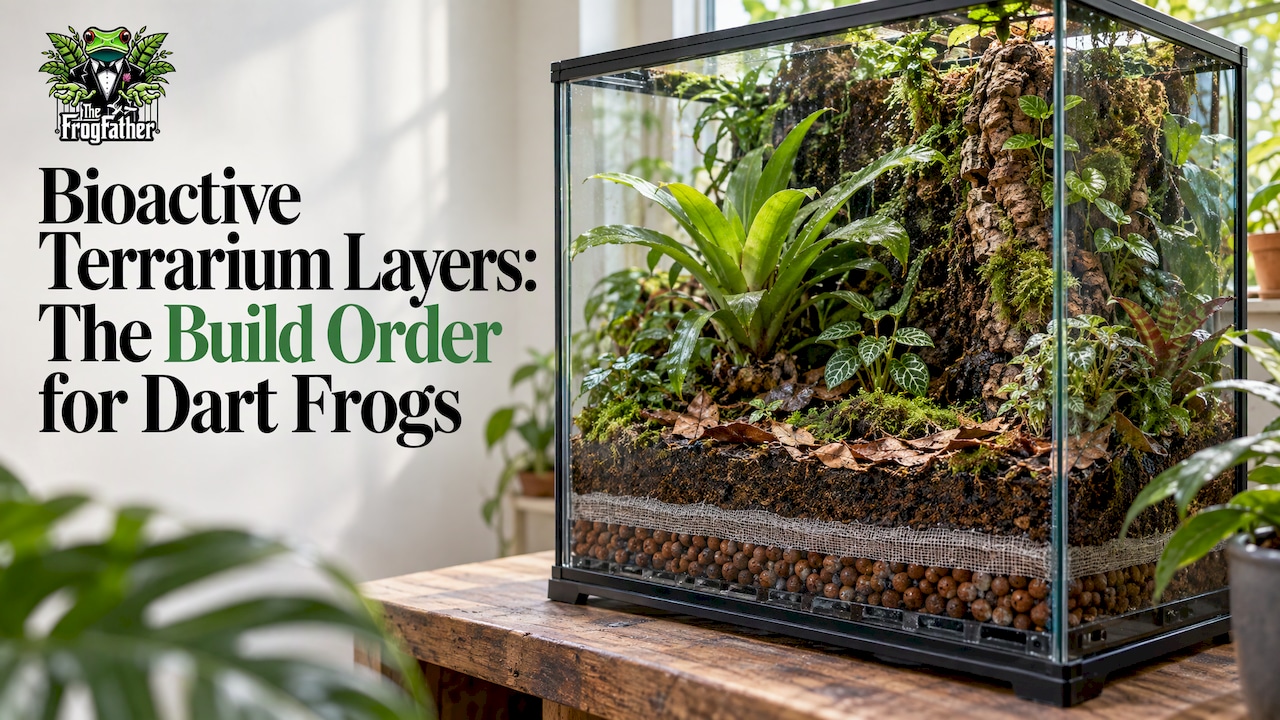
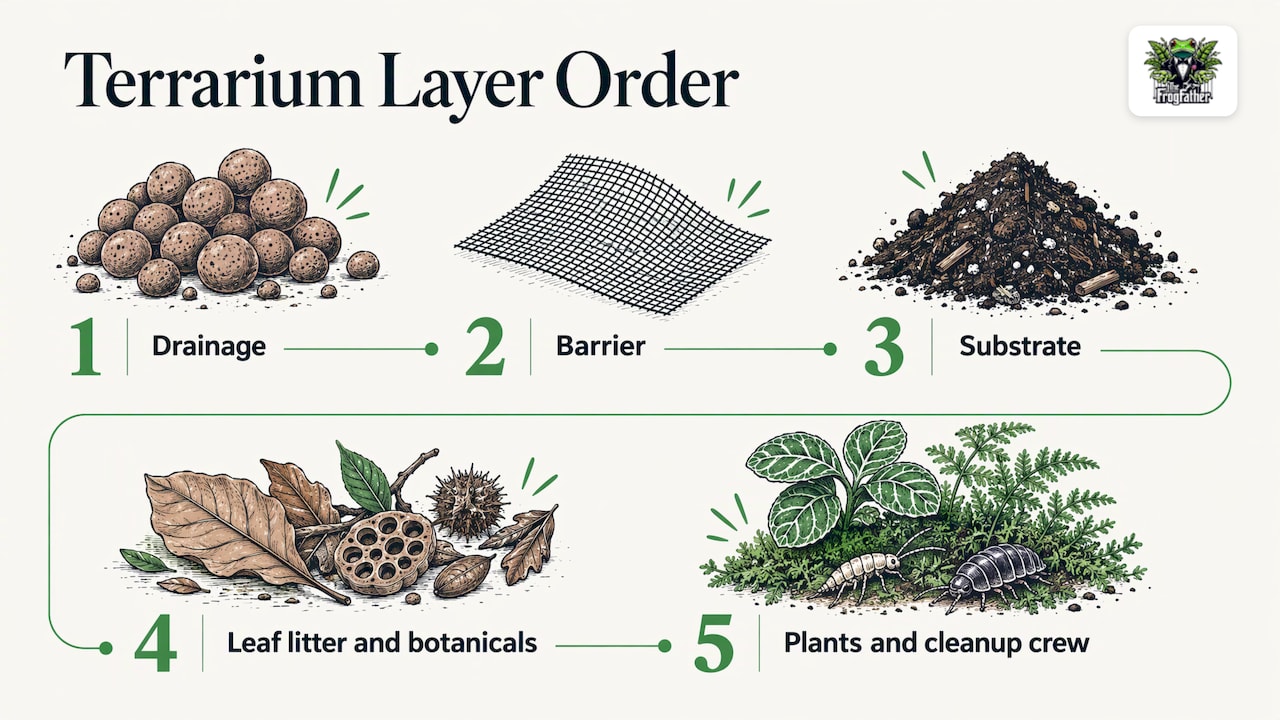
A bioactive dart frog vivarium is built from the bottom up in five layers: a drainage layer, a barrier, a substrate, a leaf litter cover and the living planting and cleanup crew on top. Each layer has one job, and the setup only runs well when all of them are doing it. Below we explain what goes where, why, and how to keep the stack working once the frogs are in.
TL;DR
- Build in this order: drainage layer, mesh barrier, substrate, leaf litter, then plants and microfauna.
- Drainage stops water pooling under the soil, which is what turns a substrate sour. Do not skip it.
- Choose a tropical, fertiliser-free, ABG-style substrate. Avoid plain garden soil, gravel, perlite, vermiculite and wood chips.
- Let springtails and isopods establish for a few weeks before the frogs go in.
- Bioactive still needs upkeep: pruning, topping up leaf litter, checking smell and siphoning the drainage layer when it fills.
Table of Contents
- The five layers at a glance
- Layer 1: the drainage layer
- Layer 2: the barrier
- Layer 3: the substrate
- Layer 4: leaf litter and botanicals
- Layer 5: plants and cleanup crew
- Do colour morphs change the layers?
- Perspective
- Maintaining the layers over time
- Build it with us
- FAQ
- Sources
The five layers at a glance
Before the detail, here is the whole stack, bottom to top.
| Layer | Typical material | What it does |
|---|---|---|
| 1. Drainage | False bottom (egg-crate) or LECA clay balls | Holds surplus water away from the roots and soil |
| 2. Barrier | Fine mesh or screen | Keeps substrate from sinking into the drainage layer |
| 3. Substrate | ABG-style tropical mix | Holds moisture, feeds roots and microfauna, resists compaction |
| 4. Leaf litter | Dried leaves such as oak, plus botanicals | Cover for frogs, food and habitat for microfauna, slows evaporation |
| 5. Living layer | Plants, springtails, isopods | Uses waste, breaks down debris, keeps the system turning over |
We go through each below. The depth you use depends on the height of your enclosure, so treat any figure as a starting point rather than a fixed rule. If you want a fuller step-by-step build, our substrate and drainage guide covers it in more detail.
Layer 1: the drainage layer
Every bioactive vivarium is misted or watered, and that water has to go somewhere. Without a gap beneath the soil it collects at the bottom, the substrate goes anaerobic and the smell tells you quickly. One care guide notes that a drainage layer should sit below the substrate to prevent anaerobic bacteria and excess moisture. Another source calls the drainage reservoir the single most important structural choice in the build, because waterlogged soil goes sour and harms plants, microfauna and eventually frogs.
There are two common ways to do it.
False bottom
A sheet of egg-crate (light diffuser panel) is raised on supports and covered with mesh. It is light, and it gives you a large open water gap that you can siphon out when needed. It is a good choice for taller or larger enclosures where weight matters.
LECA or clay balls
Expanded clay pebbles go in as a layer under a mesh barrier. This approach is simpler and cheaper to set up, but the water gap is smaller, so you need to watch how full it gets. Other suitable materials include high-porosity filter foam and egg-crate, as the same care guide lists.
Whichever you choose, think about how you will get excess water out later. A drainage layer that you can never reach is a problem waiting to happen. Many keepers fit a siphon tube or a small access point at the corner during the build, when it costs nothing.
Layer 2: the barrier
The barrier is the least glamorous layer and one of the most important. A fine mesh or screen sits between the drainage layer and the soil. Its job is to stop substrate working down into the gaps, which would slowly fill your water reservoir with mud and defeat the point of having it.
Get the following right:
- Use a mesh fine enough that substrate cannot pass through, but open enough that water can.
- Cut it to run slightly up the glass at the edges, so soil cannot slip down the sides.
- Make sure it is fully supported. A sagging barrier creates low spots where the substrate can sink.
- Choose materials that will not rot or corrode in permanently damp conditions.
Layer 3: the substrate
This is the layer your plants root in and your springtails and isopods live in. It needs to hold moisture without becoming a sponge, stay open enough for air, and resist compaction over months.
ABG-style mixes and similar tropical vivarium substrates are the usual choice for dart frog enclosures. One guide describes the blend as tree-fern fibre, peat or coco, charcoal, sphagnum and fine bark, which holds moisture, feeds roots and microfauna and does not sour.
What to avoid in the substrate
Frogs sit on the ground, catch food from it and can swallow small particles by accident, so the substrate matters beyond plant growth. According to a dart frog care guide, avoid:
- 100% coco coir
- mixes with added fertilisers
- substrates containing pebbles, gravel, perlite, vermiculite or wood chips that could cause harm if ingested
- sphagnum moss as a top dressing
Plain garden soil and fertilised soil are also best avoided. The same caution applies to plants and décor you add later: check that nothing has been treated with fertiliser, pesticide or slow-release feed. If you are sourcing non-toxic foliage, a list of pet-safe low light plants is a handy starting point for thinking about what is safe around animals, though always confirm a species suits a humid vivarium before buying.
How deep?
There is no single correct depth. As a working rule, give the substrate enough depth for roots and burrowing microfauna, and leave enough headroom in the enclosure for plants and frogs. In a shallow enclosure, a thinner substrate and a lower-profile drainage layer is a sensible trade. Slope the substrate slightly if you want a drier area and a damper one, which gives frogs a choice.
Layer 4: leaf litter and botanicals
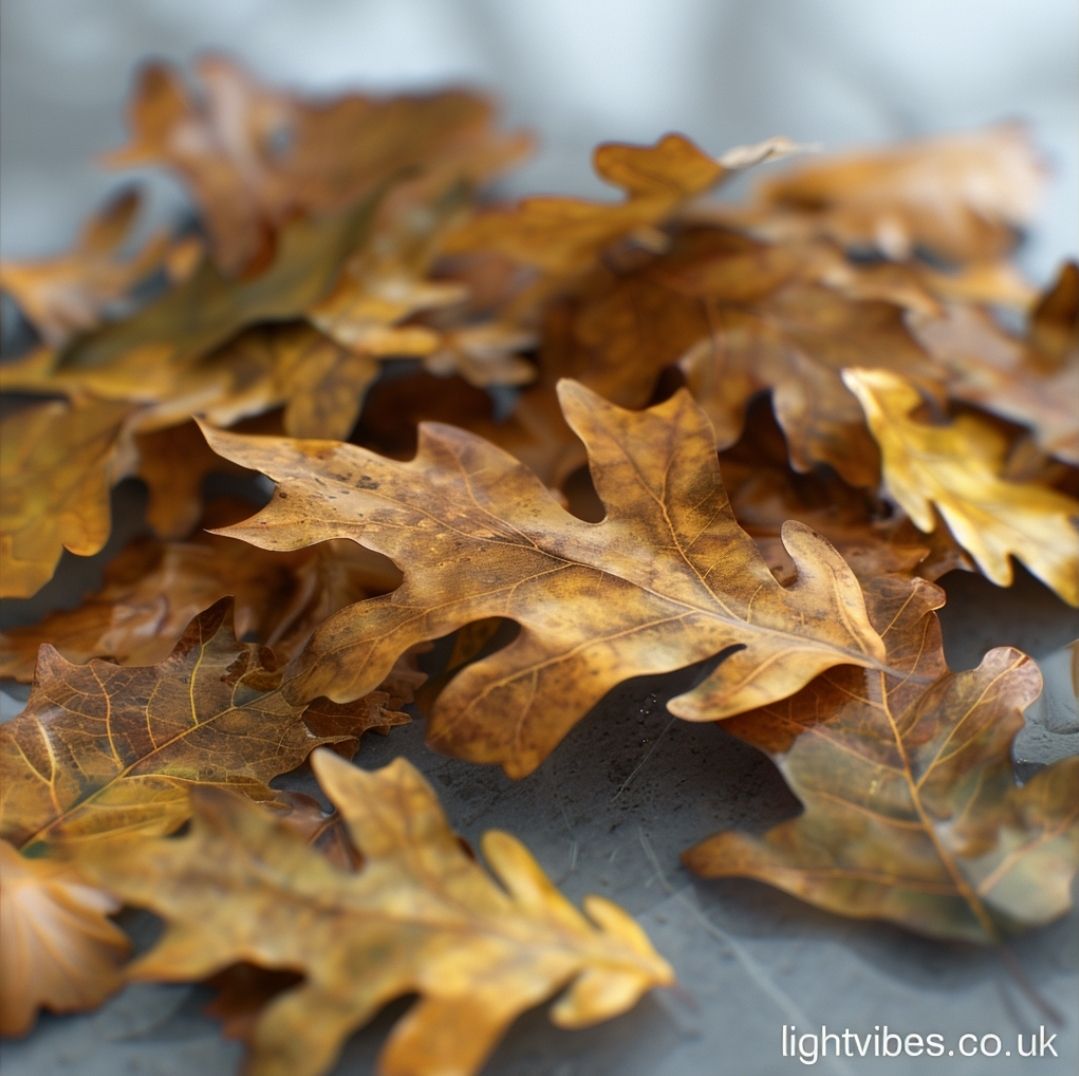
Leaf litter is not decoration. It gives frogs cover and a sense of security, a surface for springtails and isopods to feed on, and a buffer that slows moisture loss from the soil. One husbandry sheet lists plenty of leaf litter and low cover among the priorities for a planted tropical terrarium.
In practice:
- Lay the leaves thickly, deeper than looks tidy. They break down and compress.
- Use dried, untreated leaves such as oak, collected away from roads and sprayed areas, or bought from a supplier.
- Add botanicals such as seed pods, cork and bark pieces on top for variety and hiding places.
- Top up as the layer thins. This is a regular job, not a one-off.
Botanicals also give springtails and isopods somewhere to graze, which feeds the whole system. For how isopods fit into the setup, read our guide to keeping dart frogs with isopods.
Layer 5: plants and cleanup crew
The top layer is the living one. Plants take up nutrients, stabilise humidity and give frogs cover and climbing routes. Springtails and tropical dwarf isopods eat mould, waste and decaying material.
Planting
Plant into the substrate before you add the leaf litter, so you are not disturbing the top layer afterwards. Bromeliads, ferns, creeping ficus and similar tropical species are common choices. Our guides to selecting and maintaining vivarium plants and bromeliads for dart frog vivariums go through what works in UK conditions.
Seeding the cleanup crew
Seed springtails and dwarf isopods into the finished setup and let them establish for a few weeks before adding frogs. That gap lets the population grow and shows you whether the moisture balance is right, while mistakes are still cheap to fix. Keeping separate springtail and fruit fly booster cultures is also recommended, so you can top up the vivarium when numbers dip.
If you are choosing species, our article on mixing isopods in a dart frog vivarium explains what tends to happen over time.
Do colour morphs change the layers?
In our experience, no. Colour morphs of the same species, such as the different Dendrobates tinctorius forms, share the same basic needs: a stable, humid, planted setup with good drainage and plenty of cover. The layer structure above stays the same.
What changes is the species. Smaller, more active frogs such as many Ranitomeya suit different enclosure heights and planting than bulkier tinctorius, and some species like more climbing structure than others. Pick the species first, then size the enclosure and plan the planting around it. Our list of the most popular dart frogs based on UK sales is a good place to see what keepers are choosing.
Perspective
We build and keep bioactive vivariums every week in our frog rooms, and the pattern is consistent: the setups that run well are the ones where the boring basics were done properly at the start.
Drainage and the barrier are where most problems begin. A tank that smells sour six months in usually has a drainage layer that filled up and was never emptied, or a barrier that let substrate sink through. Both are cheap to prevent and tedious to fix once the tank is planted.
We also want to be straight about upkeep. Bioactive does not mean maintenance-free. It means the vivarium shares some of the cleaning work with plants, springtails and isopods, while you still prune, top up leaf litter, culture feeders and watch for changes. Our free course and guides are written for exactly that steady, observant approach, and our live setups, microfauna and accessories are built to support it.
Frogfather
Maintaining the layers over time
Once built, the stack needs regular, modest attention. Sources agree on a short routine: prune plants, wipe the glass, top up microfauna, watch for persistent mould or sour smells, rotate feeder cultures and siphon the drainage layer if it fills.
A simple checklist:
- Weekly: look at the leaf litter, check the frogs, wipe the front glass, and note any smell.
- Monthly: prune back plants, top up leaves and botanicals, and check the drainage layer water level.
- As needed: siphon excess water, add springtails or isopods if numbers drop, and replant if roots rot.
- On a schedule: replace UVB bulbs if you use them, typically every 6 to 12 months depending on the manufacturer.
If the substrate smells sour, do not rush to rebuild. Check drainage first, reduce misting, increase airflow and let it recover. Our article on why bioactive is not self-sustaining goes into this in more depth, and our guide to automating a bioactive vivarium covers misting systems that keep moisture steadier.
Build it with us
If you would rather start from a finished setup, we design and build custom bioactive vivariums in Nottingham, and we breed dart frogs here in the UK. We also supply the pieces for a DIY build: plants, springtails, isopods, supplements and enclosure supplies, plus our own 3D-printed accessories developed in our frog rooms.
For feeding, our live food range includes fruit fly culture subscriptions, so you do not run out between orders. If you are still planning, the free Bioactive Vivarium Fundamentals course walks through the build from the beginning.
FAQ
Is a drainage layer necessary in a bioactive terrarium?
For dart frogs, yes. Husbandry guidance lists reliable drainage under the substrate as a priority, because standing water under the soil turns it sour. A false bottom or LECA layer keeps that water away from the roots and microfauna.
What is the best substrate for dart frogs?
An ABG-style tropical mix is the usual choice. Avoid fertilised soil, gravel, perlite, vermiculite, wood chips and pure coco coir, as the care guidance above explains. Our substrate guide has more on UK options.
Do different colour morphs need different layers?
No. Morphs of one species share the same basic setup, so the layers stay the same. Species differ more, so choose the species first and size the enclosure and planting to suit it.
How long should I wait before adding frogs?
Give the planted setup and its springtails and isopods a few weeks to establish. This lets the microfauna population build and shows up any moisture problems before the frogs arrive.
Sources
- Advanced Bioactive Dart Frog Vivarium: Drainage & Microfauna
- Poison Dart Frog Care Guide, Vivipedia
- Dendrobates azureus, Herpeton Academy
- Low Light Plants Safe for Pets
Recommended
- The Complete Guide To Bioactive Vivariums (UK)
- The Complete Guide To Bioactive Vivariums (UK)
- Dart Frog Vivarium Substrate & Drainage Guide (2026)
- Top 5 Plants For A Thriving Dart Frog Habitat