Husbandry & Evidence Review – 5 September 2026
This current escaped-fruit-fly guide remains appropriate: use physical containment/trapping and avoid insecticides, fly sprays, essential oils and household cleaners around occupied amphibian enclosures.
Escaped Fruit Flies in the House: How to Stop Them Without Harming Your Dart Frogs
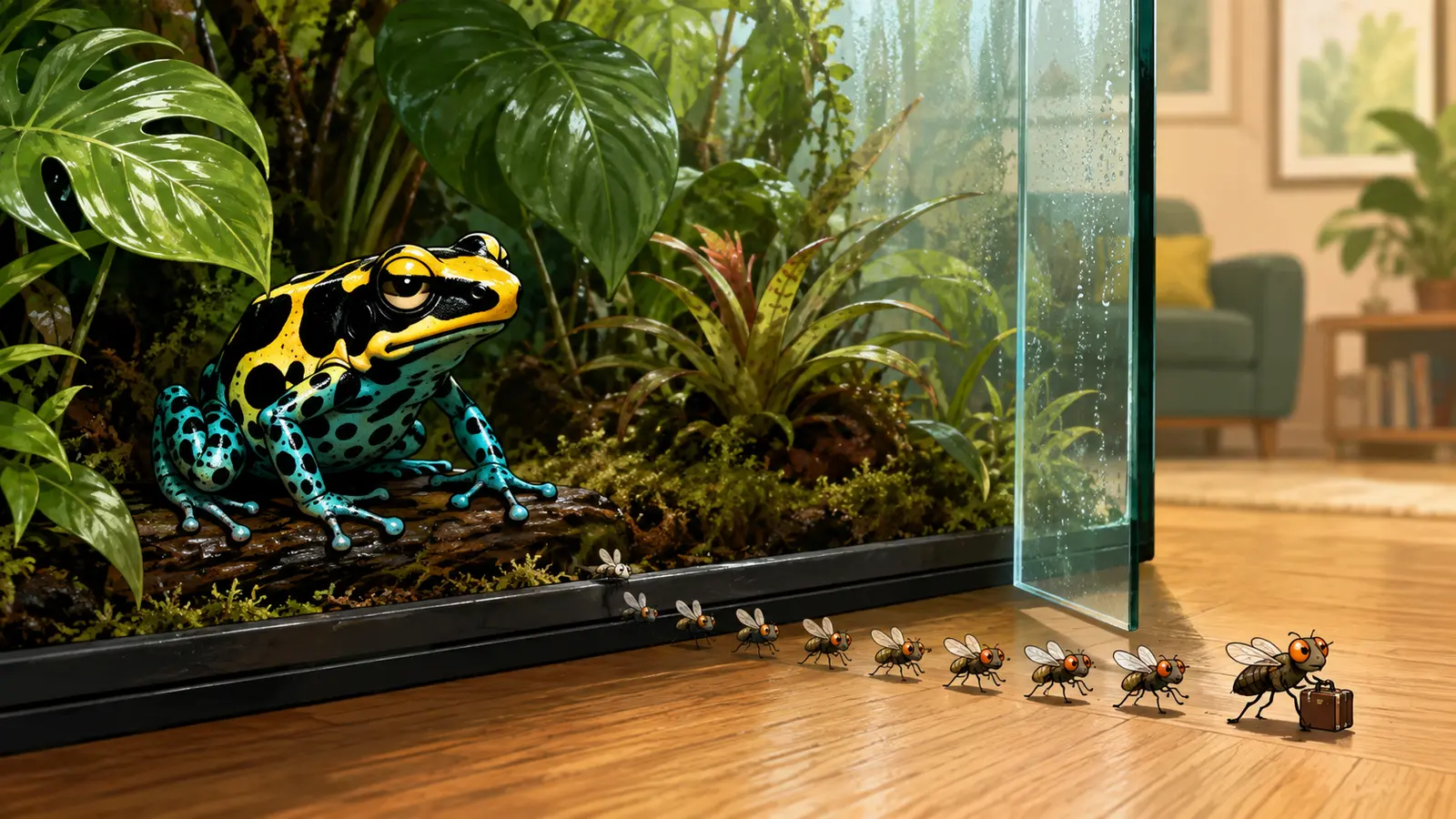
There is a particular moment every dart frog keeper eventually experiences: you sit down with a cup of tea and notice a fruit fly walking across the television. Then another appears near the window. By the third, somebody else in the house is questioning every decision that led to a rainforest being installed in the spare room.
Escaped feeder flies are annoying, but they are normally manageable. The solution is not to spray the room indiscriminately. It is to work out which small fly you actually have, stop the continuing supply, remove anything they can breed in and use simple traps where frogs cannot reach them.
Are they really escaped feeder fruit flies?
Do not assume every tiny fly near a vivarium came from your feeder culture. Correct identification matters because traps alone will not solve a population breeding in wet substrate or a dirty drain.
| Small fly | Typical appearance and behaviour | Likely source |
|---|---|---|
| Feeder fruit fly | Small tan or brown fly, often with visible red eyes; flightless strains mainly walk, hop and climb | Open culture, feeding cup, vivarium gap or spilled culture medium |
| Wild fruit or vinegar fly | Similar in shape but flies normally and gathers around fermenting fruit, recycling or drinks | Overripe produce, bottles, bins, food residue or drains |
| Fungus gnat | Darker, more slender and mosquito-like; often flies above soil or gathers at windows | Persistently wet potting mix, decaying roots or saturated vivarium substrate |
| Phorid fly | Small, often hump-backed, with a distinctive rapid scuttling run | Decaying organic material, drains, waste or contaminated cultures |
If the flies are dark and hovering over the substrate rather than marching out after feeding, start with the Frogfather guide to fungus gnats in dart frog vivariums. Treating every small fly as Drosophila can leave the actual breeding site untouched.
Find the source before setting traps
A trap catches adults. It does not close the culture lid, clean the banana from beneath a cabinet or seal the gap beside the vivarium door. If new flies keep emerging, trapping alone becomes a slightly depressing subscription service.
Check every culture
- Is the lid fully seated all the way around?
- Has the fabric or ventilation membrane split, lifted or become detached?
- Is culture medium smeared around the rim?
- Are flies gathering outside one particular cup?
- Has an old culture been left open or loosely bagged?
- Can wild flying Drosophila reach the cultures?
Inspect the feeding area
Look beneath culture shelves, vivarium stands and skirting boards. A spoonful of wet culture medium or a piece of fruit used to bait flies can support larvae out of sight. Clean spills promptly rather than relying on them to dry eventually.
Check ordinary household sources
Fruit bowls, empty beer or wine bottles, food recycling, compost caddies, mop heads and residues beneath appliances may attract wild fruit flies. If flies continue after all feeder cultures are secured, widen the search. The vivarium may simply be the most obvious suspect in the room.
Look inside the vivarium without dismantling it
A few uneaten feeder flies living temporarily inside a planted enclosure are not the same as a self-sustaining household infestation. However, excess food, permanently wet organic material and poor maintenance can support unwanted fly populations. The guide to cleaning and maintaining a bioactive vivarium explains how to intervene without stripping out a functioning ecosystem.
A safe plan for escaped fruit flies
The most effective approach combines source removal, physical capture and prevention. I use the following order because it reduces numbers without exposing amphibians to unnecessary chemicals.
Step 1: Secure cultures and vivariums
Close every lid and door before beginning. Move a damaged culture into a clean ventilated secondary tub or replace the lid. Do not place a sealed culture somewhere hot: fruit fly cultures still need ventilation.
Step 2: Remove breeding material
Bag failed cultures, spoiled fruit and contaminated waste before moving them through the house. Wipe culture residue from shelves and rims. Empty recycling and rinse bottles. This is the part that actually breaks the cycle.
Step 3: Vacuum visible adults
A handheld vacuum is remarkably effective for flies clustered on windows, walls or culture shelves. Keep the nozzle away from open vivarium ventilation and check that no frog is near an open door before you start. Empty the chamber outdoors or seal the contents in a bag.
Step 4: Use enclosed traps away from animals
Place traps near the household source or culture shelf, not inside the frog enclosure. They should be stable, covered and inaccessible to children and other pets. If a trap spills, clean it before opening a vivarium nearby.
Step 5: Repeat the source check
If numbers do not fall clearly after several days, assume a breeding source remains. Check drains, bins, plant pots and old cultures again, and reconsider whether the insect is actually a fungus gnat or phorid fly.
How to make an enclosed fruit fly trap
Fruit and vinegar flies are attracted to fermenting odours. An enclosed trap helps concentrate that attraction while reducing the chance of an accidental spill.
You will need
- a small jar or stable cup;
- a little apple cider vinegar;
- one small drop of ordinary washing-up liquid;
- cling film or a securely fitting lid that can be pierced;
- an elastic band if using cling film.
Method
- Add a shallow layer of apple cider vinegar to the container.
- Add one small drop of washing-up liquid and mix gently. This reduces surface tension.
- Cover the opening securely.
- Make a few small entry holes that flies can enter but cannot easily leave.
- Place the trap on a stable surface near the concentration of flies, outside every vivarium.
- Replace the bait when it becomes dirty or loses its attraction.
An enclosed trap is preferable to an exposed bowl in a frog room. Sticky cards can also catch adult flies, but they must remain completely outside animal enclosures. A dart frog, gecko or loose feeder animal can be seriously injured by contact with adhesive.
Why I would not spray the frog room
Aerosol fly killers, foggers, automatic dispensers, fragranced oils and improvised “natural” sprays are poor choices around open or ventilated amphibian enclosures. A product being plant-based, pet-friendly or available in a supermarket does not demonstrate that it is safe for a dart frog’s permeable skin.
UK Health and Safety Executive guidance requires pesticide users to follow the authorised label and take precautions to protect human health and the environment. General pet-pesticide guidance also recommends removing animals from indoor treatment areas. With a bank of ventilated vivariums, removing every animal and eliminating residue from every surface is far more difficult than people imagine.
For a nuisance that normally responds to sanitation, exclusion, vacuuming and enclosed traps, introducing airborne insecticide is an unnecessary welfare risk. If a wider household infestation genuinely requires professional pest control, tell the contractor that you keep amphibians before treatment is planned. Do not assume covering the front glass protects a ventilated enclosure.
What if the flies are escaping from the vivarium?
Flightless does not mean stationary. Feeder flies can climb silicone seams, cable routes, ventilation mesh and the tiny gaps around front-opening doors. They also seem to discover the one imperfect corner approximately three minutes after you do.
Inspect common escape routes
- the centre gap between twin doors;
- spaces beneath the doors or around hinges;
- cable and misting-tube entry points;
- coarse ventilation mesh;
- warped lids or conversion panels;
- feeding ports left open after use.
Do not solve a fly gap by sealing the vivarium completely. Dart frogs still require controlled fresh-air exchange. The aim is fine physical exclusion alongside suitable ventilation, not a stagnant glass box. Our practical guide to fly-proofing an Exo Terra or similar vivarium shows how to address door gaps, while the dart frog ventilation guide explains why airflow must be preserved.
Change where you release the flies
Tip flies towards a feeding leaf, ledge or station well away from the doors. Close the door as soon as the transfer is complete. A feeding station will not imprison every fly, but it reduces the number already standing at the exit when the enclosure is opened.
The simple dart frog feeding guide covers controlled presentation and sensible quantities. Overfeeding does not merely waste flies; it leaves more adults roaming the enclosure after the frogs have lost interest.
What if the flies are escaping from the cultures?
A sound culture needs a properly fitted lid with fine ventilation. If the lid fabric is damaged, replace it. Do not cover the culture with airtight cling film as a permanent repair because yeast activity and the insects themselves require gas exchange.
Use a secondary culture station
Store cultures on a washable tray inside a larger smooth-sided, ventilated container or shelving area. This will not replace secure culture lids, but it contains spills, makes escaped flies easier to see and simplifies cleaning.
Feed from a separate cup
Tap the required flies into a small dusting cup rather than holding the entire culture over an open vivarium. Add supplement lightly, swirl rather than violently shaking them, then feed. If something goes wrong, you have released one feed rather than an entire producing culture.
Retire failing cultures promptly
Very old, wet, foul-smelling or mite-heavy cultures belong in a sealed waste bag, not indefinitely at the back of the shelf. Stagger fresh cultures so that disposing of one never leaves the frogs without food. The Frogfather fruit fly culture media guide explains the balance required for reliable production.
If “flightless” flies begin flying
First establish whether wild flying Drosophila have entered the culture. A compromised culture should not be used to seed every new cup. Excessive warmth can also change performance in some flightless feeder strains, but not every flying insect near a warm culture represents genetic reversion. Isolate the suspect culture, start clean replacements from trusted stock and review storage temperature.
How to prevent escaped fruit flies becoming a household problem
- Keep cultures in one clean, easy-to-inspect area.
- Use properly fitted ventilated lids and replace damaged fabric immediately.
- Make new cultures on a washable tray and clean medium from every rim.
- Never leave culture cups open while answering the phone or working on another enclosure.
- Transfer one feed into a separate dusting cup.
- Feed an amount the frogs can reasonably consume.
- Release flies away from door gaps and close the vivarium promptly.
- Seal cable routes and door gaps without eliminating ventilation.
- Remove old cultures, fruit waste and recycling before they become breeding sites.
- Keep a simple enclosed trap ready during warm weather rather than reaching for an aerosol.
For keepers who want a more controlled culture-to-vivarium system, the Frogfather article on the automatic self-dusting fruit fly feeder explains the design principles. It is an optional tool, not a substitute for secure lids and sensible housekeeping.
Frequently asked questions
Can flightless fruit flies infest a house?
They can survive and reproduce if they reach suitable moist, fermenting material. A few loose flies normally disappear once cultures are secured and breeding sources are removed, but a continuing population means food residue, waste, a damaged culture or another source remains.
What is the safest way to catch escaped fruit flies near dart frogs?
Secure the source, vacuum visible adults and use a stable enclosed vinegar trap outside the vivarium. Keep all trap liquid and adhesive completely inaccessible to frogs and other animals.
Can I put a vinegar fruit fly trap inside the vivarium?
No. Vinegar and washing-up liquid traps are for the room, not the enclosure. A frog could contact or ingest the mixture, so the trap must remain securely outside the vivarium.
Can I spray fly killer in a room containing dart frogs?
I would not use aerosol insecticide, foggers, automatic dispensers or essential-oil sprays around ventilated amphibian enclosures. Remove the source and use physical control. If professional treatment is unavoidable, disclose the amphibians and agree a safe relocation and decontamination plan first.
Why are my flightless fruit flies suddenly flying?
Wild flying Drosophila may have entered the culture, or temperature may be affecting some flightless strains. Isolate the culture, do not use it to seed all replacements, obtain clean stock and review culture storage conditions.
How do I stop feeder flies escaping through vivarium doors?
Inspect the centre door gap, lower edge, hinges, cable entries and ventilation mesh. Use fine physical barriers or suitable gaskets while preserving controlled airflow, and release flies at a feeding station away from the doors.
Are the tiny flies in my vivarium definitely fruit flies?
No. Dark slender flies hovering over wet substrate are more likely to be fungus gnats, while rapidly running hump-backed flies may be phorids. Identify the insect and its breeding site before choosing a control method.
How long should it take to get rid of escaped fruit flies?
Adult numbers should fall noticeably within several days once the source is removed and traps are operating. If they do not, search again for fermenting residue, drains, plant compost, old cultures or a different fly species.