Husbandry & Evidence Review – 5 September 2026
This is Frogfather’s current canonical humidity guide. It treats relative humidity as one measurement within a changing enclosure and emphasises moisture gradients, ventilation, leaf litter and sensor placement rather than a permanent 80–100% RH target.
This article forms part of Frogfather’s Complete Dart Frog Care series. The complete cornerstone guide will be linked here once it has been published.
Dart Frog Humidity Guide (2026)
Humidity is one of the most discussed aspects of dart frog husbandry, but it is also one of the most misunderstood. New keepers often believe they should keep their vivarium at 100% humidity all day, every day. In reality, healthy rainforest environments naturally fluctuate throughout the day as temperatures rise, air circulates and water evaporates.
Rather than chasing a single humidity number, the goal should be to create a stable, bioactive ecosystem where humidity rises and falls naturally while still providing the damp conditions dart frogs require.
In our own Frogfather vivariums we focus on maintaining healthy environmental cycles rather than fixed readings. Well-planted enclosures with good ventilation, deep leaf litter and appropriate misting generally regulate themselves far better than constantly spraying the enclosure every few hours.
This guide explains the ideal humidity for dart frogs, how to measure it correctly, why ventilation is just as important as moisture and the common mistakes that lead to unhealthy enclosures.
Contents
- Why humidity matters
- Ideal humidity for dart frogs
- Why humidity should fluctuate naturally
- Humidity and ventilation
- How to measure humidity correctly
- How to increase humidity safely
- Signs humidity is too low
- Signs humidity is too high
- Common humidity mistakes
- Frequently Asked Questions
Why Humidity Matters
Dart frogs absorb water through their skin rather than drinking large quantities like many reptiles or mammals. Their skin is extremely specialised and must remain hydrated to function correctly.
Maintaining suitable humidity helps support:
- Healthy skin function.
- Normal hydration.
- Successful shedding.
- Egg development.
- Tadpole production.
- Plant growth.
- Microfauna activity.
- Overall bioactive stability.
Humidity doesn’t just benefit the frogs—it supports the entire miniature rainforest ecosystem. Healthy springtails, isopods, tropical plants and beneficial microorganisms all contribute towards maintaining stable environmental conditions.
For this reason, humidity should never be considered in isolation. It works alongside temperature, ventilation, substrate depth, leaf litter and planting density to create a balanced enclosure.
🐸 Frogfather Verdict
Don’t build a humid box. Build a healthy ecosystem that naturally produces humidity.
What Is the Ideal Humidity for Dart Frogs?
For many commonly kept dart frog species, humidity will usually cycle between approximately 70% and 100% over the course of a normal day.
Immediately after misting, humidity may briefly reach close to saturation before gradually reducing as fresh air enters the enclosure and water evaporates naturally.
This daily fluctuation is far more representative of rainforest conditions than trying to maintain one fixed percentage.
| Humidity | Interpretation | Action |
|---|---|---|
| Below 60% | Usually too dry | Investigate ventilation, misting and substrate moisture. |
| 60–70% | Acceptable for short periods | Monitor closely and ensure humidity recovers after misting. |
| 70–90% | Ideal daytime range | Suitable for most commonly kept dart frogs. |
| 90–100% | Expected after misting | Allow humidity to reduce naturally rather than remaining saturated all day. |
Remember that humidity varies considerably throughout different areas of the enclosure. Conditions beneath leaf litter, inside bromeliads and amongst dense planting are often considerably more humid than the air immediately behind the front glass.
Humidity Should Rise and Fall Naturally
One of the biggest misconceptions in dart frog keeping is that the enclosure should remain at 100% humidity throughout the day.
In reality, rainforest humidity constantly changes.
Morning misting raises humidity quickly before temperatures gradually increase and moisture begins evaporating from leaves, substrate and hardscape.
Throughout the day, airflow slowly replaces saturated air with fresher air while plants continue transpiring moisture back into the enclosure.
By evening, another misting cycle may begin the process again.
This natural rhythm is considerably healthier than permanently saturated, stagnant air.
A humidity graph often tells a much more useful story than one isolated reading because it demonstrates how the enclosure behaves throughout the day.
🐸 Frogfather Tip
Don’t chase one humidity number. Look for a healthy daily humidity cycle.
Humidity and Ventilation Go Hand-in-Hand
One of the biggest mistakes new dart frog keepers make is trying to increase humidity by blocking every ventilation opening. Although this often causes the hygrometer reading to rise, it usually creates stagnant air rather than a healthier environment.
Rainforests are humid because they are constantly exchanging air. Warm air rises, cooler air moves through the forest and evaporation continually replaces moisture. Replicating this gentle airflow inside a vivarium is far more important than simply trapping moisture behind glass.
Without sufficient ventilation, several problems can develop:
- Persistent condensation on the glass.
- Stale, stagnant air.
- Reduced oxygen exchange.
- Slower drying of surfaces.
- Increased mould growth.
- Poor plant health.
- Reduced visibility.
- An enclosure that remains permanently wet instead of naturally cycling.
A healthy dart frog vivarium should allow fresh air to enter while still retaining enough moisture for the frogs, plants and microfauna.
This is why enclosure design, planting density and airflow are just as important as the humidity reading itself.
🐸 Frogfather Verdict
High humidity is good. Stagnant humidity is not. Aim for humid air that is constantly and gently refreshed.
How to Measure Humidity Correctly
A hygrometer is one of the most useful tools you can own, but understanding what the readings actually mean is far more important than simply watching one number.
Many beginners look at the display once a day and assume that represents the conditions inside the vivarium. In reality, humidity changes constantly throughout the day.
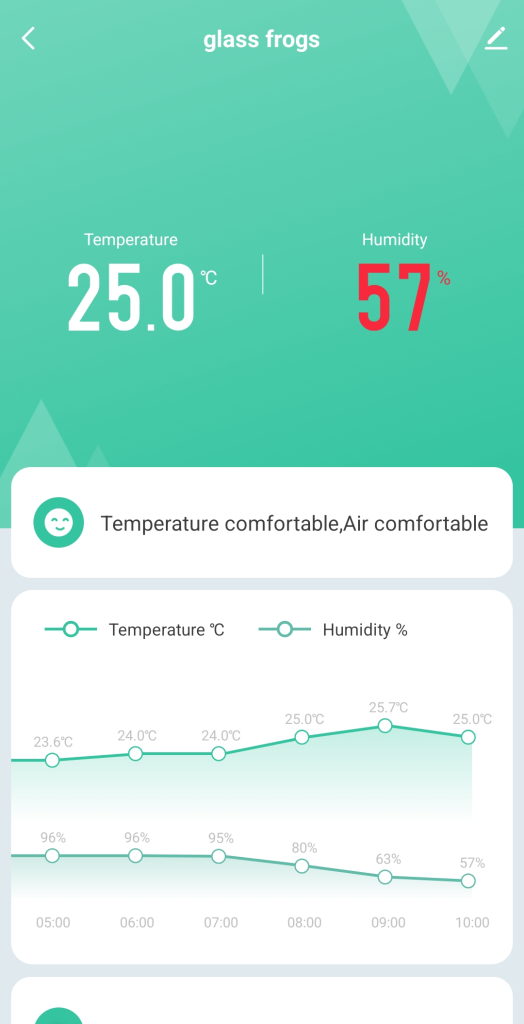
Modern Wi-Fi temperature and humidity monitors allow you to view historical data, showing exactly how your enclosure behaves after misting, during the warmest part of the day and overnight.
These trends provide far more useful information than a single reading.
Where should the hygrometer be positioned?
Avoid placing the sensor:
- Directly beneath a misting nozzle.
- Touching wet moss.
- Inside a bromeliad.
- Against the front glass.
- Beside a ventilation strip.
Instead, position it in the general area where the frogs spend most of their time, roughly halfway up the enclosure and away from direct water spray.
Use graphs rather than snapshots
The most useful information comes from observing humidity over time.
For example, a healthy vivarium may reach 95–100% immediately after misting before gradually falling into the 70–80% range during the day, only to increase again during the evening.
That natural cycle tells you far more than simply reading “82%” at lunchtime.
How to Increase Humidity Safely
If your enclosure is consistently too dry, the solution is rarely to spray more water every hour.
Instead, improve the vivarium so that it naturally stores and recycles moisture.
Increase live planting
Dense planting dramatically improves humidity stability by slowing evaporation and releasing moisture back into the air through transpiration.
Well-established tropical plants create a far more stable environment than bare glass and decorative plastic plants.
Use deep bioactive substrate
A deep substrate acts as a water reservoir beneath the surface, slowly releasing moisture over many hours rather than drying rapidly after each misting cycle.
Add leaf litter
Leaf litter traps moisture around the forest floor while providing essential habitat for springtails and isopods.
It also creates humid retreats that frogs naturally use throughout the day.
Maintain healthy microfauna
Springtails and isopods help recycle organic material, improving overall substrate health and supporting a balanced bioactive ecosystem.
Use automated misting
Automated misting systems generally produce far more consistent humidity cycles than irregular manual spraying.
A short morning mist followed by a heavier evening mist often provides a much more natural rhythm than repeated spraying throughout the day.
Don’t simply block ventilation
Closing vents might increase humidity temporarily, but it often does so at the expense of healthy air movement.
Whenever possible, improve the enclosure’s ability to retain moisture naturally instead of trapping stale air.
🐸 Frogfather Tip
Healthy humidity comes from plants, substrate and ecosystem design—not from constantly spraying the glass.
Signs Humidity Is Too Low
Dart frogs rely on consistently damp environmental conditions to remain hydrated and maintain healthy skin. If the enclosure remains too dry for prolonged periods, the frogs may begin to show behavioural and physical changes.
Low humidity often develops gradually, particularly during winter when central heating dries the air or during hot weather when evaporation increases.
Common signs of low humidity include:
- Frogs spending long periods hiding beneath leaf litter.
- Reduced daytime activity.
- Poor or incomplete shedding.
- Dry substrate and crisp leaf litter.
- Plants beginning to wilt.
- Springtail and isopod populations declining.
- Water bowls evaporating unusually quickly.
One dry afternoon is unlikely to cause problems in an otherwise healthy enclosure, but consistently low humidity should be investigated before it begins affecting the frogs or the bioactive ecosystem.
Signs Humidity Is Too High
High humidity is often misunderstood. Extremely high humidity immediately after misting is perfectly normal, but if the enclosure remains saturated all day with little air movement, problems can begin to develop.
The goal is not permanent condensation. The goal is a healthy enclosure that naturally dries slightly before the next misting cycle.
Possible signs that humidity remains too high include:
- Heavy condensation remaining on the glass throughout the day.
- Water collecting on leaves for many hours.
- Substrate becoming waterlogged.
- Persistent mould growth.
- Poor airflow.
- A stale smell inside the vivarium.
- Plants beginning to rot around the crown.
Many people assume that because dart frogs live in rainforests they require permanently soaking conditions. In reality, rainforest environments experience constant air exchange and natural drying between rainfall events.
Healthy humidity should feel fresh rather than stagnant.
Common Humidity Mistakes
Spraying constantly throughout the day
Frequent manual spraying often creates repeated spikes in humidity without allowing the enclosure to settle into a natural cycle.
Blocking every ventilation opening
Higher humidity readings do not necessarily mean healthier conditions. Fresh air exchange remains essential.
Using a single humidity reading
A hygrometer tells you what the humidity is now. A graph tells you what your enclosure has been doing all day.
Ignoring the plants
Healthy tropical plants are one of the best humidity regulators available. If the planting is struggling, the overall enclosure is often struggling too.
Using humidity as the only measure of success
Temperature, ventilation, substrate, lighting and planting all influence humidity. Looking at one figure in isolation rarely provides the full picture.
🐸 Frogfather Verdict
If you’re chasing one perfect humidity percentage, you’re probably solving the wrong problem.
Instead, build a planted bioactive ecosystem that naturally cycles between wetter and slightly drier periods throughout the day. The frogs will benefit from a far more stable environment, and you’ll spend much less time worrying about individual readings.
Frequently Asked Questions
What humidity do dart frogs need?
For many commonly kept dart frog species, humidity naturally cycling between approximately 70% and 100% throughout the day provides suitable conditions. Exact requirements vary between species.
Should dart frogs stay at 100% humidity all day?
No. Humidity should rise after misting and gradually reduce as water evaporates and fresh air enters the enclosure.
Can humidity be too high?
Yes. Permanently saturated air with poor ventilation can encourage mould, reduce air quality and create unhealthy conditions despite high humidity readings.
How often should I mist a dart frog vivarium?
This depends on enclosure size, ventilation, planting and room conditions. Automated misting systems generally provide more consistent results than irregular manual spraying.
Do live plants help increase humidity?
Yes. Healthy tropical plants release moisture through transpiration while also reducing rapid evaporation from the enclosure.
Does leaf litter affect humidity?
Yes. Deep leaf litter helps retain moisture around the forest floor while creating humid retreats for dart frogs and supporting beneficial microfauna.
Should condensation always be present?
No. Temporary condensation after misting is normal. Glass that remains permanently covered in condensation may indicate insufficient ventilation or excessive humidity.
How do I know if my hygrometer is accurate?
Use a quality digital hygrometer and compare long-term trends rather than relying on a single reading. Wi-Fi monitoring systems make this much easier.
Continue Reading
Humidity works together with temperature and enclosure size to create a stable environment.
Future supporting guides in this series will include:
- Dart Frog Ventilation Guide
- Dart Frog Lighting Guide
- Dart Frog UVB Guide
- Choosing the Best Dart Frog Misting System
- Live Plants for Dart Frogs
Summary
Humidity is far more than a percentage displayed on a hygrometer. Healthy dart frog vivariums experience natural daily fluctuations, with humidity rising after misting before gradually falling as fresh air circulates through the enclosure.
For many commonly kept species, a daytime range of approximately 70–90% with brief peaks close to saturation after misting provides suitable conditions. The aim should always be a stable, bioactive ecosystem rather than permanently saturated air.
Dense planting, deep substrate, healthy leaf litter, thriving microfauna and sensible ventilation all contribute towards maintaining humidity naturally. Rather than chasing one perfect number, focus on building an enclosure that behaves like a miniature rainforest.
When temperature, humidity and ventilation work together, dart frogs are far more likely to display natural behaviours, healthy skin, successful breeding and a thriving bioactive ecosystem.