
The Rubber Ducky isopod is an undescribed Cubaris species with a yellow, rounded head that looks like a toy duck from the front. It is a shy, slow-breeding animal that suits patient keepers with a warm, humid, well-ventilated enclosure. It costs more than common isopods because it grows slowly and has small broods. It is a good second or third species rather than a first. This guide covers how to identify one, what the setup needs, what to feed and how to breed them. It also covers what to expect from the price.
TL;DR
- Rubber Ducky isopods are an undescribed Cubaris from the hobby trade. They are harmless, and they do not bite or sting.
- They cost more because they breed slowly, are fussy about conditions and are in constant demand.
- Aim for a warm, humid burrow zone, a slightly drier surface, good ventilation, deep substrate and plenty of leaf litter.
- Calcium is not optional. Offer it permanently, and give protein sparingly.
- Be patient. Expect a colony to take months to establish, and do not fiddle with it.
Table of Contents
- What a Rubber Ducky isopod actually is
- Can you keep them as pets, and do they bite?
- Why Rubber Ducky isopods are so expensive
- Setting up the enclosure
- What to feed them
- Behaviour and breeding
- Common mistakes
- Our perspective
- Building the system around them
- Is a Rubber Ducky isopod right for you?
- FAQ
- Sources
What a Rubber Ducky isopod actually is
Cubaris sp. “Rubber Ducky” is a pet-trade name, not a formal species name. It is an undescribed species in the hobby, and many hobby Cubaris are undescribed or unidentified. The name comes from the face. Seen head-on, the pale yellow head and the darker marbled body look like a rubber duck with its bill. Care sheets describe a high-domed, globose body with a cream to ivory base and irregular brown marbling.
Like pill bugs, they have a round, segmented body and can roll up. That domed shape is why they look so different from the flat, grey woodlice in a British garden.
A note on identification
Colour alone is a weak guide. The British Myriapod and Isopod Group says colour can help identify woodlice, but some species vary, so identification relies on combinations of characters. That matters here. Several look-alike Cubaris circulate under different names, and a trade name does not guarantee what you are buying. Ask the seller how long they have bred the line and whether the animals are captive-bred.
There is also a bigger picture. Researchers writing in Conservation Biology note that the terrestrial isopod pet trade is expanding, and many traded species are not scientifically described and have unknown conservation status. Buying captive-bred stock rather than wild-collected animals is the responsible choice.
Can you keep them as pets, and do they bite?
Yes, you can keep them as pets, and no, they do not bite. Terrestrial isopods are widely kept as pets. Sowbugs and pillbugs are harmless to people and pets and do not bite or sting. Their mouthparts are built for chewing decaying plant matter. A Rubber Ducky will not do anything to your fingers except roll into a ball and sit very still.
They are not a handling animal, though. They spend long stretches burrowed, and they are easily stressed by a dry enclosure or by being dug up. Treat them as an animal to watch, not to hold.
Why Rubber Ducky isopods are so expensive
There are three reasons, and none of them is hype.
- Slow reproduction. Broods are small, and the young take a long time to mature. The species is relatively costly because of its slow reproductive rate, its specific environmental needs and constant hobbyist demand.
- Unforgiving husbandry. A dry spell or a hot spot can wipe out a small colony. Losses push up the price of what survives.
- Demand. The duck face made this isopod famous online. Popular, slow-breeding animals hold their price.
In the UK, expect to pay several times more per animal than for a common species such as a dwarf white or a Porcellio. Prices move with supply, so check a current listing rather than trusting any figure in an article. Buying a group rather than a pair gives you a better chance of a breeding colony. A single animal tells you nothing, and a lone female may never produce young.
Be cautious about very cheap listings. They are often a different, more common Cubaris sold under the name.
Setting up the enclosure
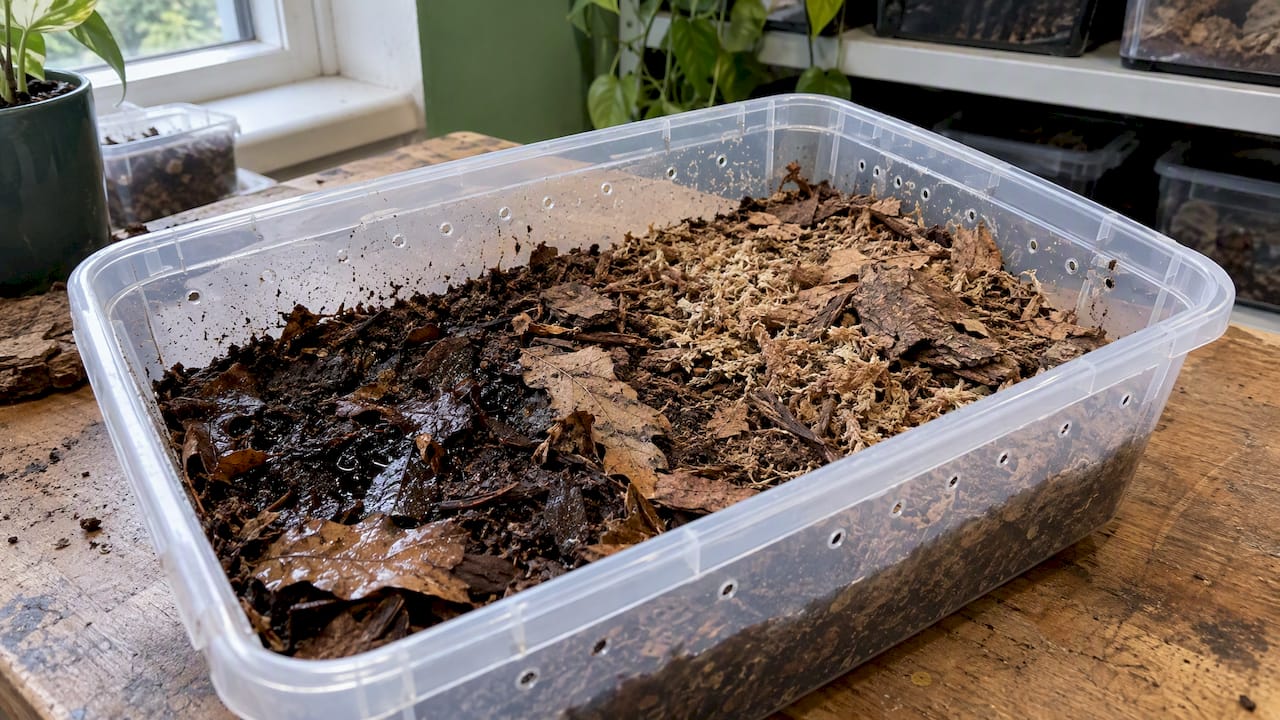
The aim is a gradient: a damp, humid burrow zone and a drier surface where the animals can choose. Most keepers use a plastic tub with ventilation, because it holds humidity better than a glass tank.
Substrate depth and mix
Use deep substrate. Around 8 to 10 cm of organic-rich substrate is commonly recommended, because the animals burrow and the lower layers hold moisture. A good mix includes:
- Chemical-free organic topsoil as a base
- Sphagnum or coco fibre to hold moisture
- Crushed limestone or a calcium source mixed through
- Rotting hardwood chunks, which double as food and hides
- A thick layer of leaf litter on top
Seeing a gap for a bioactive setup? Our isopod display article covers how layout and 3D-printed features give you control over humidity zones and hides.
Humidity and moisture
Woodlice lose water easily and rely on behaviour, staying in humid refuges, to avoid drying out. That is why the gradient matters. Keep-sheet advice for this species is 75 to 90% humidity with a damp, not dripping, moss area. Think damp like a wrung-out sponge, not flooded.
To keep it simple:
- Wet one end of the substrate and leave the other drier.
- Mist lightly rather than pouring water in.
- Check the lower layer with a finger. It should feel moist, not waterlogged.
- Never let the whole tub go bone dry or turn to mud.
Temperature
Most care sources place the comfortable range at 22 to 26°C, with stress and losses above about 28°C. Never heat from underneath, because it dries the burrow zone. In a British house, a room that stays around 20°C in winter may need gentle ambient warmth. A heat mat on the side of a rack, controlled by a thermostat, is a common approach. Always measure with a thermometer at substrate level, not by guessing.
Ventilation
Stale, wet air breeds mould and mites. Add ventilation holes, ideally at the top and sides, covered with fine mesh so springtails and isopods cannot escape. Good airflow with a moist substrate is the combination that works. Sealed and soggy is the combination that fails.
What to feed them
Rubber Duckys are detritivores. They feed mainly on decaying hardwood, white-rot wood and leaf litter, which should always be present. Keep this foundation constant.
Calcium
Isopods need calcium to build and renew their exoskeleton. Woodlice are naturally rich in it, and the BMIG notes that their calcium content was the basis of old medicinal uses. In captivity you supply it. Cuttlebone, crushed limestone or crushed eggshell left in the enclosure all work. Replace them when they are used up or mouldy.
Protein and fresh food
Offer protein sparingly. One or two small portions a week, such as dried shrimp or fish flakes, is the usual advice. Remove uneaten food within a day or two. Overfeeding fresh food is a common cause of mould and mite problems. Small amounts of vegetable are fine, but wood and leaf litter must do the heavy lifting.
A simple weekly routine
- Top up leaf litter and check wood chunks
- Check the calcium source is still there
- Add one small protein portion, and one more if the first was eaten quickly
- Re-moisten the damp end, and leave the dry end alone
- Look, then leave them alone
Behaviour and breeding
They are shy and reclusive and spend a lot of time burrowed. Often the only sign of a healthy colony is a surface scatter of juveniles at night and the odd adult under a piece of bark. Do not dig around to check on them. That is the quickest way to wreck the process by fiddling.
Breeding is slow. Because of slow growth and small broods, keepers should be patient and treat this as a second or third species. Things that help:
- Start with a group of at least five to eight animals, not a pair.
- Keep conditions stable. Swings in humidity or temperature cause more setbacks than any single mistake.
- Provide a deep substrate and lots of cover so females feel secure.
- Keep calcium and wood permanently available.
- Wait. Check the colony monthly rather than weekly.
If a colony stalls, tighten up the weak point first. That is usually moisture, ventilation or calcium, and one change at a time is better than five.
Common mistakes
- Too wet. Waterlogged substrate leads to mould, mites and drowned animals.
- Too dry. The surface can be drier, but the burrow zone cannot.
- Underfloor heating. It dries the lower layers and cooks the animals. Heat the air, not the base.
- Shallow substrate. They need depth to burrow and to hold moisture.
- No calcium. Moulting problems follow.
- Starting with one animal. You need a group.
- Buying them as a first isopod. A hardier species teaches you the basics at a lower cost.
Our perspective
We breed amphibians and we keep bioactive systems running, so we think about isopods as part of a living system as well as pets in their own right. Our view is simple. Rubber Duckys are a rewarding species, but they punish impatience.
If you are new to isopods, build experience first with a hardier species. Learn how your substrate behaves, how much water it really takes and how a colony responds when you leave it alone. Then move on to the slow, expensive species with the habits you have learned.
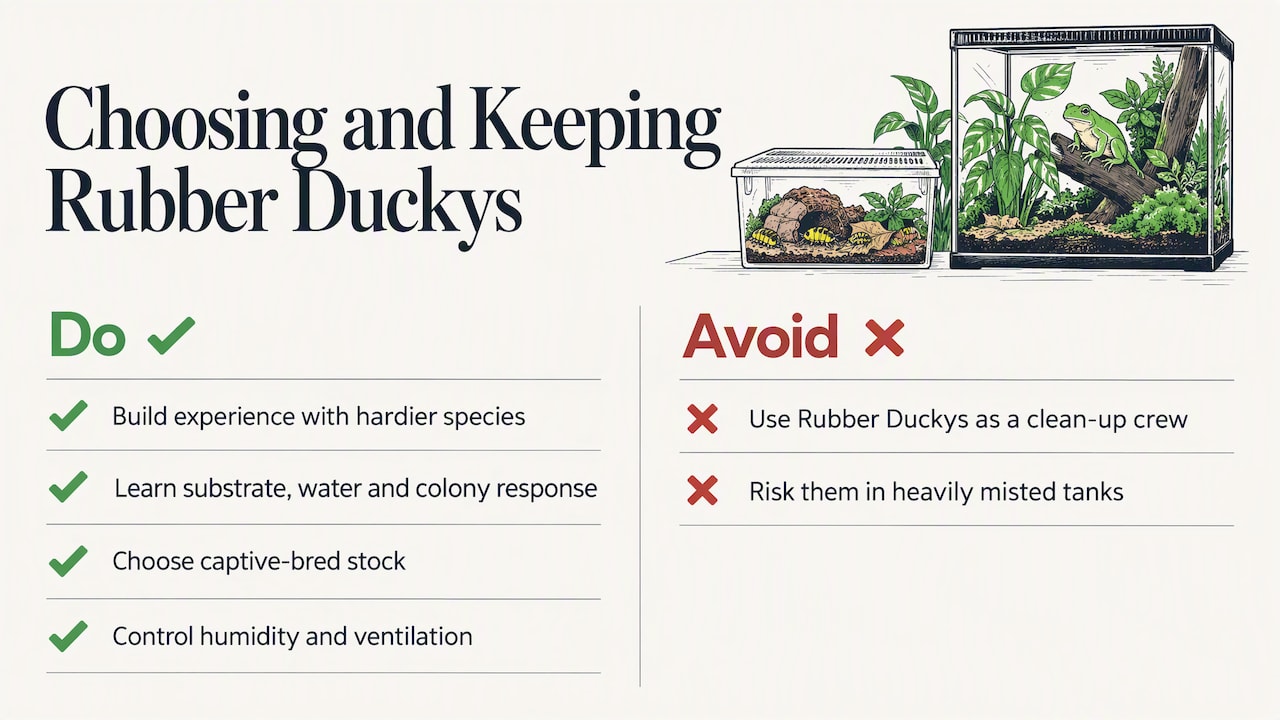
If you want isopods as a clean-up crew in a dart frog or tree frog vivarium, a Rubber Ducky is usually not the right choice. They are shy, slow to establish and costly to risk in a tank that will be misted heavily. A hardy, fast-breeding species does that job better. Keep the specialist isopods for their own display, where you control humidity zones and ventilation.
Always choose captive-bred stock from a seller who will tell you how long they have kept the line. It protects wild populations and gives you animals already used to captivity.
— User
Building the system around them
A stable isopod setup depends on the same things we use for frogs: a good substrate, plenty of leaf litter and the right feeders for the rest of the system. If you are also running a vivarium, we supply live cultures, leaf litter, bioactive supplies and accessories. For your frogs’ feeder insects, our All-In-One Vitamin & Mineral Dust and our fruit fly cultures and subscriptions keep the routine simple. If you want a purpose-built enclosure, we also build custom bioactive vivariums.

Is a Rubber Ducky isopod right for you?
They suit you if:
- You enjoy watching a colony develop over months
- You can keep a stable, warm room or a thermostat-controlled rack
- You are comfortable with a high price per animal and slow returns
- You have already kept a hardier isopod
They are probably not right if:
- You want a quick clean-up crew for a frog vivarium
- You want something to handle
- You cannot keep temperature steady through a British winter
If you also keep dart frogs, our guides on feeding dart frogs and supplementation follow the same principle: a steady routine beats clever tweaks.
FAQ
Why are Rubber Ducky isopods so expensive?
They breed slowly, have small broods and are fussy about conditions. Demand has stayed high since the duck-faced look went viral. Together these keep supply tight and prices well above common isopods.
Can you have a Rubber Ducky isopod as a pet?
Yes. Terrestrial isopods are kept as pets, and they are harmless. They are best as a display animal for patient keepers, not as a first species.
Can Rubber Ducky isopods bite?
No. Isopods such as pill bugs and sowbugs do not bite or sting people or pets. Their mouthparts are made for chewing decaying plant material.
How many should I buy to start a colony?
Buy a group, not a single animal. Five to eight gives you a reasonable chance of both sexes. Because they breed slowly, a larger starter group often saves time.
What temperature and humidity do they need?
Commonly quoted guidance is about 22 to 26°C, with a damp burrow zone and a drier surface. Avoid anything above about 28°C, and never heat from underneath.
Sources
- Cubaris (Wikipedia)
- Rubber Ducky Isopod Care Sheet (VivKeeper)
- Rubber Ducky Iso Species Guide (Furry Critter Network)
- Woodlice, British Myriapod and Isopod Group
- Society for Conservation Biology, 2025
- Sowbugs & Pillbugs, University of Kentucky Entomology
- Rubber Ducky Isopods: Care, Feeding & Bioactive Setup Guide (Krawlo)
- Rubber Ducky Isopod Care: Humidity, Limestone & Diet Guide (Plantsolve)
- Rubber Ducky Isopod Care Guide (Vivipedia)
- Isopods: Care, Temperament & Health (Pawholt)
Written with BabyLoveGrowth’s AI writer