Description
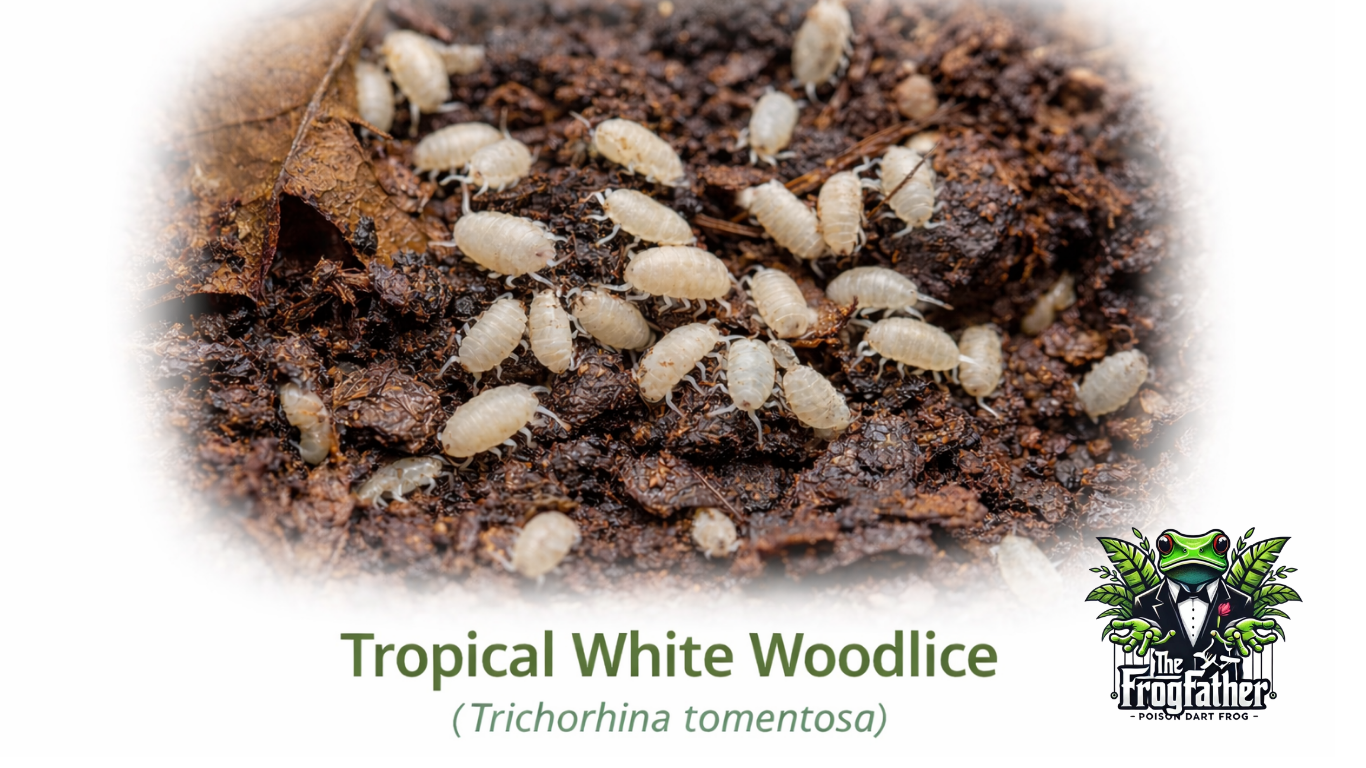
Tropical White Woodlice (Trichorhina tomentosa) – Live Culture
Tropical White Woodlice are small terrestrial isopods widely maintained in humid bioactive vivariums. They spend much of their time beneath leaf litter and within the upper substrate.
Role in a bioactive enclosure
- Feed on decaying plant material and other suitable organic matter.
- Fragment leaf litter and contribute to decomposition and nutrient cycling.
- Can form persistent populations when temperature, food, moisture and refuges are suitable.
- May occasionally be eaten by suitable small insectivores.
We have removed claims that they maintain a “balanced environment”, guarantee healthier substrate or make a system self-sustaining. Terrestrial isopods contribute strongly to litter decomposition, but their effect depends on the whole system and they do not eliminate the need to remove inappropriate or excessive waste.
Establishment
Introduce them into suitable moist substrate beneath leaf litter and provide appropriate refuges and food. Avoid uniformly saturated conditions: terrestrial isopods need access to moisture but also benefit from appropriate gas exchange and microclimate variation.
Population growth varies with husbandry and should not be assumed to continue indefinitely.
Isopod & Evidence Review
Last reviewed: 5 September 2026
Terrestrial isopods are well-established detritivores and can contribute to leaf-litter fragmentation, decomposition and nutrient cycling. That does not mean a colony will remove every form of animal waste or make an enclosure maintenance-free. Population performance depends on food, moisture, temperature, refuge, substrate and the species concerned.
Evidence & further reading
- Zimmer – Nutrition in terrestrial isopods: an evolutionary-ecological review
- Hassall et al. – terrestrial isopods and leaf-litter decomposition