
Description
Amazon Milk Frog Tadpoles – Trachycephalus resinifictrix
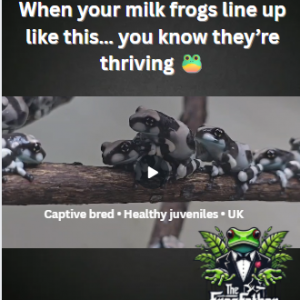
Captive-bred Amazon Milk Frog tadpoles for keepers prepared to manage an aquatic larval stage followed by the transition to an arboreal froglet.
Husbandry
- Water: use clean, conditioned water with chemistry appropriate to the rearing system. Avoid sudden changes in temperature or water chemistry.
- Feeding: offer a suitable varied tadpole diet in small portions and remove excess food before it deteriorates. Tadpole feeding ecology differs markedly among amphibian species, so one generic “fish flake” recipe should not be treated as nutritionally complete.
- Temperature: Frogfather has successfully reared Milk Frog tadpoles in warm tropical-room conditions. We have removed the claim that 24–27°C is a proven universal optimum or that warmer water should be used simply to accelerate metamorphosis.
- Aeration: gentle water movement/aeration can be useful in suitable setups; avoid strong flow that exhausts or traps larvae.
Group housing
Earlier copy said keepers should buy several because the tadpoles are “social”. We have removed that claim. Tadpoles may be reared in groups where water volume, feeding and stocking density are appropriate, but grouping should not be justified as a social requirement. Density can affect growth, competition, water quality and development in amphibian larvae.
Development time
Metamorphosis timing varies with individual, temperature, nutrition and husbandry. We do not guarantee “a few weeks” or a fixed 6–10 week schedule.
Metamorphosis
As forelimbs emerge, ensure a secure, gently sloping or floating exit from the water so the froglet cannot drown. Prepare the terrestrial grow-out enclosure before this stage. Newly metamorphosed frogs need appropriate small live prey and environmental conditions; a bioactive tub is a husbandry tool, not a guarantee of stress-free development.
Beginner wording
We no longer describe raising Milk Frog tadpoles as automatically “easy”, “hardy and forgiving” or suitable for every first-time keeper. The project is very achievable with preparation, but live amphibian larvae are sensitive to water quality and metamorphosis is a significant husbandry transition.
Live animal note: availability and dispatch are subject to animal condition, weather and suitable welfare-compliant transport arrangements.
Tadpole Husbandry & Evidence Review
Last reviewed: 5 September 2026
Tadpole diets, water chemistry, temperature tolerance, social behaviour and development rates vary substantially among amphibian species and through larval development. Fixed recipes and development times on this page are therefore presented only as Frogfather husbandry starting points where relevant, not universal biological requirements.
Published amphibian work also shows that water composition can influence larval development. Untreated reverse-osmosis water should not automatically be assumed preferable simply because it is pure; where RO is used, use a suitable reconstituted/remineralised approach for the species and rearing system.
Evidence & further reading
- Pryor (2014) – tadpole nutritional ecology and digestive physiology
- Ferrie et al. (2014) – Nutrition and Health in Amphibian Husbandry
- Higgins et al. (2021) – water composition, supplementation and spindly-leg syndrome in Andinobates geminisae