
Description
Frogfather New Frog Care Package
A practical starter bundle containing live microfauna, supplementary livefood, feeder supplement, a hide and an optional clay dish.
This package brings together products we commonly use at Frogfather. It is intended to support an established, species-appropriate husbandry plan rather than act as a substitute for correct enclosure conditions, quarantine, feeding, water quality or veterinary care.
Included in the package
- Yellow springtails – useful microfauna for bioactive enclosures and as very small incidental prey.
- White springtails – additional microfauna for decomposition and bioactive substrate systems.
- Tropical white isopods (50g) – detritivores commonly used in bioactive vivaria.
- Grindal worm starter culture – supplementary livefood where appropriately sized for the species being kept.
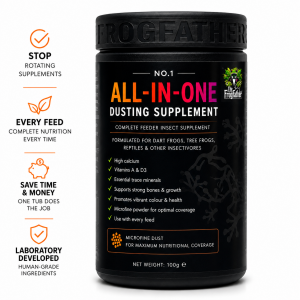
- 10g Frogfather All-in-One Mineral Dust – for lightly coating suitable feeder insects immediately before feeding.
- 10g Dart Frog Clay Bath – optional natural-clay husbandry feature.
- Dart Frog Hide – provides additional cover and retreat opportunity.
Supplementation
Many cultured feeder insects are poor sources of calcium and may be deficient in other micronutrients. Supplementation is therefore an important part of captive amphibian nutrition. Exact requirements vary, however, and no single supplementation frequency has been scientifically established as optimal for every dart frog species and life stage.
At Frogfather we use our All-in-One powder as our routine single-powder system. This is our practical husbandry approach rather than a claim that the same schedule is scientifically proven for every amphibian.
About the clay
The clay provides an optional damp natural-clay surface. We do not claim that captive dart frogs require clay baths, that they self-dose minerals according to physiological need, or that clay treats hydration, skin or mineral disorders. Those benefits have not been established by suitable controlled evidence.
Using the package
Use each component according to the needs of the species and enclosure. Maintain appropriate temperature, moisture, ventilation, water quality and feeder provision, and seek veterinary advice for signs of illness.
Husbandry & Evidence Review
Last reviewed: 5 September 2026
This product guidance has been reviewed against relevant peer-reviewed amphibian nutrition literature. Product-use observations are identified separately from claims supported by published evidence.
Sources & further reading
- Ferrie et al. – Nutrition and Health in Amphibian Husbandry
- Clugston & Blaner – Vitamin A metabolism and actions in amphibians