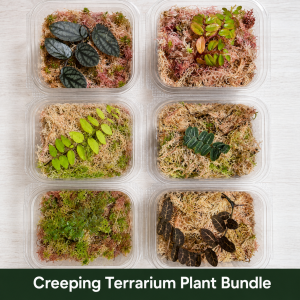


Description
Dragon’s Tongue – Strobilanthes sinuata
A rooted tropical foliage plant with narrow rippled leaves, green upper surfaces and purple/burgundy undersides.
Botanical name
Strobilanthes sinuata is the currently accepted name used by Kew’s Plants of the World Online. Hemigraphis repanda is treated there as a synonym.
Growing conditions
- Light: bright filtered to medium indirect light.
- Moisture: keep evenly moist but avoid permanently saturated roots.
- Humidity: performs well in humid planted enclosures; one fixed RH value is not necessary.
- Airflow: maintain useful ventilation, particularly in enclosed displays.
- Temperature: warm indoor/tropical conditions are generally suitable; adjust from plant response rather than treating 20–28°C as a precise universal optimum.
Vivarium use
The upright foliage can provide cover, visual barriers and colour contrast. We no longer describe the plant as automatically suitable for every dart frog, tree frog, gecko or reptile enclosure. Suitability depends on enclosure size, plant placement and the intended animals.
Residue preparation
Before use with sensitive amphibians, inspect and prepare the plant to minimise nursery fertiliser, pesticide or propagation residues. Plant identity alone is not evidence of “amphibian safety”.
Growth
Rooted stock can provide a useful starting point, but establishment speed and eventual height depend on light, root condition, watering, temperature and pruning.
Plant & Vivarium-Use Review
Last reviewed: 5 September 2026
Plant performance depends on the individual species or cultivar, root condition, light, substrate, watering, ventilation and temperature. Frogfather therefore avoids presenting one fixed relative-humidity range as a universal requirement or calling a plant automatically “safe” for amphibians simply because the species is commonly used in vivariums.
For sensitive amphibian enclosures, plants should be inspected and prepared to minimise pesticide, fertiliser and propagation-product residues before introduction.
Taxonomic source
Kew Plants of the World Online – Strobilanthes sinuata