
Husbandry & Evidence Review – 6 September 2026
Fruit-fly media claims are kept within what culture husbandry supports. Methylparaben/Tegosept is concentration-dependent, and neither preservatives nor a recipe can guarantee mould-free or nutritionally complete flies.
If you keep dart frogs, mantids, jumping spiders, or any other insectivorous pets, you’ll know that fruit flies are a staple live food. But buying premade cultures every week quickly adds up. That’s why many keepers search for the best fruit fly media mix DIY recipe — a reliable formula that produces large, long-lasting cultures of flies for feeding.
This article describes a Frogfather-style DIY fruit-fly media recipe. Ingredient choice can influence culture productivity, but no recipe guarantees mould-free cultures, high output or nutritionally complete feeders.
Why Make Your Own Fruit Fly Media?
Homemade media offers several benefits:
- Cost-effective – bulk ingredients are far cheaper than constantly buying cultures.
- Customisable – you can tweak nutrition for your frogs, isopods, or reptiles.
- Reliable – no guessing what’s in the mix; you control it.
- Less waste – one large bag of oats or mashed potato flakes lasts dozens of cultures.
Plus, by using a proven DIY mix, you can avoid common culture crashes caused by mould, poor nutrition, or drying out.
The Best Fruit Fly Media Mix DIY Recipe
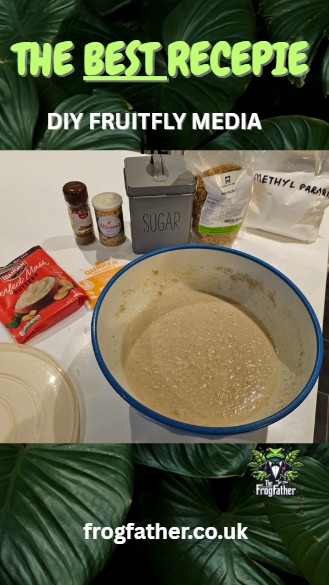
Here’s the base recipe we recommend at Frogfather:
- Rolled oats – 1 cup (finely ground or blitzed in a blender)
- Mashed potato flakes – 1 cup
- Sugar – ½ cup
- Bee pollen – 2–3 teaspoons
- Yeast (Allicin’s or brewer’s yeast) – 2 tablespoons
- Methylparaben – ½ teaspoon (dissolved in hot water)
- Ground cinnamon – a pinch
- Warm water – enough to create a thick porridge-like consistency
Optional but recommended: excelsior (wood wool) or wood shavings to give larvae extra climbing and pupating space.
Why These Ingredients Work
Rolled oats / potato flakes / sugar / yeast: provide carbohydrate/fermentation substrates for the culture; productivity depends on the complete recipe and conditions. Bee pollen: optional ingredient; it does not guarantee nutritionally complete flies. Methylparaben (Tegosept): a preservative used in many Drosophila media to suppress microbial growth; effects are concentration-dependent. Cinnamon: sometimes used in hobby media, but Frogfather does not rely on it as a proven antifungal/antibacterial control at unspecified concentrations.
Step-by-Step Method
- Mix dry ingredients – Combine oats, potato flakes, sugar, cinnamon, yeast, and bee pollen.
- Add preservative – Dissolve methylparaben in hot water and stir in.
- Add warm water – Stir until the mix is thick, like porridge.
- Let it activate – Leave the mix covered for 12–20 hours. This allows the yeast to activate and the mix to “rise,” ensuring strong culture growth.
- Prepare your culture pot – Add a layer of media to the bottom.
- Add excelsior or wood shavings – This provides surface area for larvae to climb and pupate.
- Seed the culture – Add about 50 adult fruit flies to start the colony.
- Cover securely – Use a vented lid (see our <a href=”[insert URL]”>3D Printed Culture Lids</a> for escape-proof options).
Temperature & Growth Control
- Keep cultures within a range suitable for the fly strain and production goal; 20–22°C is one practical Frogfather range, not a universal optimum.
- To slow down culture growth and extend lifespan, drop the temperature slightly.
- To speed up production and get faster cycles, keep them towards the higher end of the range.
With good rotation (starting a new pot every 1–2 weeks), you can maintain an endless supply of flightless fruit flies.
Tips for Success
- Keep cultures out of direct sunlight.
- Don’t overwater — soggy media collapses quickly.
- Use measured preservatives only where they form part of the chosen recipe. Cinnamon is optional and neither ingredient guarantees mould prevention.
- Cross-seed new cultures before old ones crash.
Conclusion
Making your own fruit fly media can be cost-effective and supports a culture rotation, but it does not ensure a continuous supply or nutritionally complete feeders.
Use several staggered cultures and appropriate temperature management to reduce the risk of running out; mites, contamination, heat and failed cultures can still interrupt supply.