
Husbandry & Evidence Review – 6 September 2026
Winter guidance now treats temperatures and photoperiod as species/setup-specific rather than fixed universal numbers.
If you keep dart frogs in the UK, you already know — our weather’s about as stable as a frog on a trampoline. One minute it’s balmy, the next you’re pulling on a jumper and wondering if you can see your breath indoors.
For us humans, it’s mildly annoying. But for your dart frogs? These sudden temperature dips can spell real trouble. Let’s dig into how UK seasonal changes affect your frogs, what you need to be watching for, and how to get your vivs winter-ready.
Why UK Autumn and Winter Are Tough on Dart Frogs
The UK’s not exactly known for tropical heatwaves, but it’s the swings in temperature that catch people out — especially in autumn. You’ll get mild days followed by frosty nights, and central heating that kicks in sporadically, drying out the air like a lizard under a heat lamp.
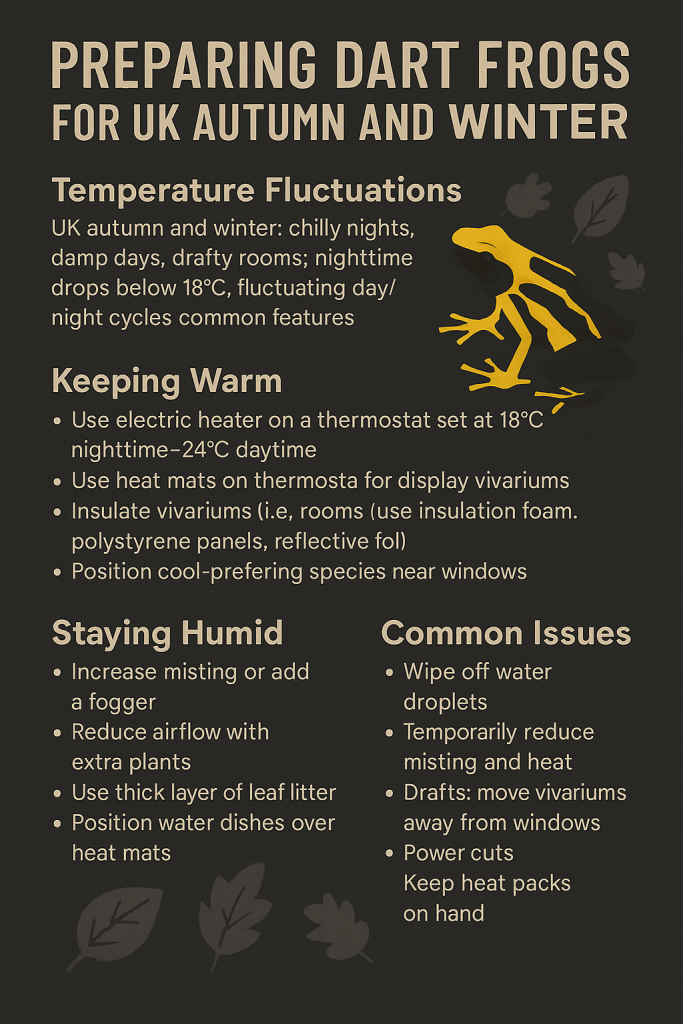
Many commonly kept dart frogs are maintained successfully in the low-to-mid 20s °C, but day/night needs vary by species/locality. Avoid using 22–26°C and an 18°C floor as universal rules; use the current temperature guide and measure the actual enclosure.
Common Problems When the Cold Rolls In
- Temperature Drops: Frogs slow down, eat less, and stress out. Long-term cold can lead to respiratory issues and even death.
- Humidity Plummets: Central heating = desert vibes. Vivariums dry out fast, especially without a misting schedule.
- Condensation Chaos: Cold rooms + warm vivs = foggy glass, water pooling, and sometimes mould.
- Power Cuts: Winter storms knock out the grid more often than you’d like. No power = no heat = big problem.
Your UK Dart Frog Winter Checklist
1. Heat Mat or Cable + Thermostat
Don’t rely on ambient room temperature. Use a thermostat-controlled heat mat or cable, ideally beneath or behind your viv. Keep probes inside the viv at frog level, not just on the glass.
🐸 Tip: If you’re running multiple vivs, consider a multi-zone thermostat to keep things tidy.
2. Insulate the Room, Not Just the Viv
You can wrap your vivarium in foam board or insulating film, sure. But the best solution? Make the room frog-friendly.
- Draught excluders on doors
- Thermal curtains
- Portable oil-filled radiators (safe and steady)
- Reflective backing on vivs to reduce heat loss
In my main frog room, I use a small electric heater hooked up to a thermostat, set to 24°C during the day and 18°C overnight. It keeps the room consistent and toasty without needing to tweak every viv individually. The house is well insulated, which helps massively.
Downstairs, the display vivs run off thermostat-controlled heat mats — simple but effective, especially when the room itself stays reasonably warm.
3. Humidity Control is a Must
Buy a hygrometer (or five). Daily misting becomes essential in dry seasons. If you use an automated misting system like MistKing or Exo Terra Monsoon, double-check it’s working and has backup water.
🌿 Pro tip: Add more leaf litter and moss — it holds moisture better and buffers the drying effects of indoor heating.
4. Lighting Adjustments
Keep a consistent day/night cycle appropriate to the species and plants. A 12-hour photoperiod is a common practical choice, not a universal winter requirement.
Some keepers add a slight seasonal shift in photoperiod to mimic natural changes, but don’t go overboard. You’re not trying to trigger a hibernation response.
5. Plan for Power Cuts
It’s rare, but it happens. Have a backup plan:
- Portable battery-powered heat packs
- Insulated blankets to wrap vivs temporarily
- Thermos-style flasks for warm water bottles (outside viv, obviously)
⚡ Keep torches and frog-safe heat sources in a labelled box so you’re not scrambling in the dark.
Things That Catch People Out
- Viv Near a Window? That’s now a cold trap. Move it or insulate.
- Floor Placement? Cold air sinks. Elevate vivs off the ground if possible.
- Dehumidifier in the Room? Bad idea — that’s your humidity gone.
- Radiators Nearby? Great, but watch for hot spots and uneven heating.
That said, not every dart frog species wants the same cosy conditions. My Ameerega pepperi, for example, actually prefer things a little cooler. Their viv backs onto a window, which is blacked out and insulated during summer to block heat — but come winter, I remove that heat shield. The natural chill from the window keeps their environment right where they like it.
It’s a good reminder that while general guidelines are helpful, each species has its quirks. Get to know your frogs.
Real Talk: What I Do in My Frog Room
I’ve got a south-facing frog room with shocking insulation. Every October, I:
- Use thermostatically controlled room/enclosure heating only where needed, with targets chosen for the actual species rather than a universal 24°C/18°C programme.
- Add fleece covers behind all vivs
- Chuck a bowl of water on the radiator to keep ambient humidity up
- Check every misting nozzle and refill the reservoir
- Run through a simulated power cut drill (yes, really)
Downstairs, the vivs run their own little thermostat-controlled heat mats, and the room stays warm enough that they only kick in when absolutely needed.
Honestly, it’s more prep than my own winter wardrobe — but it’s worth it. The frogs stay active, breeding continues, and nobody ends up curled in a mossy corner looking miserable.
Final Thoughts? Nah. Just Stay Warm and Watch Your Frogs.
This isn’t about panicking every time the forecast shows a snowflake — it’s about consistency. UK weather is unpredictable, but your vivarium doesn’t have to be.
Stay one step ahead, monitor your temps and humidity like a hawk, and your dart frogs will thank you. Probably not out loud. But still.