
Description
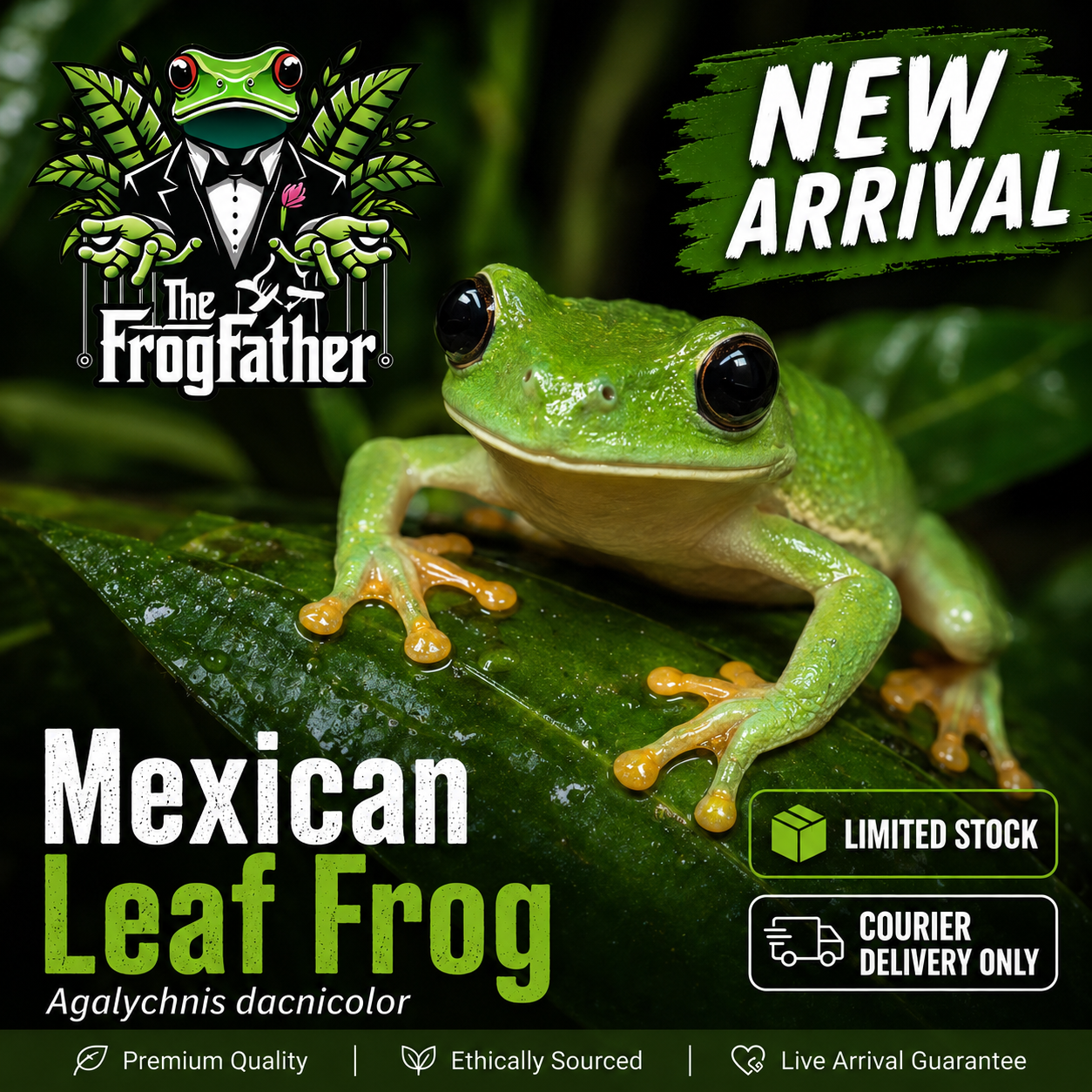
Mexican Leaf Frog – Agalychnis dacnicolor
Limited stock available. Specialist courier delivery only.
The Mexican Leaf Frog, Agalychnis dacnicolor, is a large and impressive arboreal frog from Mexico. It is sometimes referred to as the Giant Mexican Leaf Frog and was previously known under the genus Pachymedusa. This is a striking green tree frog with large eyes, strong climbing pads and a calm, confident look that makes it a brilliant display species for the right keeper.
This species is far larger and chunkier than many of the smaller tree frogs and glass frogs that occasionally appear in the hobby. Care sheets commonly place adult size around 7–12 cm, with a potential lifespan of around 7–10 years when kept properly.
Mexican Leaf Frogs are best kept in a spacious, well-ventilated, planted arboreal vivarium with strong climbing branches, broad leaves and stable temperatures. They are nocturnal, so they are usually most active in the evening and overnight. During the day they may sit quietly among foliage or on suitable perches.
In captivity, they should be fed appropriately sized live insects, with sensible supplementation and careful attention to hydration, cleanliness and enclosure stability. They are not a frog to rush into a bare or newly set-up vivarium. A mature, planted setup gives them better cover, better humidity stability and a more natural environment.
Please note: these are live amphibians and are available by specialist courier delivery only. Delivery will be arranged around suitable weather, courier availability and animal welfare.
Key points
- Species: Agalychnis dacnicolor
- Common names: Mexican Leaf Frog, Giant Mexican Leaf Frog
- Price: £80 each
- Stock: Limited availability
- Delivery: Specialist courier delivery only
- Experience level: Intermediate amphibian keepers
- Setup: Spacious, planted, arboreal vivarium
Climate & Husbandry Review
Last reviewed: 5 September 2026
Temperature, moisture and ventilation requirements are species- and life-stage-specific. Relative humidity is useful for monitoring trends but should not be treated as a universal single-number target: enclosure airflow, substrate and leaf-litter moisture, access to wet and drier microhabitats, temperature and sensor position all affect the conditions experienced by the animal.
Avoid prolonged overheating, stagnant saturated conditions and rapid environmental swings. Where additional heat is required, provide controlled gradients and monitor temperature at animal level. Frogfather’s own misting schedules are practical husbandry methods rather than universal biological requirements.
Evidence & further reading
- St Claire et al. – The husbandry and care of dendrobatid frogs
- Pough – Amphibian Biology and Husbandry