Description
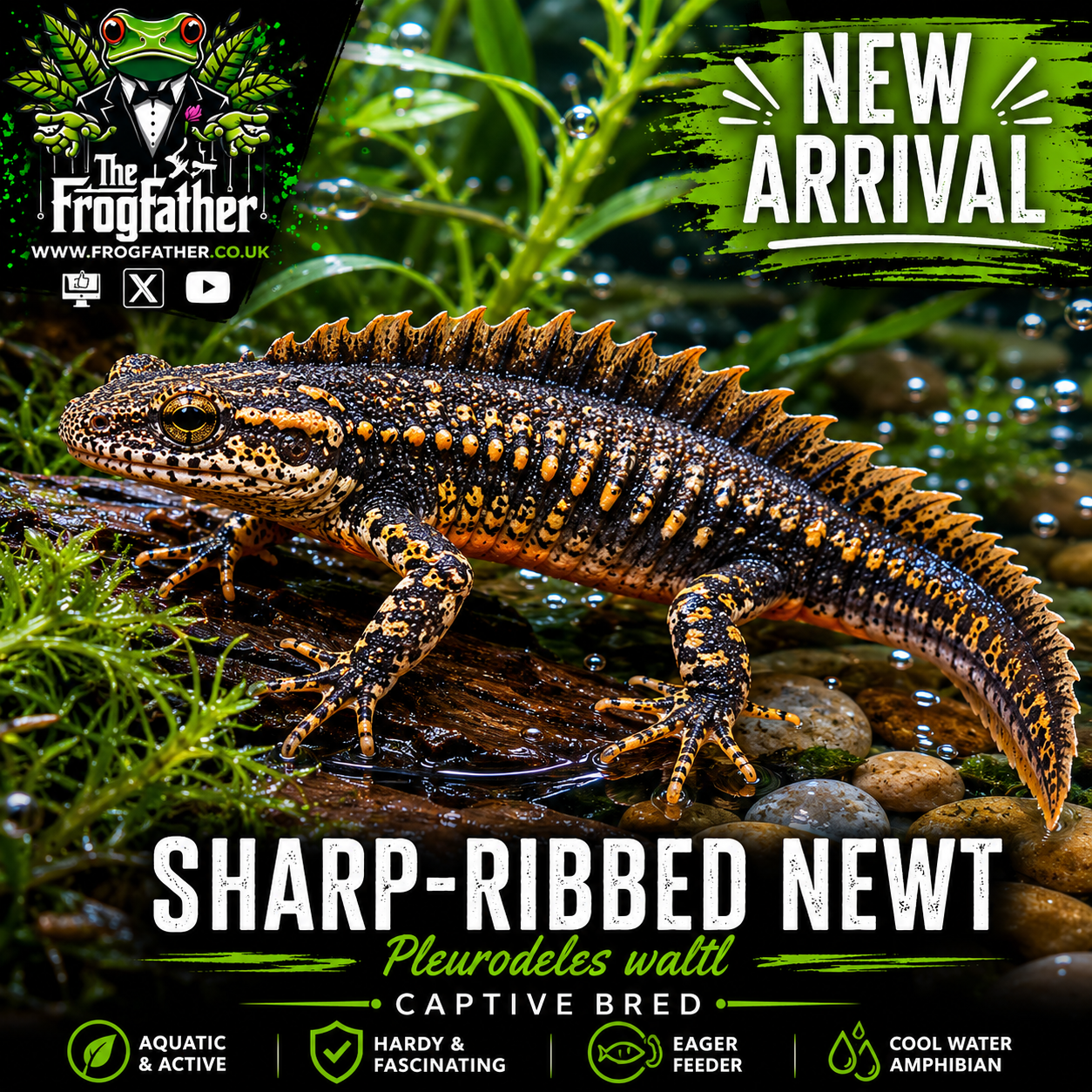
Spanish / Sharp-Ribbed Newt – Pleurodeles waltl
Captive-bred Iberian/Spanish ribbed newts, a large predominantly aquatic salamandrid species widely maintained in laboratory and specialist captive collections.
Beginner/hardiness wording corrected
We have removed claims that this is automatically one of the “hardiest” aquatic newts or an “ideal introduction” for every beginner. Their aquatic lifestyle makes observation straightforward, but good water quality, correct temperature and secure housing remain essential.
Housing
Provide a spacious aquarium with high water quality, secure cover, submerged refuges and appropriate aquatic planting/hardscape. Group housing can work when space and feeding access are adequate, but monitor individuals for competition or injury.
Temperature
This is a cool-water species. Frogfather previously listed 16–24°C as a general range; avoid treating the upper end as an ideal target. Published laboratory husbandry protocols provide species-specific management and support avoiding unnecessary heat.
Feeding
Offer a varied aquatic carnivore diet such as appropriately sized earthworms and other suitable aquatic/invertebrate foods. We have removed the claim that variety automatically produces “vibrant colouration”; diet quality should be judged by body condition, growth and health rather than cosmetic colour alone.
Defensive mechanism
Pleurodeles waltl has a remarkable defensive system involving the ribs and specialised skin/gland structures. We have softened the old phrase “toxin-coated glands”: studies demonstrate concentrated granular glands containing proteinaceous secretions thought to be repellent or poisonous, but the mechanism is more complex than a simple coating of each rib with toxin.
Handling
Handle only when necessary. Avoid triggering defensive behaviour and wash hands after contact.
Live-Animal Husbandry Review
Last reviewed: 5 September 2026
Temperature, moisture, enclosure size, social compatibility and supplementation should be matched to the species, life stage and individual animals. Frogfather therefore avoids treating a single RH percentage, fixed enclosure size or pair/group formula as a universal rule.
Evidence & further reading
- Joven, Kirkham & Simon – husbandry of Pleurodeles waltl
- Heiss et al. – cutaneous glands in Pleurodeles waltl