
If you spend more than five minutes researching dart frog vivariums, you’ll probably come away thinking drainage layers are absolutely essential.
Hydroballs. LECA. False bottoms. Egg crate systems. Mesh separators. Entire tutorials built around stacking layers like you’re building a rainforest lasagne.
But here’s the awkward truth most care guides skip…
Loads of keepers install drainage layers without actually understanding what they do.
And even worse, loads of vivariums with drainage layers still fail.
Plants rot. Substrate goes swampy. Microfauna crash. Glass stays permanently fogged. Frogs start hiding constantly. The tank smells earthy at first… then slowly turns into warm compost soup.
A drainage layer isn’t magic. It’s just a tool.
Used properly, it can massively stabilise a bioactive dart frog vivarium. Used badly, it can create hidden problems you won’t even notice until months later.
Why Drainage Layers Became So Popular
Drainage layers exploded in popularity because most tropical vivariums used to be massively overwatered.
People chased humidity numbers instead of actual ecosystem balance.
So tanks stayed soaking wet constantly.
Without somewhere for excess water to go, substrate became anaerobic — meaning oxygen disappeared from the lower layers.
That’s where problems begin.
- Plant roots suffocate
- Beneficial bacteria decline
- Microfauna struggle
- Rotting pockets develop
- Waste accumulates
- Sour smells appear
The drainage layer was basically a buffer zone designed to separate standing water from biologically active substrate.
That’s useful.
But it doesn’t automatically make a vivarium healthy.
What A Drainage Layer Actually Does
This is the part people misunderstand.
A drainage layer does not “create humidity”.
It does not “hydrate frogs”.
It does not magically fix poor misting habits.
What it actually does is:
- Store excess water below the substrate
- Prevent total substrate saturation
- Improve oxygen availability lower down
- Create stability during heavy misting
- Reduce swamp conditions
That’s it.
The important thing is what happens ABOVE the drainage layer.
That’s where the real ecosystem lives.
The Biggest Mistake: Saturated Substrate
Most struggling dart frog vivariums aren’t too dry.
They’re too wet in the wrong places.
You’ll often see:
- Wet lower substrate
- Dry upper substrate
- Bone-dry leaf litter
- Fogged glass
- Humidity reading 90%
Which sounds ridiculous until you realise humidity meters only measure air moisture where the probe sits.
Meanwhile the actual biological layer — where springtails, isopods, roots, fungi and frogs interact — is collapsing underneath.
This is exactly why the article on dart frog humidity matters so much.
Humidity isn’t a number.
It’s environmental function.
Do All Dart Frog Vivariums Need Drainage Layers?
Honestly?
No.
Some incredibly successful dart frog keepers barely use them at all.
Especially in:
- Heavily planted tanks
- Mature bioactive systems
- Lower misting setups
- Naturalistic vivariums with thick substrate depth
- Tanks with excellent airflow
A well-built substrate can sometimes regulate moisture naturally through:
- Capillary action
- Plant uptake
- Microbial cycling
- Evaporation balance
- Leaf litter buffering
But beginners often struggle to recognise when substrate is becoming unstable.
That’s why drainage layers still make sense for many setups — especially in the UK where homes can swing wildly between damp winters and overheated summers.
The UK Problem Nobody Talks About
American vivarium advice doesn’t always translate well to UK homes.
Our houses often have:
- Lower ambient temperatures
- Less air conditioning
- Higher seasonal dampness
- Poor airflow in winter
- Condensation-heavy rooms
That means stagnant moisture becomes a much bigger risk.
A drainage layer can help buffer against this — but only if airflow and planting are balanced properly too.
Otherwise you just end up trapping wetness inside a sealed box.
Hydroballs vs Egg Crate vs Foam
Hydroballs / LECA
Still the most common option.
They’re lightweight, easy to use and create decent water separation.
But they can compact slightly over time and sometimes trap mulm between layers.
Egg Crate False Bottoms
These create a large open water reservoir underneath the substrate.
Useful for very large vivariums.
But they can become nasty if neglected because waste accumulates invisibly underneath.
Filter Foam Systems
Some modern keepers now use porous foam layers because they maintain airflow while supporting bacterial colonisation.
These can work brilliantly in carefully designed systems.
Especially when paired with mature microfauna populations from products like:
Aged Bioactive Vivarium Substrate
The Real Secret Is Oxygen
Healthy vivariums are oxygenated ecosystems.
That’s the bit most people miss.
Bioactive systems aren’t just “wet tropical boxes”.
They’re living microbial environments.
When oxygen disappears:
- Anaerobic bacteria increase
- Substrate chemistry changes
- Roots weaken
- Microfauna decline
- Rot accelerates
This is also why airflow matters so much:
Poor air exchange kills bioactive balance slowly .
Leaf Litter Changes Everything
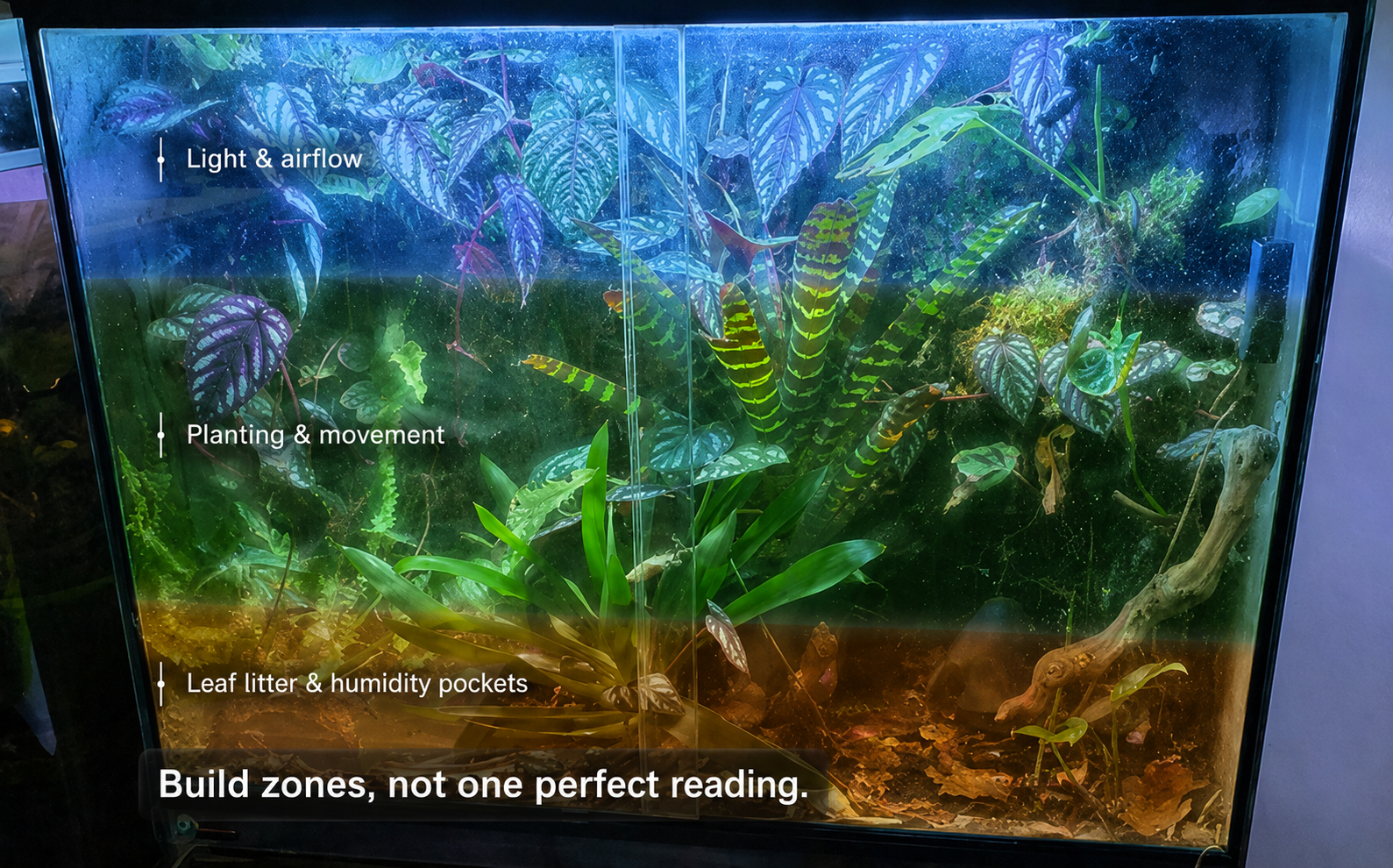
One of the best moisture stabilisers in a dart frog vivarium isn’t the drainage layer.
It’s leaf litter.
Proper tropical leaf litter:
- Buffers humidity
- Slows evaporation
- Protects upper substrate
- Feeds fungi and microfauna
- Creates hydration zones
- Prevents surface compaction
Thin decorative leaf coverage usually isn’t enough.
You want genuine depth and layering.
Especially with tropical leaves like:
Premium Tropical Leaf Litter Mix
Signs Your Drainage Layer Is Failing
- Permanent swamp smell
- Glass constantly fogged
- Substrate blackening
- Plants melting at the base
- Springtail decline
- Visible stagnant water
- Frogs constantly sitting high up
- Fungus blooms exploding repeatedly
And one of the biggest warning signs?
You stop seeing natural drying cycles.
Healthy vivariums breathe.
They fluctuate slightly.
Permanent saturation usually means imbalance somewhere.
Modern Vivariums Are Moving Away From “Wet Boxes”
This is probably the biggest shift happening in dart frog keeping right now.
The old approach was:
“Keep everything soaking wet constantly.”
Modern keepers are realising healthier systems usually involve:
- Microclimates
- Humidity gradients
- Dry upper zones
- Moist lower zones
- Better airflow
- Deeper biological substrate
- Smarter misting
That creates more natural frog behaviour too.
More exploring.
More calling.
More visible frogs.
So… Should You Use A Drainage Layer?
For most UK dart frog keepers?
Yes — probably.
Especially if:
- You mist heavily
- You’re newer to bioactive systems
- Your home struggles with airflow
- You keep dense tropical planting
- You’re building larger vivariums
But the drainage layer itself is not the goal.
Balance is.
A thriving dart frog vivarium depends on how the entire ecosystem functions together:
- Substrate
- Leaf litter
- Plants
- Microfauna
- Humidity
- Airflow
- Lighting
- Water management
The healthiest tanks rarely rely on a single trick.
They behave like ecosystems.
If you’re still building your setup, starting with a properly balanced bioactive dart frog vivarium from the beginning prevents most of the problems people spend months trying to fix later.
FAQ: Dart Frog Vivarium Drainage Layers
Do dart frog vivariums need a drainage layer?
Not always, but many UK dart frog vivariums benefit from one. A drainage layer helps separate excess water from the main substrate, reducing the risk of swampy conditions, root rot and anaerobic pockets.
Can a dart frog vivarium work without a drainage layer?
Yes, but only if the substrate, misting, planting, airflow and moisture balance are managed properly. Experienced keepers can run successful setups without traditional drainage layers, but beginners usually benefit from the extra safety buffer.
Does a drainage layer increase humidity?
Not directly. A drainage layer stores excess water below the substrate, but real humidity stability comes from hydrated substrate, leaf litter, moss, plants and proper microclimates.
What happens if the drainage layer fills with water?
If the water level reaches the substrate and stays there, the substrate can become saturated and oxygen-poor. This may lead to root rot, sour smells, microfauna decline and biological imbalance.
What is the best drainage layer for a bioactive dart frog vivarium?
Hydroballs, LECA, egg crate false bottoms and filter foam systems can all work. The best option depends on vivarium size, misting routine, substrate depth, planting density and long-term maintenance style.
Why does my vivarium smell swampy?
A swampy or rotten smell usually suggests stagnant water, anaerobic substrate pockets, trapped waste, poor airflow or over-saturation. A healthy bioactive vivarium should smell earthy, not foul.
Should there be standing water in the drainage layer?
A small amount after misting is normal, but long-term standing water should be monitored. If the water level rises into the substrate, the system is too wet or drainage is failing.
Is leaf litter more important than a drainage layer?
They do different jobs. Drainage controls excess water below the substrate, while leaf litter buffers surface humidity, protects microfauna, supports decomposition and gives dart frogs natural cover.