Husbandry & Evidence Review – 6 September 2026
Smell is a useful warning cue but not a diagnosis. Persistent foul odour should prompt direct inspection for decaying material, stagnant water, substrate problems and animal health issues.
A healthy dart frog vivarium shouldn’t smell bad.
Not neutral. Not “earthy but a bit off”. Not something you notice every time you walk past.
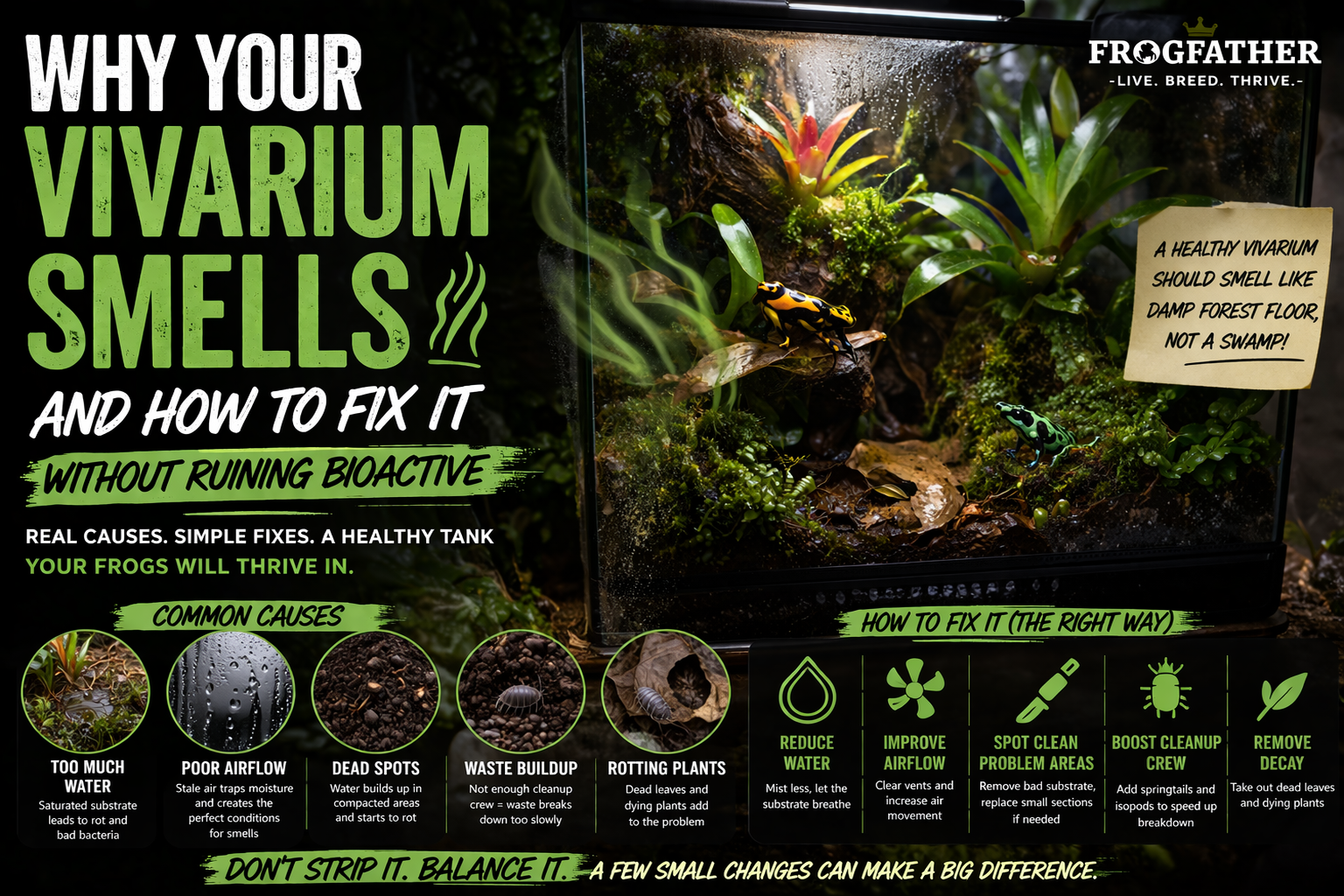
It should smell like damp forest floor. Subtle. Clean. Almost nothing.
So when a tank starts to smell — properly smell — it’s not just one of those things you ignore. It’s your setup telling you something’s out of balance.
The mistake most people make is panicking and ripping everything apart. Full clean, substrate out, start again.
That’s usually the worst move you can make.
Because if your vivarium is bioactive, the whole point is that it manages itself. If something smells, the system isn’t broken — it’s just out of balance.
This is about fixing that without nuking the setup you’ve spent weeks building.
If you haven’t already, this sits alongside your common vivarium issues guide, but we’re focusing purely on smell here.
What a healthy vivarium should smell like
Before fixing anything, it helps to know what “right” actually is.
A stable bioactive vivarium should:
- Smell faintly earthy
- Have no sharp or sour odour
- Not change dramatically after misting
If you’re getting:
- Sour smells
- Rotting smells
- Stagnant, heavy air
Something’s off.
The most common causes of bad smells
1. Too much water (the big one)
This is easily the most common issue in UK setups.
Too much misting, poor airflow, and suddenly your substrate isn’t “humid” — it’s saturated.
That leads to:
- Anaerobic bacteria
- Rotting organic matter
- That swampy smell you can’t ignore
This ties directly into your misting guide — because most people are simply overdoing it.
2. Poor airflow
Even a well-built vivarium will struggle if air isn’t moving.
Stale air traps moisture and slows down breakdown.
You end up with:
- Lingering smells
- Mould patches
- General stagnation
3. Dead spots in the substrate
These are areas where water sits and doesn’t move.
Often caused by:
- Compacted substrate
- Poor drainage
- Overwatering specific areas
These spots start to break down differently — and smell worse.
4. Too much waste, not enough cleanup crew
Bioactive only works if the system is balanced.
If you’ve got:
- Too many frogs for the space
- Not enough springtails or isopods
Waste builds faster than it breaks down.
That smell creeps in slowly.
5. Rotting plant matter
Dead leaves, dying plants, buried organic material.
Normally, this gets processed.
If it doesn’t, it starts to rot instead.
How to fix a smelly vivarium (without restarting)
This is where people go wrong.
You don’t need to tear it down.
You need to correct the imbalance.
Step 1: Reduce water
Cut back misting slightly.
Let the tank breathe.
Don’t dry it out — just stop overloading it.
Step 2: Improve airflow
Make sure vents aren’t blocked.
If needed, slightly increase airflow.
Even small changes make a difference.
Step 3: Spot clean problem areas
If you can identify a bad patch:
- Remove affected substrate
- Replace with fresh mix
No need to strip the whole tank.
Step 4: Boost your cleanup crew
Springtails and isopods should be doing most of the work.
If they’re struggling, the system slows down.
This links directly with your microfauna setup and feeding — something worth expanding into its own article later.
Step 5: Remove obvious decay
Dead leaves, melting plants, anything clearly breaking down badly.
Let the system handle the rest.
What not to do
Don’t fully strip the vivarium
You’ll reset everything — including the good parts.
Don’t flood it to “wash it out”
This makes the problem worse.
Don’t ignore it
Smell is an early warning. It won’t fix itself if the cause stays.
How long does it take to fix?
If you correct the issue properly, you’ll usually notice improvement within days.
Full balance might take a couple of weeks.
The key is consistency — not overcorrecting.
Preventing smells long-term
- Controlled misting (not soaking)
- Good airflow
- Balanced microfauna population
- Regular light maintenance
It’s not about perfection. It’s about stability.
Why smell is one of the best warning signs you’ve got
You don’t always see problems straight away.
You don’t always notice behaviour changes immediately.
But smell?
That shows up early.
If your vivarium smells off, it’s worth paying attention to.
Fix the cause, not just the symptom, and your setup usually settles back into place.
Frequently Asked Questions
Why does my dart frog vivarium smell bad?
Usually due to excess moisture, poor airflow, or waste buildup in the substrate.
Should a bioactive vivarium smell?
It should have a mild earthy smell, not a strong or unpleasant odour.
Can I fix a smelly vivarium without restarting?
Odours can arise from waterlogging, decaying food/animals/plants, anaerobic areas, contaminated water or other causes. Check the actual source rather than assuming a simple moisture/airflow/clean-up-crew balance.
Is mould causing the smell?
Sometimes, but it’s usually a symptom of too much moisture or poor airflow.
How do I stop my vivarium smelling long-term?
Maintain balance with proper misting, airflow, and a healthy bioactive system.