Husbandry & Evidence Review – 6 September 2026
Vivarium dimensions in this article are practical starting points, not stocking guarantees. Adult size, species, sex ratio, usable floor/vertical area, visual barriers, feeding access and individual aggression determine whether a pair/group is actually suitable.
Tank size is one of those topics where people either massively overcomplicate things… or completely underestimate it.
You’ll see everything from tiny cubes with a pair of frogs crammed in, to huge display vivariums with barely any usable space because the layout’s wrong.
The truth sits somewhere in the middle.
Dart frogs don’t need massive enclosures to survive — but if you want them to behave properly, feed confidently, and actually use the space, then size, layout, and structure all matter more than people realise.
Especially in UK setups, where room conditions, lighting and airflow already limit how forgiving your vivarium can be.
What “tank size” actually means for dart frogs
It’s not just litres or dimensions.
It’s about:
- usable space (not just empty volume)
- cover and structure
- how many frogs you’re keeping
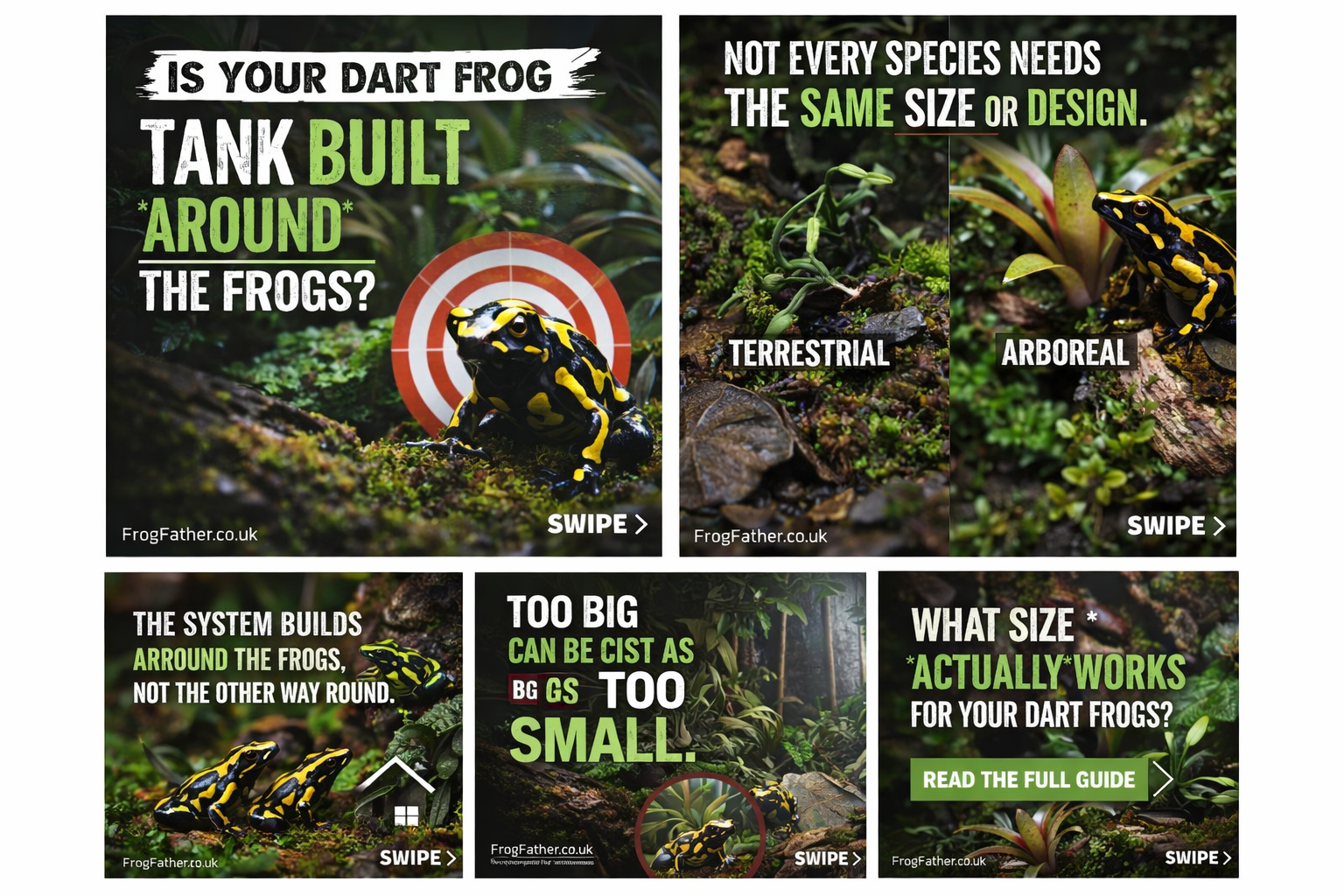
- whether they’re terrestrial or more arboreal
A poorly designed large tank can feel smaller to a frog than a well-structured smaller one.
This is why tank size always links back to your vivarium setup guide — because layout matters just as much as dimensions.
Minimum tank sizes (realistic UK guidance)
These aren’t “absolute minimums for survival”.
These are realistic sizes where frogs can behave properly.
Pair of dart frogs
- Minimum: 45 x 45 x 45 cm
- Better: 45 x 45 x 60 cm
Small group (3–4 frogs)
- Minimum: 60 x 45 x 60 cm
- Better: 90 x 45 x 60 cm
Larger groups
Scale width first, not just height.
More frogs = more floor space and more visual barriers.
This ties directly into your mixing species guide — because overcrowding and mixing issues often overlap.
Terrestrial vs arboreal behaviour (why it changes everything)
Not all dart frogs use space the same way.
Terrestrial species
Most dart frogs fall into this category.
They use:
- leaf litter
- low-level cover
- ground space
For these species, floor space matters more than height.
A tall tank doesn’t help if the base is cramped.
More arboreal / vertical users
Some species will use height more:
- climbing plants
- bromeliads
- background structure
For these, adding height makes sense — but only if it’s usable.
This is where your planting guide becomes critical. Vertical space without structure is just empty air.
How many dart frogs per tank?
This is where things get messy online.
There isn’t a universal rule, but there are patterns.
Species that do well in groups
- Generally more social or tolerant species
- Often kept in small groups successfully
With enough space and cover, these can coexist well.
Species that can show aggression
Some frogs are far less tolerant.
Common issues include:
- territorial behaviour
- dominance over feeding
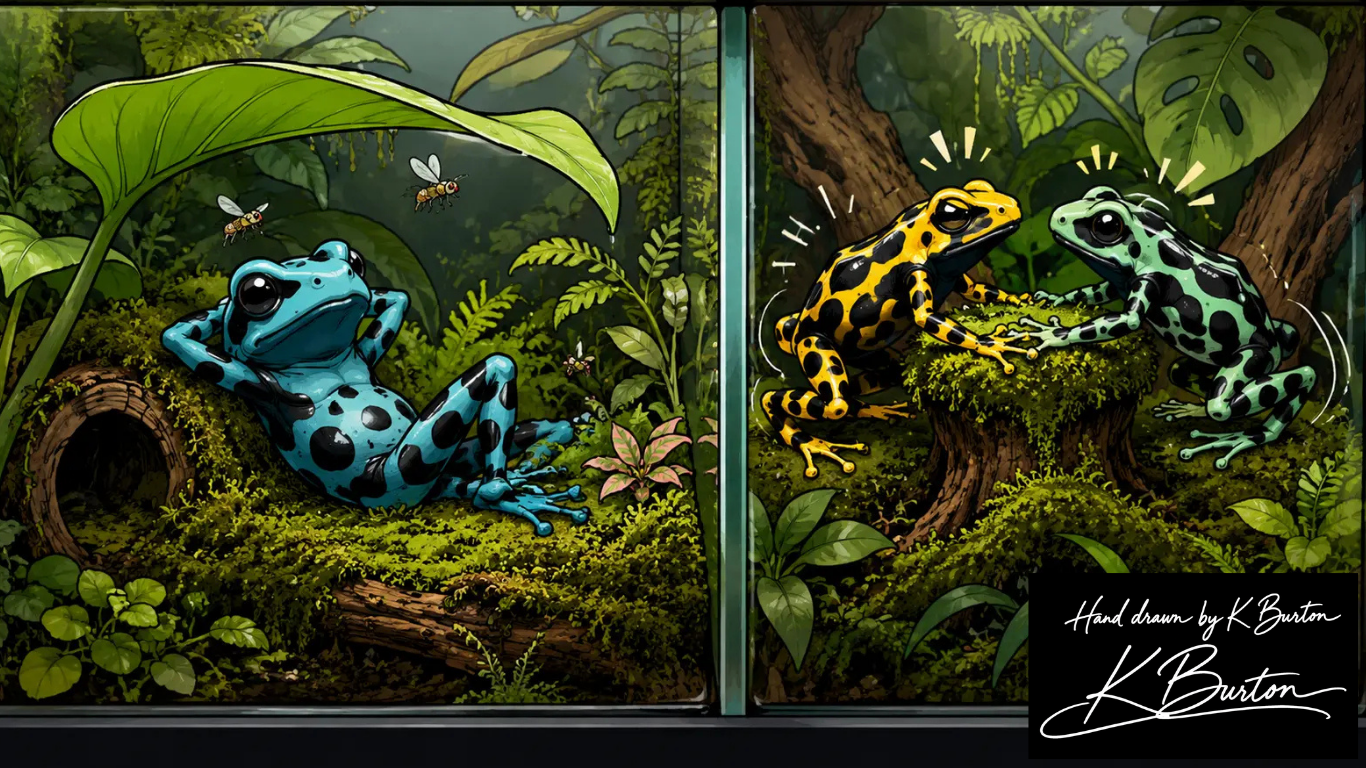
- one frog constantly hiding
This is where your behaviour guide becomes important — because the signs show up there first.
If one frog is always hidden or not feeding, it’s often not a “shy frog”… it’s a setup or social issue.
Why more space doesn’t automatically fix problems
This is a common assumption.
“Just go bigger and it’ll be fine.”
Not always.
If the tank is:
- too open
- poorly planted
- lacking cover
Frogs will still compete for the same safe areas.
That’s why structure matters more than raw size.
The role of planting and layout
A good vivarium creates:
- multiple hiding spots
- broken lines of sight
- different humidity zones
This reduces stress and allows frogs to coexist properly.
This links directly with:
Without these, even a large tank can feel exposed.
Common tank size mistakes
Too small for the number of frogs
This leads to stress, competition and poor feeding.
Too open
Lack of cover makes frogs feel exposed, reducing activity.
Too tall without structure
Height is wasted if frogs can’t use it.
Ignoring behaviour signals
The frogs will tell you if the setup isn’t working.
How tank size affects long-term success
This isn’t just about space.
It affects:
- feeding response
- stress levels
- visibility
- breeding behaviour
All things that tie back into your wider system:
What actually works (simple approach)
- Start slightly bigger than you think you need
- Focus on floor space first
- Add height only if it’s usable
- Plant heavily
- Watch behaviour, not just numbers
That’s what separates a tank that “holds frogs”… from one that actually works long-term.
Frequently Asked Questions
What size tank do dart frogs need in the UK?
A pair can be kept in 45x45x45 cm, but larger setups provide better long-term stability and behaviour.
Can dart frogs live in groups?
Some species can, but it depends on space, structure and individual behaviour.
Do dart frogs need tall tanks?
Only if the vertical space is usable with plants and structure. Otherwise, floor space matters more.
How many dart frogs can I keep together?
Small groups can work in larger, well-planted vivariums, but overcrowding leads to stress.
Does tank size affect behaviour?
Yes. Poor sizing or layout can lead to hiding, reduced feeding, and stress.