Husbandry & Evidence Review – 5 September 2026
Isopod suitability is species- and enclosure-specific. Frogfather practical preferences are labelled as such rather than presented as universal safety rules.
Part of the Frogfather Dart Frog Knowledge Base
Isopods for Dart Frog Vivariums (2026): Best Species, Care & Common Problems
Isopods are one of the foundations of a mature bioactive dart frog vivarium, but they are not all interchangeable. A species that thrives in a ventilated, partly dry isopod enclosure may slowly disappear in the warm, damp leaf litter of a frog tank.
This guide explains which isopods work best with dart frogs, how to establish a breeding population, what they actually do and why apparently healthy colonies sometimes vanish.
What are isopods?
Isopods are terrestrial crustaceans. In the UK, many keepers simply call them woodlice. They breathe through specialised structures that must remain moist, which is why humidity matters, but that does not mean every species wants permanently saturated conditions.
In nature, isopods occupy leaf litter, rotting timber, soil and other sheltered microhabitats. In a vivarium they perform the same basic role: feeding on softened plant material and organic debris, fragmenting it into smaller particles and helping nutrients move through the substrate.
They are living animals with their own husbandry requirements, not a product that can be tipped into any enclosure and forgotten.
What do isopods do in a dart frog vivarium?
A healthy isopod population helps process decaying leaves, dead plant tissue, leftover food and other organic material. As they chew and fragment this material, fungi, bacteria and smaller microfauna can process it more efficiently.
Isopods can help with:
- Breaking down softened leaf litter and rotting wood
- Processing organic debris and small food remains
- Returning nutrients to planted substrate
- Keeping the lower leaf-litter layers active
- Providing occasional natural prey for dart frogs
They do not make a vivarium maintenance-free. Uneaten food should still be managed, dead animals must be removed and drainage, airflow and substrate condition still need checking. No clean-up crew can correct a waterlogged or badly ventilated enclosure.
Which isopods are best for dart frog vivariums?
The best species is not necessarily the largest, rarest or most colourful. In a frog vivarium, reliability matters more than display value.
| Isopod type | Suitability | Important points |
|---|---|---|
| Tropical White Woodlice Trichorhina tomentosa |
Best general choice | Small, discreet, moisture-tolerant and productive. Their size and burrowing behaviour help part of the colony avoid frog predation. |
| Dwarf Purple Isopods | Often suitable | Another small tropical option, although availability and colony performance vary. |
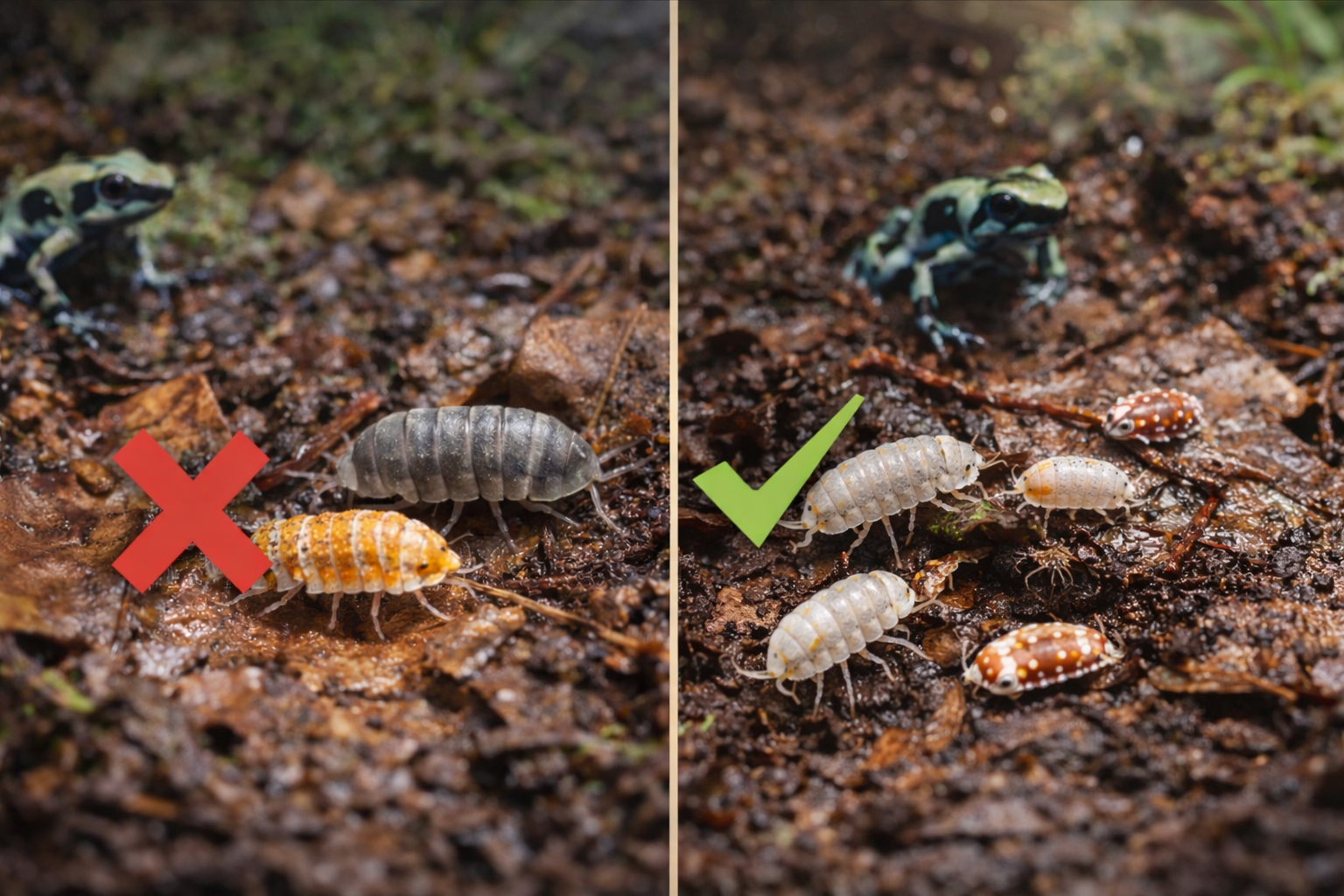
| Cubaris murina types | Possible with care | Can work where there is suitable ventilation, nutrition and a usable moisture gradient, but they are not as foolproof as Tropical Whites. |
| Large Porcellio and Armadillidium | Usually a poor match | Many prefer more airflow or a substantially drier area than a typical dart frog vivarium provides. |
| Rare display species | Keep separately | Expensive specialist species are often better maintained in a dedicated colony where their conditions, feeding and breeding can be controlled. |
Individual species and local strains differ, so research the requirements of the exact isopod before adding it. “Tropical” on a sales label is not enough on its own.
Why Tropical White Woodlice are the usual recommendation
Trichorhina tomentosa has earned its place in dart frog keeping because it suits the job. Adults are small, juveniles are smaller still and much of the population remains concealed below leaves and in loose substrate. This makes the colony less exposed than larger surface-active species.
They also tolerate the warm, humid conditions found in properly managed tropical vivariums and can reproduce steadily when given leaf litter, calcium, food and refuge. Dart frogs may eat some individuals, but a well-established colony can usually continue below the surface.
The Frogfather Tropical White Woodlice culture can be used to seed a new bioactive setup or strengthen an existing population. For a new build, add them before the frogs whenever possible.
Isopods versus springtails: do you need both?
Yes. They overlap slightly, but they work at different scales.
| Microfauna | Main strengths |
|---|---|
| Isopods | Fragmenting leaf litter, decaying wood and larger pieces of organic material. |
| Springtails | Feeding on fungal films, mould and very fine organic particles; also useful as micro-food. |
A dependable bioactive setup normally contains both. Read the complete Frogfather guide to springtails for dart frogs for culture care, feeding and harvesting.
When should you add isopods?
The ideal time is after the vivarium has been planted and the leaf litter has been added, but before the dart frogs move in. This gives the isopods time to find refuges and begin reproducing without immediate predation.
If the frogs are already present, you can still add isopods. Introduce them in several sheltered places rather than tipping the whole culture onto an exposed patch.
How to introduce an isopod culture
- Check that the substrate is damp but not waterlogged.
- Create several deep leaf-litter pockets beneath cork, wood and planting.
- Place portions of the culture under cover in different areas.
- Include some of the culture medium, provided it is suitable for the vivarium.
- Add a calcium source and a tiny amount of food close to a refuge.
- Replace the leaf litter gently and leave the colony to settle.
Avoid releasing every individual at the front of the tank. Dart frogs quickly learn where exposed food appears.
What an isopod colony needs to establish
Deep, varied leaf litter
Leaf litter provides food, shelter and moisture-buffered microhabitats. Use enough to create overlapping leaves and protected pockets rather than a single decorative sheet. It does not independently control whole-vivarium humidity. Replace it gradually as it is consumed. The Frogfather leaf litter guide explains suitable leaves and how to use them.
A moisture gradient
The lower leaf litter and parts of the substrate should remain humid, but the entire enclosure should not be swamp-like. A little variation lets the colony move to the conditions it needs. Constant saturation fills air spaces in the substrate and can cause an isopod colony to stall.
Air exchange
High humidity and fresh air are not opposites. Good ventilation supports the frogs, plants, microfauna and substrate. If every surface stays soaked throughout the day, review both misting and airflow using the dart frog ventilation guide and humidity guide.
Safe refuges
Cork bark, decaying hardwood, seed pods and deeper piles of leaves protect juveniles from frogs. Refuges are especially important in smaller vivariums and established frog groups.
Time
Not seeing isopods is not automatically a failure. Tropical Whites often spend most of their lives out of sight. Look for juveniles beneath bark or in a food station before assuming the colony is gone.
Do isopods need feeding?
Yes. Leaf litter and decaying wood form the base of the diet, but small supplementary feeds can support reproduction, especially in a young vivarium with little decomposed material.
Offer tiny quantities of suitable isopod food, dried plant material or occasional protein. Add less than you think you need and remove anything that remains before it spoils. Heavy feeding can create mites, mould and fouled patches faster than the clean-up crew can process them.
Calcium matters
Isopods need a continuing calcium source for their exoskeletons and successful moulting. Cuttlebone, clean calcium-rich materials or a formulated isopod diet can be placed beneath cover. Replace the source when it has been consumed or degraded.
Will dart frogs eat isopods?
Yes. Dart frogs may take small isopods and juveniles when they find them. This is natural background feeding, but it can prevent a small starter colony becoming established.
Reduce the pressure by:
- Adding the clean-up crew before the frogs
- Starting with a strong culture
- Creating several deep refuges
- Maintaining plenty of leaf litter
- Keeping a separate backup colony
Isopods are supplementary prey, not a replacement for a properly dusted staple feeder routine. Read more in Do Dart Frogs Eat Isopods?
Why keep a separate backup colony?
A separate culture gives you insurance. If the vivarium population is hit by predation, flooding, a dry spell or a major rebuild, you can reseed it without buying another culture.
Keep the backup in a ventilated tub with damp substrate, leaf litter, decaying wood, calcium and modest supplementary food. Do not let it become waterlogged, and check it often enough to catch drying or food problems early.
Why do isopods disappear or fail to breed?
| Likely cause | What to check | Practical response |
|---|---|---|
| Wrong species | Does it require a much drier area or stronger airflow? | Use a proven humid-vivarium species such as Tropical Whites. |
| Waterlogged substrate | Standing water, sour smell or constantly soaked leaves. | Correct drainage, reduce excessive misting and improve air exchange. |
| Too little leaf litter | Bare soil and few protected pockets. | Build deeper, overlapping layers and replenish gradually. |
| Predation | Adults appeared briefly but no juveniles establish. | Seed more heavily and add covered refuges in several areas. |
| Poor nutrition or low calcium | Low reproduction, unsuccessful moults or an exhausted food base. | Maintain leaves, wood, calcium and controlled supplementary feeding. |
| Colony is merely hidden | No surface activity, but conditions remain suitable. | Check beneath a refuge or place a small food station overnight. |
A living clean-up crew is a useful warning system. If both isopods and springtails repeatedly crash, investigate the enclosure rather than continually adding new cultures.
Should you mix different isopod species?
Usually not. Two species using the same food and refuges rarely remain evenly balanced forever. One generally reproduces faster or handles the conditions better and gradually dominates.
For a dart frog vivarium, one reliable isopod species plus springtails is normally more useful than a mixture of isopods. If you enjoy rare or colourful woodlice, maintain them in separate species cultures where you can meet their precise needs and monitor their breeding.
For a deeper look at competition, read Can You Mix Isopods in a Dart Frog Vivarium?
A simple isopod maintenance routine
Weekly
- Check that lower leaf litter remains humid without being flooded.
- Look for drainage or stale, sour-smelling areas.
- Remove spoiled supplementary food.
- Check that a calcium source remains available.
Monthly
- Lift one refuge briefly and look for several sizes of isopod.
- Add leaf litter where the old layer has thinned.
- Inspect the backup culture and use it to boost the vivarium if needed.
- Review misting and ventilation if the surface never has a chance to become less wet.
Do not keep turning over the entire substrate to count the colony. Frequent disturbance destroys the protected microclimates you are trying to create.
Common isopod mistakes
- Choosing by colour or rarity instead of habitat requirements
- Assuming high humidity means permanently soaked substrate
- Adding a small culture to a frog-filled tank with no refuges
- Using a thin decorative layer of leaves and never replenishing it
- Forgetting calcium and supplementary nutrition
- Overfeeding and creating more waste than the colony can process
- Expecting isopods to replace springtails or routine maintenance
- Mixing valuable species and eventually losing the slower breeder
Frequently asked questions
What are the best isopods for dart frog vivariums?
Tropical White Woodlice (Trichorhina tomentosa) are the most dependable general choice for most humid dart frog vivariums. They are small, moisture-tolerant and reproduce well when supplied with leaf litter, calcium, food and refuge.
Do dart frogs eat isopods?
Yes. Dart frogs may eat small isopods and juveniles. A strong colony, deep leaf litter and protected refuges help enough individuals remain hidden and continue breeding.
Can isopods replace springtails?
No. Isopods are better at fragmenting larger organic material, while springtails work on fungal films, mould and much finer particles. A bioactive dart frog vivarium benefits from both.
Why have my isopods disappeared?
They may simply be hidden, but common causes of a real decline include frog predation, unsuitable species choice, waterlogged substrate, too little leaf litter, inadequate calcium and poor nutrition.
How many isopods should I add?
There is no universal number because culture density and vivarium size vary. Use a healthy established culture, distribute it between several refuges and avoid relying on a handful of exposed adults in an occupied tank.
Should I add isopods before the dart frogs?
Yes, where possible. Adding the clean-up crew after planting but before the frogs gives it time to settle, find shelter and begin reproducing without immediate predation.
Do isopods need extra food?
Leaf litter and decaying wood are the dietary base, but small controlled supplementary feeds can improve reproduction. Avoid leaving excess food to spoil.
Do isopods need calcium?
Yes. Isopods require a continuing calcium source for their exoskeletons and moulting. Provide cuttlebone, a suitable mineral source or a formulated isopod diet beneath cover.
Can a dart frog vivarium be too wet for isopods?
Yes. Humid does not mean saturated. Waterlogged substrate loses useful air spaces and can cause colonies to fail. Maintain damp lower layers, effective drainage, airflow and some variation across the enclosure.
Can I mix different isopod species?
You can, but it is usually not worthwhile. Species compete for the same resources and one often dominates over time. One well-matched isopod species plus springtails is the more predictable clean-up crew.
Final verdict
The best isopod for a dart frog vivarium is the one that can live and reproduce in the conditions the frogs actually need. For most keepers, that makes Tropical White Woodlice the sensible starting point.
Give them damp but oxygenated substrate, deep leaf litter, calcium, modest feeding and places to escape predation. Combine them with springtails and keep a backup culture. Do that, and the clean-up crew becomes a stable part of the vivarium rather than something you repeatedly replace.