
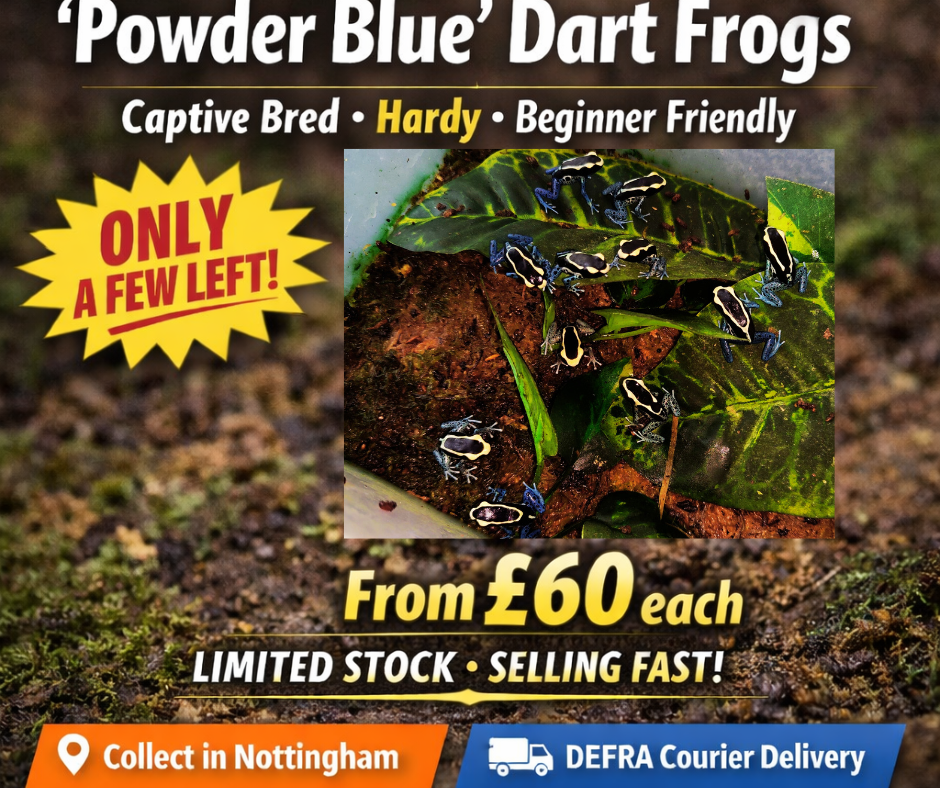
Description
Juvenile Dendrobates tinctorius ‘Powder Blue’ – Captive Bred UK
Well-started captive-bred juvenile Powder Blue Dendrobates tinctorius, feeding reliably on appropriately sized live prey.
Temperament and beginner wording
D. tinctorius are often visible and confident in well-structured planted enclosures, which can make them rewarding display animals. We have removed the previous claims that Powder Blues are inherently “hardy”, “resilient”, or one of the “best beginner dart frogs”. They are still specialist amphibians requiring reliable live food, supplementation and close environmental management.
Environment
Frogfather commonly maintains D. tinctorius at moderate tropical-room temperatures in the low-to-mid 20s °C. Provide a humid, well-ventilated enclosure with substantial leaf litter, refuges and access to wetter and drier microhabitats rather than targeting a constant 70–85% RH.
Housing
Do not use 45 × 45 × 45 cm as a universal pair/trio rule. Adult usable floor area, enclosure structure, sex and individual compatibility all matter. Same-sex aggression is documented in D. tinctorius, so a spare suitable enclosure should be available if animals need separating.
Feeding and supplementation
Offer appropriately sized live prey and an appropriate supplementation programme. We have removed the phrase “correct supplementation” because no single schedule is scientifically established for every individual and husbandry system.
Live animal note: availability and transport are subject to animal condition, weather and welfare-compliant arrangements.
Live-Animal Husbandry Review
Last reviewed: 5 September 2026
Temperature, moisture, enclosure size, social compatibility and supplementation should be matched to the species, life stage and individual animals. Frogfather therefore avoids treating a single RH percentage, fixed enclosure size or pair/group formula as a universal rule.
Evidence & further reading
- Rojas & Pašukonis – natural history and aggression in Dendrobates tinctorius
- St Claire et al. – dendrobatid husbandry


