Husbandry & Evidence Review – 5 September 2026
This older Green & Black Auratus profile has been aligned with the current species guide. Fixed 80–100% RH, automatic group ratios, routine vitamin boosters and bulb-percentage UVB prescriptions are removed.
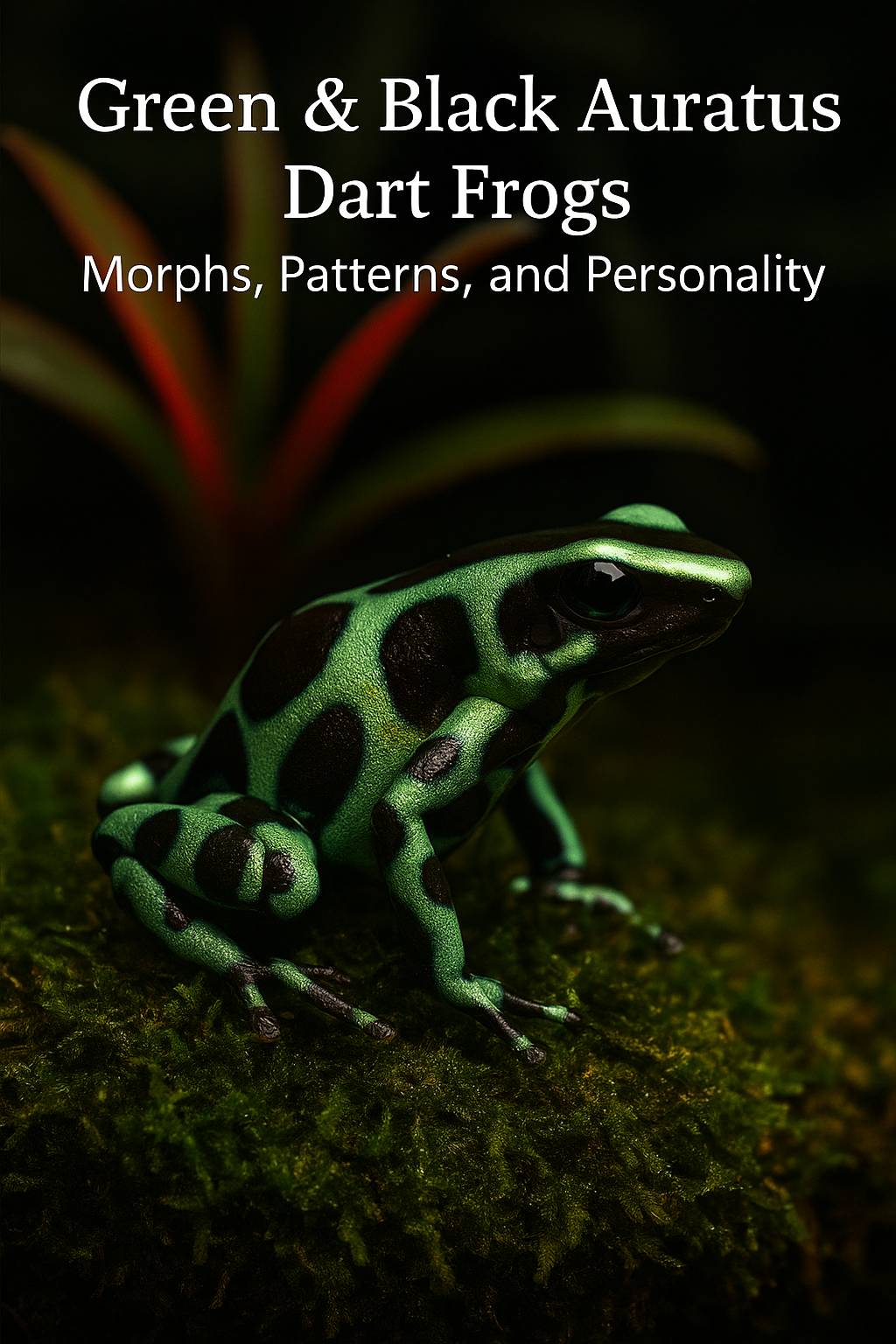
The Dendrobates auratus — better known as the Green & Black Auratus Dart Frog — is one of the most striking and beginner-friendly dart frogs you’ll ever come across. Famous for their bold emerald and black patterns, these frogs are native to Central and South America, where they spend their days exploring the forest floor under a dense, humid canopy. Despite their vibrant appearance, they’re actually one of the calmer species to keep in captivity — curious, steady, and endlessly fascinating to watch.
Origins and Natural Habitat
In the wild, D. auratus are found across Costa Rica, Panama, Nicaragua, and parts of Colombia. They inhabit humid lowland rainforests, often near streams or seepage zones where the air stays warm and moist all year. These frogs are most active in the early morning and late afternoon, retreating to shaded, mossy areas during the hottest part of the day. It’s a rhythm you’ll often see them keep in captivity too — a slow, deliberate wander through the leaf litter before disappearing back under a bromeliad leaf.
Colours, Morphs, and Patterns
One of the best things about Auratus is just how variable they are. Depending on their origin, they can range from metallic mint green to deep turquoise, with blotched, banded, or reticulated (net-like) markings. Some keepers even describe certain lines as “blue” or “bronze,” though these are all considered natural variations of the same species.
The most popular morphs in the UK include the Panamanian Green & Black (classic deep green), the Mint Auratus (soft, almost pastel green), and the rarer Blue Auratus, which has a shimmering teal hue. Each morph has its own subtle personality — some are bolder, others more reclusive — so it’s worth researching before you choose your group.
Behaviour and Temperament
Unlike their jumpier cousins like Ranitomeya, Auratus are a little more laid-back. They move with a calm, purposeful gait, rarely dashing unless startled. In a well-planted vivarium, they’ll quickly learn their territory and become comfortable enough to be seen most of the day. They aren’t overly aggressive, though males may display or “chirp” occasionally to establish dominance during the breeding season.
Compatible groups can work with some D. auratus, but there is no universal one-male-to-two-or-three-females formula. Monitor feeding access, territorial behaviour and body condition, and have separation space available.
Setting Up Their Vivarium
Green & Black Dendrobates auratus are commonly maintained successfully in the low-to-mid 20s °C, but the exact range should follow the lineage, room and enclosure. Provide moist refuges, leaf litter and ventilation rather than keeping RH permanently at 80–100%. A bioactive setup is optional rather than biologically required.
These frogs love climbing into plants — especially bromeliads — so adding some 3D-printed Bromeliads or BromeliHooks can make a huge difference. They provide height, security, and egg-laying sites while looking natural and easy to clean.
Here at Frogfather, we’ve also designed four custom Euro Vivariums that perfectly suit species like Auratus — offering excellent ventilation and space for microhabitats, without taking over your living room.
Feeding and Supplements
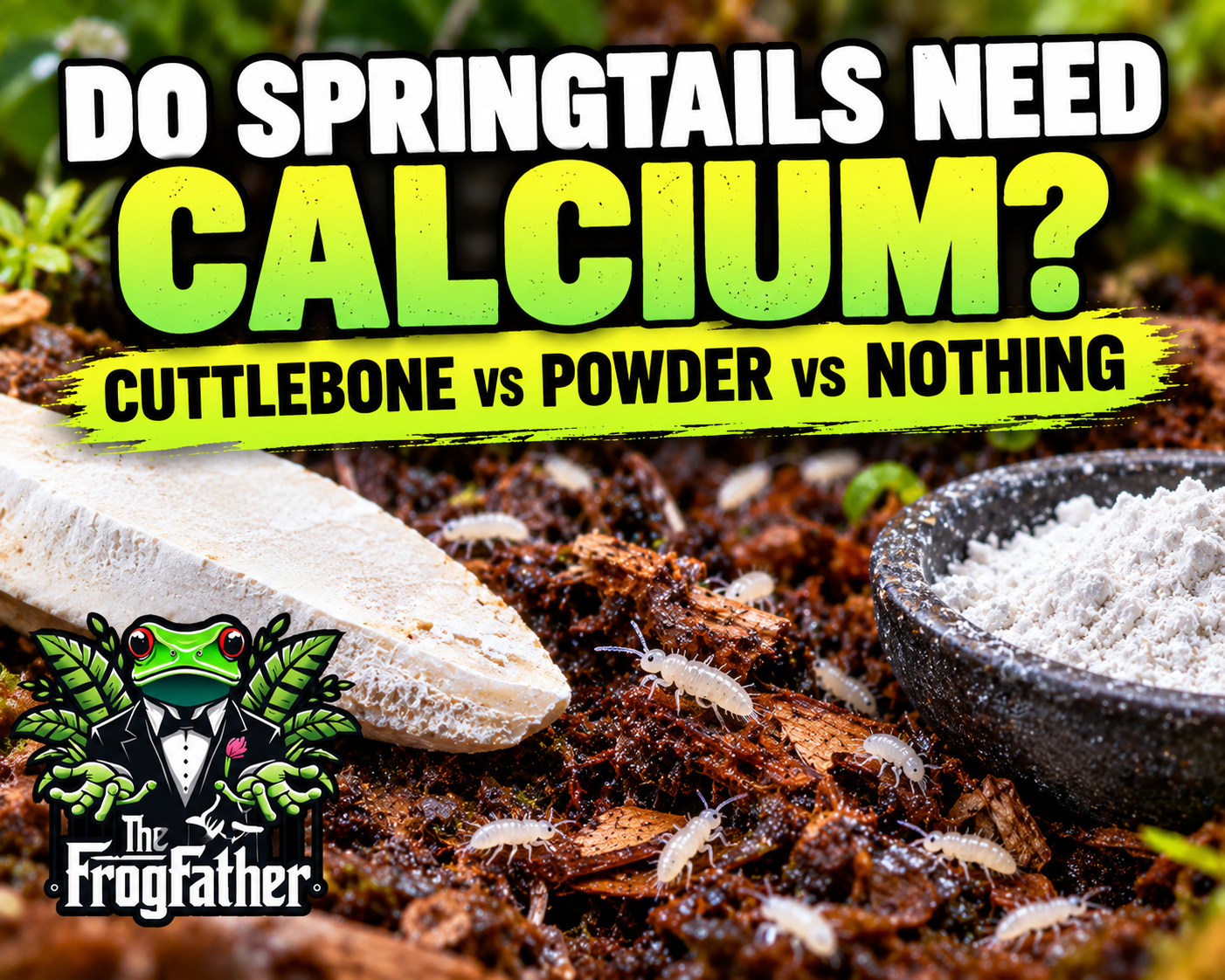
Green & Black Auratus dart frogs are insectivores, thriving on a varied diet of small livefoods such as fruit flies, springtails, and isopods. Dust your feeders regularly with calcium and vitamin supplements to prevent deficiencies and support vibrant colouration.
Use one coherent supplementation system and follow the exact product directions. Frogfather does not recommend casually stacking calcium powders, vitamin A boosters and pigmentation products or claim that doing so guarantees skin health, appetite or breeding readiness.
Breeding Auratus in Captivity
Breeding Auratus is relatively straightforward once the frogs are settled and mature. Males call softly — a low buzzing trill — to attract females. Eggs are typically laid in film canisters, bromeliad leaf axils, or other hidden damp spots. Once the tadpoles hatch, they can be raised separately in shallow water tubs or left in a carefully managed natural setup.
Unlike obligate egg-feeding species, Auratus tadpoles will readily accept powdered or crushed tadpole food, spirulina, or even algae wafers. Keep the water clean, warm (around 24°C), and oxygenated.
Why Keep Green & Black Auratus?
Simply put — they’re the perfect introduction to dart frogs. Hardy, beautiful, and active, they make an excellent display in a living room or office setup. Their vibrant colouration doesn’t fade with age, and when housed in a lush, humid environment, they display fascinating natural behaviour every single day.
Whether you’re just starting out or expanding your collection, Auratus will quickly become one of your favourite species to observe — especially if you take the time to create a thriving micro-ecosystem full of movement and life.
Summary
- Scientific name: Dendrobates auratus
- Origin: Central & South America
- Size: 3–5 cm
- Temperature: 22–25°C
- Moisture: species-appropriate humid refuges and useful ventilation; avoid a permanent fixed-RH target
- Temperament: Peaceful, confident, active
- Diet: Fruit flies, springtails, isopods, pinhead crickets
- Setup: Bioactive vivarium with bromeliads and hides
If you’re looking for a calm, colourful dart frog that thrives in bioactive setups, the Green & Black Auratus might just be your perfect match. Don’t forget to browse our Microfauna Foods & Supplements and 3D-printed Bromeliads to help build the perfect environment.
Frequently Asked Questions about Green & Black Auratus Dart Frogs
Are Green and Black Auratus dart frogs good for beginners?
Yes! They’re one of the most forgiving dart frog species, being hardy, relatively calm, and adaptable to a wide range of humidity levels.
What temperature should I keep Green and Black Auratus dart frogs at?
Use the current species-specific temperature guidance and provide useful moisture gradients/ventilation rather than a fixed 80–100% RH target.
Can I keep more than one Auratus together?
Yes, they do well in small groups, such as one male with two or three females, provided there’s plenty of cover and hiding space.
What do Green and Black Auratus dart frogs eat?
Their diet should include fruit flies, springtails, and isopods, dusted regularly with calcium and vitamin supplements. You can find these in our Microfauna Foods & Supplements range.
Do Green and Black Auratus frogs need UVB lighting?
Dedicated UVB is not always essential where dietary vitamin D3 is reliably provided. If UVB is used, assess actual frog-level exposure and shade rather than choosing a generic 2–5% bulb label.