Husbandry & Evidence Review – 6 September 2026
This sale/profile page contains practical captive-care starting points. Temperature, moisture, enclosure size, grouping, feeding and breeding behaviour vary by locality, sex, life stage and individual; the current species/care guides take priority over any older fixed formula below.
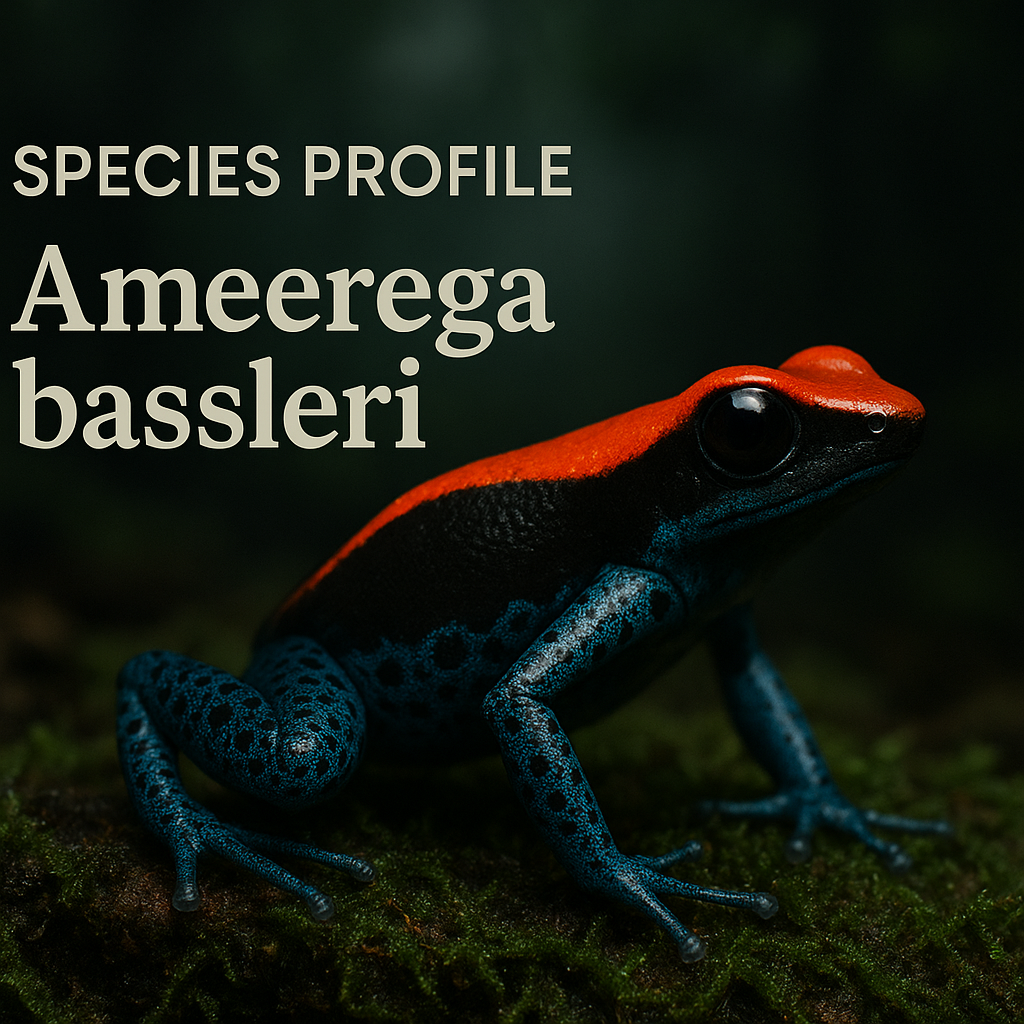
Ameerega bassleri is a striking terrestrial dart frog from Peru, celebrated for its metallic blue legs, bold red markings, and confident behaviour. Larger than most thumbnail species, these frogs are active, vocal, and thrive in spacious, humid vivaria. Their beauty, size, and personality make them a favourite among advanced keepers.
Origin & Distribution
Ameerega bassleri inhabits the foothill rainforests of central and eastern Peru. Found in leaf litter near small streams and under dense vegetation, they prefer moist, shaded microhabitats with stable humidity and cool air movement.
Size, Lifespan & Appearance
- Adult size: 35–45 mm — medium to large-bodied
- Lifespan: 10–15 years in captivity
- Appearance: deep black body with bright red dorsal stripe and iridescent blue limbs
Temperature & Humidity
- Daytime: 23–26 °C
- Nighttime: 20–21 °C
- Moisture: provide humid refuges and species-appropriate moisture cycles with useful airflow rather than a permanent 85–100% RH target or mandatory fogging
Vivarium Setup (Terrestrial)
A horizontal vivarium with generous floor area can suit this terrestrial species; group size must be based on sex ratio, compatibility and observed behaviour rather than a single 90×45×45 cm formula. Use a bioactive substrate with drainage, deep leaf litter, moss, and live plants. Provide hides (cork, logs, coconut shells) and shallow pools. A 3D vented vivarium ensures perfect airflow while maintaining high humidity. Soft LED or natural daylight brings out their iridescent colours beautifully.
Diet
Offer appropriately sized live prey frequently enough to maintain body condition. Supplement with All-in-One Vitamin & Mineral Dust to provide balanced nutrition, carotenoids, and calcium for bright colour and breeding fitness.
Social Behaviour & Visibility
Highly visible and confident. Ameerega bassleri may be managed as pairs, while larger groups require species-specific experience, substantial structure and a plan to separate incompatible individuals. They are bold feeders and often visible during the day. Males may engage in mild calling competitions but rarely serious aggression.
Calling
The male’s call is a short, loud trill repeated in bursts, particularly active at dawn and dusk. This is one of the more audible dart frog calls, adding a true rainforest feel to your home setup.
Breeding & Parental Care
Eggs are deposited under leaves or inside coco huts on damp film canisters. The male guards and moistens the eggs, carrying tadpoles on his back to shallow pools when they hatch. Tadpoles are not egg-feeding and can be raised on prepared tadpole diets. Metamorphosis time varies with temperature, nutrition, water and individual development; roughly 12 weeks may occur in some Frogfather-kept lines but is not a fixed timetable.
Availability in the UK
Ameerega bassleri dart frogs for sale in the UK are uncommon but occasionally available through experienced hobby breeders. Frogfather UK collaborates with responsible UK-based keepers to ensure strong, captive-bred lines of this charismatic species.
Quick Care Summary
- Type: Terrestrial
- Group size: Pair or 1.2 group
- Temperature: 23–26 °C day
- Moisture: species-appropriate humid refuges and useful ventilation; avoid a permanent fixed-RH target
- Behaviour: Bold, visible, moderately vocal
- Breeding: Male guards, carries tadpoles to water
FAQs
Is Ameerega bassleri suitable for beginners?
Best for intermediate to advanced keepers due to their size, humidity needs, and call volume.
How loud is their call?
The call is fairly loud — similar to a soft cricket chorus — adding natural ambience but not disruptive.
Can they live in groups?
Yes, in large enclosures with plenty of cover. Avoid housing multiple males in small tanks.
Do they climb?
Primarily terrestrial, but they may explore low branches and cork bark when available.