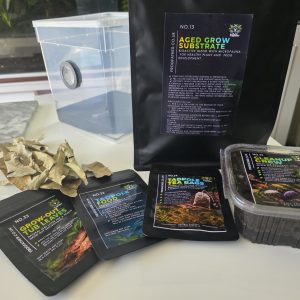


Description
Bioactive Clean-Up Crew – Springtails & Isopods
A mixed live culture of detritivorous invertebrates for seeding suitable bioactive vivariums and terrariums.
What they can contribute
- Springtails may graze fungi, microbes and decaying organic material.
- Isopods can fragment leaf litter and consume suitable decomposing plant material.
- Both can contribute to decomposition and nutrient cycling within a managed substrate system.
Claims corrected
We previously called this the “ultimate solution” for a self-sustaining, pristine vivarium and said it would prevent harmful waste build-up. That was too absolute.
A clean-up crew cannot remove every form of waste, prevent all mould or maintain a healthy enclosure on its own. Population size and ecological effect vary with moisture, food, temperature, substrate and the particular organisms supplied.
Use
Introduce microfauna into suitable substrate and leaf litter, provide appropriate food and moisture, and allow time for the populations to establish. Continue normal enclosure maintenance and remove excess food or waste when required.
Bioactive System & Evidence Review
Last reviewed: 5 September 2026
A bioactive vivarium can use plants, leaf litter, microorganisms and detritivorous invertebrates to process some organic material, but it is not a closed or self-sustaining ecosystem. Microarthropods can contribute to decomposition, although the magnitude of that effect varies with the organisms, substrate, organic material and environmental conditions.
Frogfather therefore uses terms such as aged, established or matured to describe systems that have been running before sale. Those terms do not guarantee biological stability, eliminate routine maintenance or prove that a vivarium is immediately suitable for any species.
Evidence & further reading
- Kampichler & Bruckner – microarthropods and terrestrial decomposition
- St Claire et al. – husbandry and care of dendrobatid frogs