
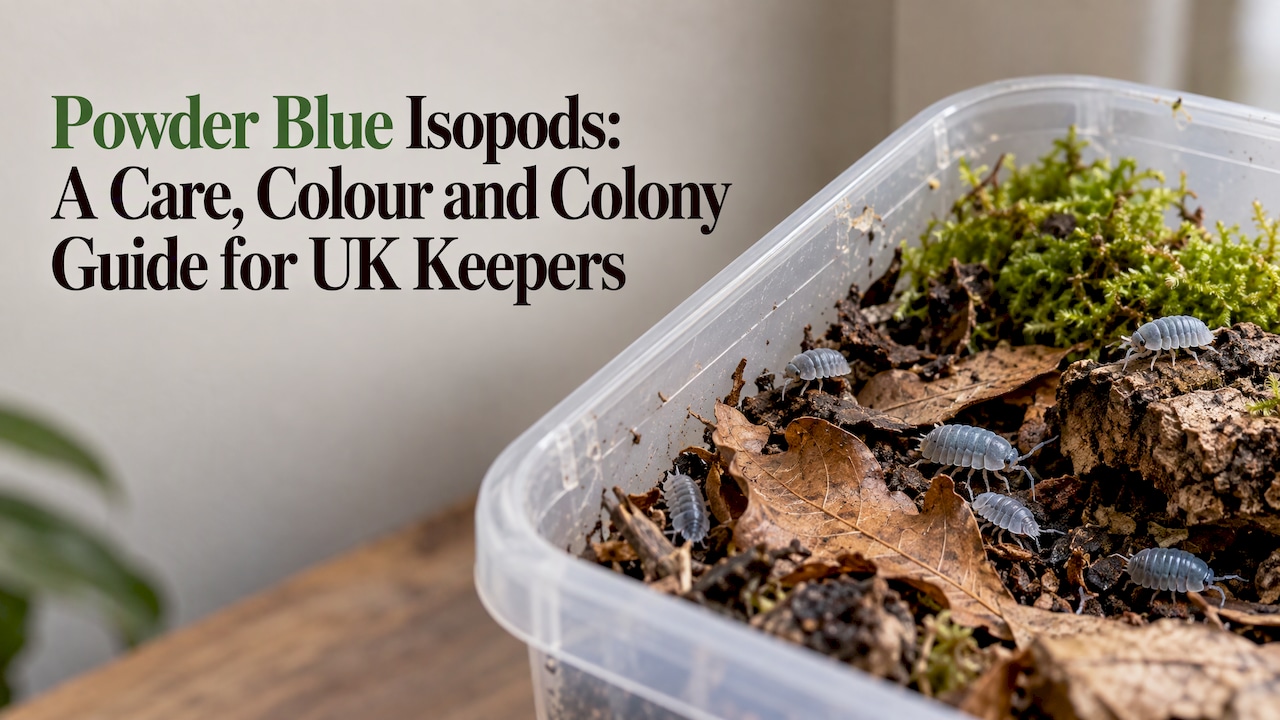
Powder blue isopods are Porcellionides pruinosus, a fast-breeding, forgiving isopod that makes an excellent cleanup crew for a bioactive vivarium. They need a ventilated tub, a moisture gradient, a steady food supply and a calcium source. Powder orange isopods are the same species in a captive-bred colour, so everything below applies to both. Get the basics right and they will multiply with little fuss. “Little fuss” is not “no maintenance”, though, and a colony still needs regular, observant care.
TL;DR
- Powder blue and powder orange isopods are one species, Porcellionides pruinosus. They differ in colour, not in care.
- Keep them warm (roughly 20 to 28°C), with one damp end and one drier end, and ventilation on opposite sides of the tub.
- Feed leaf litter, decaying wood and vegetables, plus a protein source weekly and calcium always available.
- They breed quickly, so plan to split or harvest the colony before it overcrowds.
- In a vivarium, they work best as part of a wider cleanup crew alongside springtails.
Table of Contents
- What powder blue isopods are
- Powder blue vs powder orange: are they the same?
- Setting up a culture tub
- Temperature, humidity and ventilation in a UK home
- What to feed powder isopods
- Breeding and colony size
- Using powder isopods in a bioactive vivarium
- Common problems and how to fix them
- Our perspective on powder isopods
- Build your cleanup crew with us
- FAQ
- Sources
What powder blue isopods are
The powder blue isopod is a terrestrial crustacean in the family Porcellionidae. The University at Buffalo Soil Ecology Wiki describes it as having a blueish-grey powdered coat and typically measuring around 5 to 12 mm.
That powdery look is not pigment in the usual sense. The same source reports that the tiny spheres on the surface are largely organic, made of glycoproteins and polysaccharides laid down early in the premolt stage. In practice you will see the colour shift. An animal may look glossier before a moult and a bit patchy just after it. That is normal and not a sign of illness.
Two things are worth remembering before you buy:
- Isopods are crustaceans, not insects. They breathe through gill-like structures that only work when damp, which is why humidity matters so much.
- They are detritivores. They eat dead and decaying matter, not your living plants, which is exactly why keepers value them in planted tanks.
Powder blue vs powder orange: are they the same?
Yes. Both are Porcellionides pruinosus. The orange is a captive-bred colour form. According to Furry Critter Network, hobbyists isolated orange individuals from mixed populations and bred them together over generations until the colour bred true, so powder oranges have never existed in the wild. The same source notes that this is why oranges share the care requirements of their blue and grey relatives.
What that means for you:
- Care is identical. Buy whichever colour you like. You do not need a separate setup.
- Mixing colours blends the genes. If you keep blue and orange in the same tub, expect a mix of colours over time, and sometimes orange animals turning up in a blue-looking culture. Keep them separate if you care about a pure line.
- Colour is not a health indicator. Humidity and diet do not turn blue into orange. If your animals look dull or patchy, think moult cycle first, then moisture and calcium.
Other names you will see for the same species include powder white, dalmatian and rainbow mix. They are all colour variants of one animal.
Setting up a culture tub
A simple plastic tub is all you need. The aim is a damp zone, a drier zone and plenty to eat and hide in.
- Choose a tub with a lid. A clear storage box of a few litres is fine for a starter colony.
- Add ventilation. Cut or drill vents on two opposite sides, covered with fine mesh so nothing escapes. Cross-flow keeps the air from going stale and stops mould building up.
- Add substrate. Use a deep layer of mostly organic topsoil, free of fertilisers and pesticides, mixed with some coco coir and leaf litter. Deeper is better, as it holds moisture and gives the colony space to burrow.
- Create a gradient. Keep one end damp, with a layer of damp sphagnum moss over it, and leave the other end drier. The isopods will move to what suits them.
- Add cover. Cork bark, bits of hardwood and leaf litter give hiding places and a steady food source.
- Add calcium. A piece of cuttlebone or a small dish of crushed shell or calcium carbonate should always be on hand.
The Vivipedia powder isopod guide recommends a topsoil and leaf litter mix, hardwood hides, a calcium source and a damp sphagnum area at one end, with exposed substrate at the other. That matches the layout above.
Temperature, humidity and ventilation in a UK home
Powder isopods are tropical to Mediterranean in origin and like it warm. Keepers Codex, a UK source, gives an ideal range of 22 to 28°C with a cooler side of 20 to 24°C, and humidity of 60 to 80%. It also says they breed fastest at 24 to 28°C. Vivipedia gives a slightly wider tolerance of 20 to 27°C.
In a typical British house, particularly from October to March, a tub on a windowsill or in a cold room will run below that. Colonies kept too cool usually survive but breed slowly. Options that work:
- Keep the tub in a room that stays reliably warm, such as a frog room or a warm cupboard.
- Use a heat mat controlled by a thermostat on one side of the tub, never unregulated, so the colony can move away from the heat.
- Check temperature with a digital thermometer, not by feel.
For moisture, mist the damp end rather than soaking everything. If condensation is running down the lid constantly, the tub is too wet or too poorly ventilated. If the substrate is dusty and the animals cluster at the damp end all day, it is too dry. Adjust gently and wait a few days before changing it again. Fiddling too often is how colonies get wrecked.
What to feed powder isopods
Powder isopods are not fussy, but variety matters. The Buffalo Soil Ecology Wiki says they need a diverse diet of decaying plant matter, vegetables and calcium-rich foods such as eggshell or cuttlebone, with rotting wood and leaf litter supporting growth and reproduction.
A workable feeding routine:
- Always there: hardwood leaf litter and decaying wood.
- Every few days: a small portion of raw or blanched vegetables. Remove what is left before it goes mouldy.
- Weekly: a protein source. Vivipedia lists commercial diets, fish flakes or pellets and dried protein as accepted foods, and suggests offering protein once a week for faster reproduction.
- Always available: calcium, such as cuttlebone.
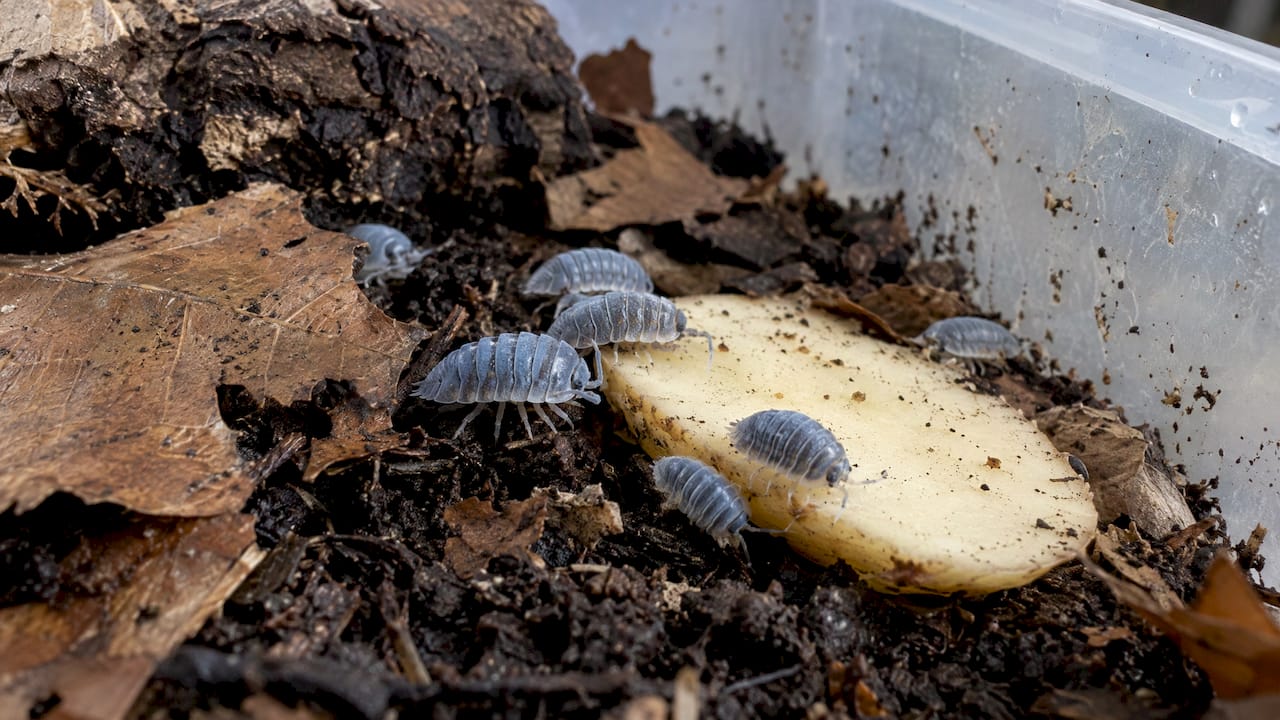
Can isopods eat potatoes?
Yes, in small amounts. Isopods readily eat starchy vegetables, and a thin slice of potato or sweet potato is a popular treat, but cooked, plain and washed is the safe approach. Never offer anything seasoned, salted or oily. Because uneaten food rots quickly in a warm tub, offer little and clear it within a day or two.
Breeding and colony size
Powder isopods are among the quickest breeders in the hobby. Keepers Codex calls them the fastest-breeding isopod commonly available, with a small starter culture able to grow into hundreds within a few months under good conditions. Females carry eggs in a brood pouch, and the young emerge as tiny, nearly translucent mancae. InvertKeeping reports gestation of around two to four weeks and maturity in roughly two to three months in good conditions.
To keep a colony productive:
- Keep the temperature in the warm end of the range.
- Maintain a reliable damp zone.
- Offer protein weekly and keep calcium available.
- Disturb the tub as little as you can. Check it, top up, and leave it alone.
Overcrowding is the other side of success. Repti Guides notes that when a colony outgrows its space, you may see more aggression and higher mortality. Do not wait for that. Split the colony into a second tub, move surplus animals into a bioactive vivarium, or pass some on to other keepers.
Using powder isopods in a bioactive vivarium
A cleanup crew breaks down waste and recycles it into the substrate, which feeds your plants. The Wisconsin Herpetological Association explains this cycle and also points out that some springtails and isopods tolerate drier or wetter conditions better than others, so the choice of decomposers should match your enclosure.
That last point matters for powder isopods. They thrive in warm, moist conditions, which suits a rainforest setup for dart frogs well. A few practical points:
- Use them alongside springtails. Springtails handle mould and fine waste, while isopods deal with larger material such as leaf litter and faeces. You can see how we put these together in our bioactive supplies and microfauna.
- Seed enough, then let the population settle. Start with a modest number and give the vivarium time to find its balance.
- Provide leaf litter and cork hides. A bioactive floor that is bare of leaf litter will not sustain a crew.
- Think about your frogs. Powder isopods are small and quick. Some keepers find that they are eaten by larger or more opportunistic frogs. Watch what your animals actually do and adjust numbers accordingly.
- Do not treat the crew as a replacement for maintenance. You still need to remove dead plant matter, spot-clean obvious waste, monitor humidity and top up leaf litter.
Common problems and how to fix them
Most colony problems trace back to moisture, calcium or leftover food. InvertKeeping lists failed moults, grain mites, dehydration and mould among the usual issues.
| Problem | Likely cause | What to do |
|---|---|---|
| Failed or patchy moults | Low humidity or too little calcium | Keep cuttlebone available and maintain a moisture gradient |
| Grain mites | Excess food, especially dry foods | Cut back supplemental feeding for a while, remove uneaten food and add springtails |
| Dehydration, animals clustering | Substrate too dry or ventilation drying the tub out | Mist more often and check that airflow is not pulling moisture out too quickly |
| Mould | Too wet, too little airflow or rotting food | Remove mouldy material, improve ventilation and mist less for a while |
| Escape attempts, mass die-offs | Moisture, temperature or air quality problem | Check each in turn, one change at a time |
Low numbers of mites are usually harmless. A heavy infestation competes for food and stresses the colony, so act early. Repti Guides also says that without enough calcium, you can expect failed moults and population crashes, so do not skimp on cuttlebone.
Our perspective on powder isopods
We keep isopods in our frog rooms because they earn their place. A well-run powder isopod culture gives you a steady supply of cleanup crew for new vivariums, and it takes the guesswork out of seeding a setup.
What we would tell any keeper is this: be boringly consistent. Warmth, a moisture gradient, leaf litter, calcium and a weekly protein feed will do more for your colony than any clever trick. Most of the problems we are asked about come from changing too many things at once.
Colour is the fun part, but the species is the same. Pick the morph you like, and give it the same patient care. If you are building a bioactive vivarium for dart frogs, think about the whole system: substrate, plants, springtails, isopods and the frogs themselves. That is how we approach every setup we build.
Anthony
Build your cleanup crew with us
We are a Nottingham-based UK specialist in dart frogs and bioactive vivariums, and we supply microfauna such as springtails and isopods, tropical plants, supplements, live foods and vivarium supplies. If you are planning a new setup or topping up an existing one, start with the Frogfather shop.

If you also keep frogs, our fruit fly cultures and live food include subscription options, so feeding day does not catch you out.
FAQ
Are powder orange and powder blue isopods the same?
Yes. Both are Porcellionides pruinosus. The orange is a captive-bred colour form and the blue is closer to the natural look. Their care needs are the same, so you can follow one guide for both.
What temperature do powder blue isopods need?
Aim for roughly 20 to 28°C. UK guidance from Keepers Codex gives 22 to 28°C as ideal, with a cooler side available, and breeding is fastest at the warmer end. Use a thermostat-controlled heat source if your room runs cold in winter.
What do powder orange isopods eat?
The same as blue ones: leaf litter, decaying wood, blanched or raw vegetables, and a protein source once a week. Keep a calcium source such as cuttlebone available at all times. Remove uneaten fresh food promptly.
How many powder isopods do I need for a vivarium?
A small starter group is enough, because they breed quickly. Seed modestly and let the population find its level. Keep a spare culture tub so you can top up the vivarium or replace losses if needed.
Why is my powder blue isopod losing its colour?
The powdery coat is laid down before each moult, so animals look patchy or duller for a day or two afterwards. If it persists and animals are also sluggish or dying, check humidity, calcium and temperature.
Sources
- Porcellionides pruinosus, Soil Ecology Wiki, University at Buffalo
- Powder Orange Isopod, Furry Critter Network
- Powder Isopods Care Guide, Vivipedia
- Tropical powder isopod, Keepers Codex
- Powder Blue Isopod Care: Beginner Guide, InvertKeeping
- Powder Blue Isopod Care Sheet, Repti Guides
- The Basics of Bio-Active, Wisconsin Herpetological Association
Made with BabyLoveGrowth to strengthen your backlink profile