
Most reptiles and amphibians kept on insects need calcium powder on their food at every feed. They also need a separate multivitamin-multimineral powder a couple of times a week. The details depend on your species, your UVB lighting and what the feeder insects are eating. This guide sorts out plain calcium, calcium with D3 and multivitamin powders. It covers how to dust, how often, and why frogs are a slightly different case.
TL;DR
- Calcium deficiency is one of the most common nutritional problems in pet reptiles, and the RSPCA’s guidance is to use a calcium supplement with a high calcium-to-phosphorus ratio at every feed.
- Add a multivitamin-multimineral powder two to three times a week. Daily use risks vitamin overdose unless an exotics vet has told you otherwise.
- Dust the food, never the water. Powder in water gives an unreliable dose.
- UVB, correct temperatures and gut-loaded feeders matter as much as the powder. Powder cannot fix a poor setup.
- Frogs, including dart frogs, usually do best on a well-chosen all-in-one dusting powder used on a schedule, rather than several separate tubs.
Table of Contents
- Why reptiles and amphibians need calcium powder
- Plain calcium, calcium with D3 or multivitamin?
- How to dust feeder insects properly
- Do UVB, temperature and feeders matter more than the powder?
- Calcium powder for frogs and other amphibians
- Can you give too much?
- Our view: keep the system simple
- Choosing a dusting product from Frogfather
- A simple weekly routine to adapt
- FAQ
- Sources
Why reptiles and amphibians need calcium powder
Insects are poor sources of calcium. Crickets, fruit flies and mealworms contain far more phosphorus than calcium, and phosphorus competes with calcium for absorption. A captive animal eating only those insects slowly runs short, so the powder on the food makes up the difference.
The consequence is metabolic bone disease (MBD), also called secondary nutritional hyperparathyroidism. It happens when calcium, phosphorus or vitamin D3 levels are out of balance because of poor diet or husbandry, and it can lead to death if untreated. According to the MSD Veterinary Manual, signs include:
- lethargy and loss of appetite
- muscle twitching
- swollen or distorted bones in the jaw or limbs
- fractures
- in severe cases, tetany or cloacal prolapse
Spinal deformities usually develop through poor husbandry while the animal is still growing. That is why juveniles and breeding females matter most. If you see twitching, a soft jaw or a wobbly gait, book an appointment with an exotics vet rather than increasing the dose yourself.
Plain calcium, calcium with D3 or multivitamin?
This is the question behind most searches. There are three kinds of powder, and each does a different job.
| Powder | What it does | Typical use |
|---|---|---|
| Calcium only (no D3) | Raises calcium intake without adding vitamin D | Most feeds, especially where UVB is good |
| Calcium with D3 | Adds vitamin D3 to help absorb calcium | Used less often, depending on species and lighting |
| Multivitamin-multimineral | Supplies vitamins (including preformed vitamin A and D3) and trace minerals | Two to three times a week |
The RSPCA’s guidance for insectivorous, omnivorous and herbivorous reptiles is simple. Use a high calcium-to-phosphorus supplement at every feed. Give a combined multivitamin-multimineral product two to three times a week. If that combined product itself has a high calcium-to-phosphorus ratio, you do not need a separate calcium supplement on those days (RSPCA).
Species change the pattern. For panther chameleons, one veterinary-reviewed guide suggests calcium without D3 at most feeds, calcium with D3 twice a week and a multivitamin once a week. A bearded dragon under strong UVB, a nocturnal gecko and a tortoise on a leafy diet will each differ again. Start from your species’ care sheet and your vet’s advice, not a generic schedule.
Why “no D3” is so common
Reptiles with proper UVB lighting make their own vitamin D3 in the skin. Adding D3 at every feed on top of that is how keepers drift into overdose. Plain calcium is the safe workhorse. The D3 version and the multivitamin are the occasional extras.
What to check on the label
- Calcium source and fineness. A fine powder sticks to insects. Coarse grit falls off in the tub.
- Phosphorus. Phosphorus-free or very low-phosphorus calcium is the aim.
- Vitamin D3. Is it included, and in what amount?
- Preformed vitamin A versus beta-carotene. Some species convert carotenoids well, others do not, so check what your species needs.
- Expiry and storage. Vitamins degrade, so buy a size you will finish.
How to dust feeder insects properly
The RSPCA notes that the most effective way to give supplements is by dusting food items. Powder in the water gives an inconsistent and unreliable dose. Here is a method that works for most insect eaters.
- Put the insects you will feed in a deep lidded tub or a shaker.
- Add a small pinch of powder. You want a light coating, not a white crust.
- Swirl gently for a few seconds so every insect is covered.
- Feed straight away. Powder rubs off as insects move and clean themselves.
- Remove uneaten dusted insects if your animal does not take them quickly.
Two habits cause most problems. The first is dusting a whole tub of crickets in advance. The second is changing the powder every few weeks chasing a better result. Pick a routine, write the schedule down and keep to it. Fiddling with the system is more likely to upset the animal than help.
Do UVB, temperature and feeders matter more than the powder?
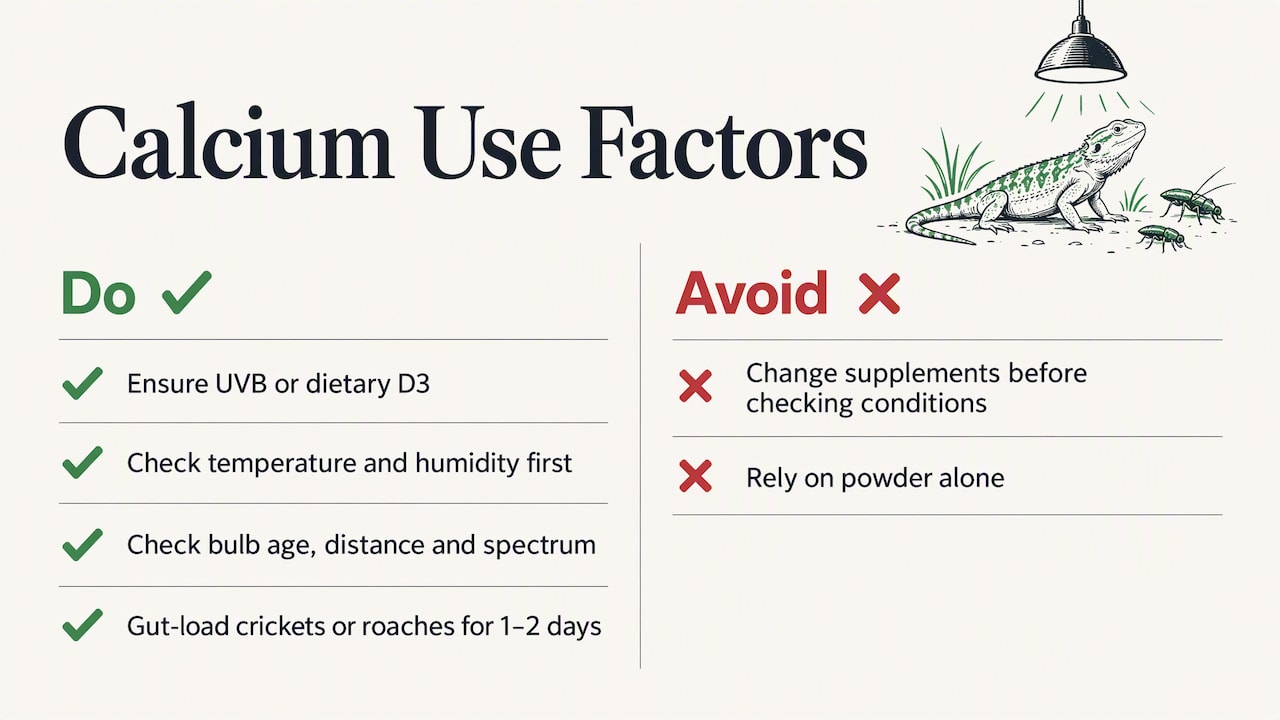
In many cases, yes. Calcium cannot be used properly without the right vitamin D3 status, and D3 comes from either UVB or the diet. A bulb that is old, too far away or the wrong spectrum fails quietly. If your animal is lethargic or struggling to move, check temperatures, humidity and bulb age first, before changing supplements.
Gut-loading also counts. Feeding crickets or roaches a calcium-rich diet for a day or two before they are eaten improves what the animal actually receives. Powder on the outside is only part of the picture.
Calcium powder for frogs and other amphibians
Frogs eat small prey, absorb nutrients through a fast metabolism and live in humid enclosures, so their routine looks different from a lizard’s. Here is what the evidence supports and where keeper practice fills the gaps.

UVB and vitamin D3 seem to matter for amphibians as well. The Amphibian Ark’s nutrition recommendations say UVB is necessary for D3 synthesis and normal calcium metabolism in many captive species. Results depend on lamp spectrum, distance and duration. A study on oriental fire-bellied toads found that UVB raised serum vitamin D3 and, together with 10% dietary calcium, improved skeletal structure. It also suggested that standard calcium-plus-D3 dusting may not fully replace UVB and calcium-rich feeders.
The practical points for dart frogs and similar small species:
- Fruit flies are low in calcium and many vitamins, so dusting is essential, not optional.
- Use a fine powder and a light coat. Fruit flies are tiny and easily clogged.
- Think in terms of a rotation. Many keepers use a calcium-based dusting at most feeds and a vitamin-rich powder on a set schedule. Our dart frog supplementation guide sets out a full schedule.
- Do not stack products. Combining a calcium-with-D3 powder, a multivitamin and a vitamin A product in one week is how overdoses happen.
- Vitamin A deserves care. Preformed vitamin A matters for amphibians, particularly breeding females, but it is fat-soluble and can build up. Use a product made for amphibians, follow its label and ask an exotics vet before adding extra.
- Feeding matters too. Our dart frog feeding guide and nutrition guide on gut-loading and supplementation cover what the flies eat before they reach the frog.
Microfauna cultures need calcium too, though they take it differently. If you keep springtails or isopods in the viv, see whether springtails need calcium.
Can you give too much?
Yes. The RSPCA says daily use of combined multivitamin-multimineral supplements could cause vitamin overdose, so avoid it unless an exotics specialist vet advises otherwise (RSPCA). Calcium itself is essential, but excess can cause hypercalcaemia, with effects on the heart, blood pressure and kidneys (PetMD).
If you are unsure whether a product suits your species, or your animal already shows signs of bone problems, see an exotics vet before changing the routine.
Our view: keep the system simple
We breed and keep amphibians in bioactive setups, and the pattern we see is consistent. Problems rarely come from a lack of products. They come from a muddled routine: three tubs, no schedule and a keeper changing things every fortnight.
Our approach is to tighten up the weak point and leave the rest alone:
- Choose one calcium powder and one all-in-one powder, and learn what is in each.
- Fix the schedule in writing, on the tub lid if need be.
- Get the lighting, temperatures and feeder diet right before blaming the powder.
- Give it time. Bone and growth problems build slowly, and so does recovery.
That is also why we developed our own range. The products are designed, selected and tested through hands-on experience keeping and breeding amphibians in established bioactive enclosures, not just stocked from a catalogue.
— User
Choosing a dusting product from Frogfather
If you keep frogs or other small insect eaters and want a simple routine, our All-in-One Dusting Supplement in an 80g easy-dose shaker is made for that. The shaker lets you apply a light, even coat. If you prefer a regular delivery, we also offer an All-In-One Vitamin & Mineral Dust for Feeder Insects subscription, so the tub does not run out mid-schedule. Check the label for ingredients and directions before you buy, and match them to your species.
If you are setting up a first enclosure, the New Frog Care Package puts the basics in one order. You can also browse our microfauna foods and supplements.

A simple weekly routine to adapt
This is an illustration of the structure, not a prescription. Adjust it to your species, your lighting and your vet’s advice.
| Day | Insect eater on a typical routine |
|---|---|
| Feed days 1, 2 | Calcium powder |
| Feed day 3 | Multivitamin-multimineral powder |
| Feed days 4, 5 | Calcium powder |
| Feed day 6 | Multivitamin-multimineral powder |
| Rest or lighter feed day | No supplement |
This follows the RSPCA’s pattern of calcium at every feed with a multivitamin two to three times a week. It does not apply when you use an all-in-one product that already has a high calcium-to-phosphorus ratio, because the RSPCA notes that separate calcium is then unnecessary on those days. Always follow the directions on the label of your particular powder.
FAQ
Is calcium powder with D3 better than plain calcium?
Not automatically. Plain calcium is the safer everyday choice when your animal has proper UVB, because it makes its own D3. Calcium with D3 is typically used less often, and the right frequency depends on species and lighting, so check your care sheet or ask a vet.
Do frogs need calcium powder?
Yes, if they eat insects such as fruit flies, which are low in calcium. Dust the food lightly and follow a set schedule. Many keepers use an all-in-one powder designed for amphibians to keep things simple.
Can I put calcium powder in the water?
No. The RSPCA says dusting food is the most effective method, and powder in water gives an inconsistent and unreliable dose. Dust the insects just before feeding.
How often should I use a reptile multivitamin powder?
The RSPCA advises two to three times a week for most insect-eating and omnivorous reptiles. Daily use could cause vitamin overdose, so avoid it unless an exotics specialist vet recommends it.
Sources
- Food supplements for exotic pets, RSPCA
- Nutritional, Metabolic, and Endocrine Diseases of Reptiles, MSD Veterinary Manual
- Metabolic Bone Disease (MBD) in Reptiles, PetMD
- Your Reptile’s Proper Diet and Environment, University of Illinois Veterinary Medicine
- Panther Chameleon Care Guide, Vet Verified
- Nutrition Recommendations for some Captive Amphibian Species, Amphibian Ark
- Impacts of UVB provision and dietary calcium, Journal of Animal Physiology and Animal Nutrition
Recommended
- Complete Guide To Dart Frog Supplementation
- Do Springtails Need Calcium? Cuttlebone & Culture Guide
- Dart Frog Nutrition Beyond Eggs: Macronutrients, Gut-Loading, And Supplementation Guide (UK 2025)
- Dart Frog Feeding Guide UK | Food, Frequency & Supplements
Written with the help of BabyLoveGrowth