Ask ten dart frog keepers what the most important part of successful husbandry is and you’ll probably receive ten different answers.
Some will say lighting.
Others will argue for humidity.
Many focus on temperatures or vivarium design.
While every one of those things matters, we’ve always believed that healthy frogs begin with healthy nutrition.
A dart frog can only ever be as healthy as the food it eats.
For that reason, feeding isn’t simply about throwing a few fruit flies into a vivarium every couple of days. It’s about understanding prey quality, variety, supplementation and developing a routine that supports your frogs throughout every stage of their lives.
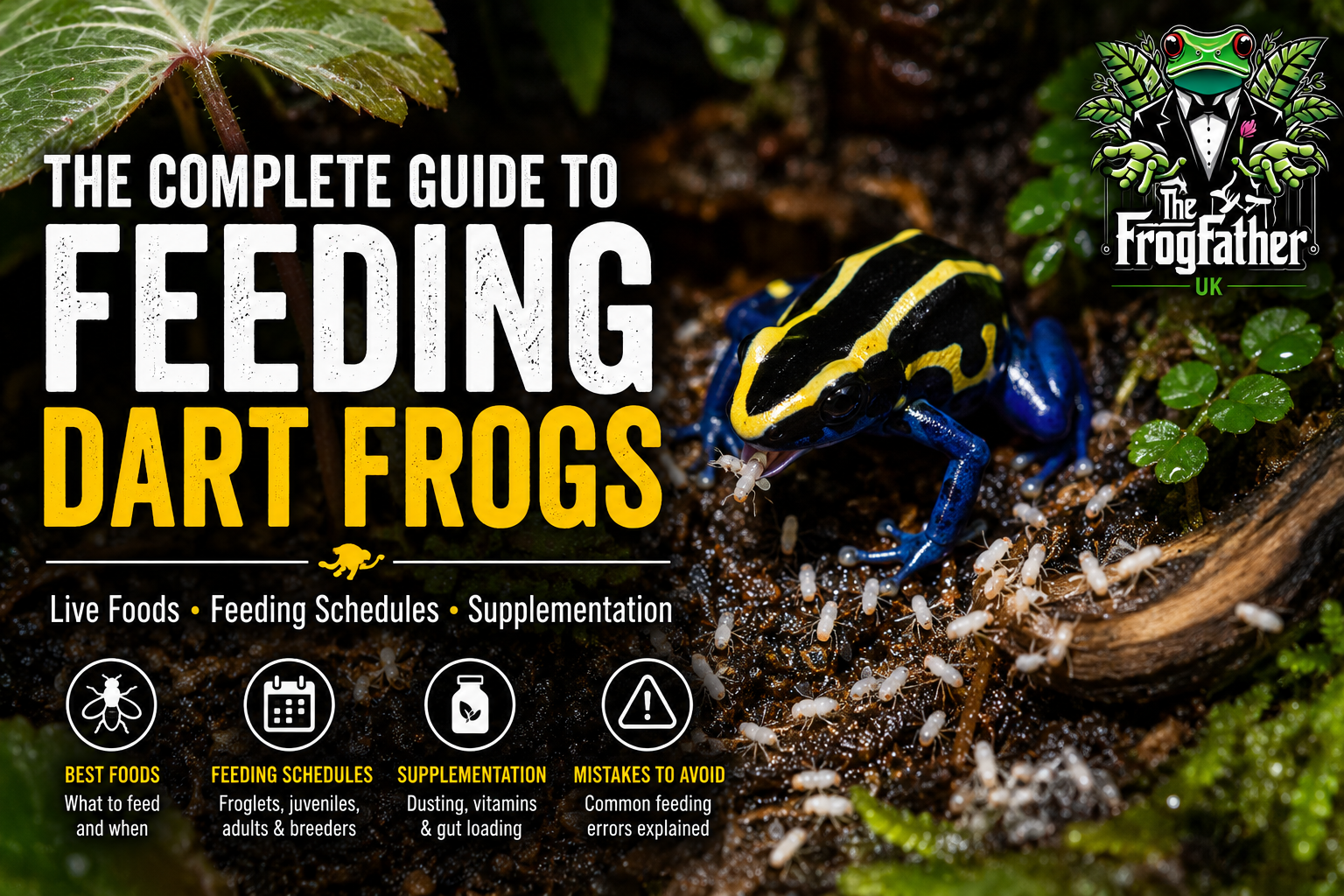
This guide brings together everything we’ve learned from maintaining and breeding dart frogs over many years, covering live foods, feeding schedules, supplementation and the practical techniques we use here at Frogfather.
What Do Dart Frogs Eat in the Wild?
Wild dart frogs spend much of their day actively searching through leaf litter, moss and decaying vegetation for tiny invertebrates.
Their diet changes constantly depending on what is available.
Rather than eating one single prey item, they consume a remarkable variety of insects and other small invertebrates throughout the day.
This diversity is one reason wild dart frogs obtain such a broad nutritional profile.
Captive frogs obviously don’t have access to the same range of prey, so it’s our responsibility to recreate that nutritional diversity as closely as possible.
Feeding Is More Than Quantity
One of the biggest misconceptions in the hobby is that more food automatically means healthier frogs.
In reality, quality matters far more than quantity.
Healthy feeder insects raised on good culture media and supplemented correctly provide far greater nutritional value than simply offering larger amounts of poor-quality prey.
Successful feeding combines four key elements:
- Appropriate prey size.
- Healthy live food cultures.
- Balanced supplementation.
- Consistent feeding routines.
Remove any one of those and the overall quality of the diet begins to decline.
Why Live Food Matters
Dart frogs are visual hunters.
Movement triggers feeding behaviour.
Unlike many reptiles, they don’t usually recognise dead food items as prey.
Live insects encourage natural hunting behaviour, provide mental stimulation and allow frogs to forage throughout the enclosure in much the same way they would in nature.
Watching dart frogs hunt is also one of the great pleasures of keeping them.
Our Philosophy at Frogfather
🐸 Frogfather Philosophy
People often ask us what the “perfect” dart frog diet looks like.
Our answer is always the same.
There isn’t one perfect feeder insect.
Instead, healthy dart frogs come from combining excellent live foods with sensible supplementation and consistency.
We’ve never believed in making feeding unnecessarily complicated.
Provide high-quality live foods, dust them appropriately, offer variety where practical and maintain a routine you can follow every week of the year.
Simple, consistent husbandry almost always outperforms complicated feeding schedules that are difficult to maintain.
What You’ll Learn in This Guide
Over the next sections we’ll compare the most commonly used feeder insects, explain when each should be used, discuss feeding schedules for froglets through to breeding adults and highlight the mistakes that most frequently cause nutritional problems.
Whether you’re keeping your first pair of dart frogs or managing multiple breeding groups, the goal is the same: healthy frogs that thrive rather than simply survive.
The Best Live Foods for Dart Frogs
No single feeder insect provides everything a dart frog needs.
In the wild, dart frogs consume dozens of different tiny invertebrates as they move through leaf litter, moss and low vegetation. Every prey item contributes something slightly different to their overall nutrition.
Captive frogs don’t have access to that diversity, so our aim is to provide the highest quality feeder insects possible, while introducing variety where practical.
Below are the live foods we regularly use or recommend at Frogfather.
Flightless Fruit Flies
Fruit flies remain the cornerstone of dart frog nutrition and are the feeder insect used by the vast majority of breeders worldwide.
They are active, easy to digest and available in two main sizes, making them suitable for everything from newly morphed froglets to fully grown adults.
They should form the foundation of most feeding routines.
Best for: Daily feeding, froglets, juveniles and adults.
Read more: Complete Guide to Fruit Fly Cultures
Springtails
Springtails are often thought of purely as a clean-up crew, but they are also an excellent natural food source.
Small froglets will actively hunt them throughout the day, allowing continuous grazing between larger feeds.
Because springtails reproduce inside the vivarium, they create a self-replenishing source of tiny prey.
At Frogfather, every new vivarium we build is seeded with multiple species of springtails because each occupies slightly different areas within the enclosure.
Best for: Froglets, thumbnails and bioactive vivariums.
Read more: Complete Guide to Springtails
Bean Beetles
Bean beetles are an excellent addition to a varied feeding programme.
Their slow movement makes them easy for frogs to catch, and many keepers find them particularly useful when encouraging shy or recently acquired frogs to feed.
They also provide welcome variety alongside fruit flies.
Best for: Adult dart frogs and larger juveniles.
Grindle Worms
Grindle worms are rich in protein and can be a valuable occasional feeder.
Because they move differently from insects, many frogs respond enthusiastically to them.
We generally recommend them as part of a varied diet rather than the sole food source.
Best for: Conditioning adults and occasional variety.
Pea Aphids
Pea aphids are one of the easiest live foods to culture and are readily accepted by many dart frog species.
They reproduce quickly, don’t climb smooth surfaces particularly well and provide useful dietary variety.
They are especially useful during periods when fruit fly production is temporarily reduced.
Woodlice (Isopods)
Most tropical isopods should be viewed primarily as part of the clean-up crew rather than a staple food.
Very small juvenile isopods may occasionally be eaten, but their main role is recycling waste and maintaining a healthy bioactive ecosystem.
Pinhead Crickets
Very small pinhead crickets can be offered to larger dart frog species and breeding adults.
They should always be appropriately dusted before feeding and should not be allowed to remain uneaten in large numbers.
While useful, they are generally a supplementary food rather than a replacement for fruit flies.
Locust Hatchlings
Freshly hatched locusts are accepted by some of the larger dart frog species.
They provide enrichment through their movement but should be fed in moderation and only when appropriately sized.
Foods We Generally Avoid
Not every feeder insect is suitable for dart frogs.
- Mealworms (too large and heavily armoured for most dart frogs).
- Waxworms (very fatty and best avoided as a routine food).
- Large crickets or locusts (can stress smaller frogs).
- Wild-caught insects (risk of pesticides and parasites).
If in doubt, choose smaller prey. A good rule of thumb is that the feeder insect should comfortably fit within the width of the frog’s mouth.
Comparison of Common Live Foods
| Live Food | Staple? | Froglets | Adults | Bioactive |
|---|---|---|---|---|
| Fruit Flies | ⭐⭐⭐⭐⭐ | Excellent | Excellent | No |
| Springtails | ⭐⭐⭐⭐ | Excellent | Occasional | Yes |
| Bean Beetles | ⭐⭐⭐⭐ | Good | Excellent | No |
| Grindle Worms | ⭐⭐⭐ | Occasional | Excellent | No |
| Pea Aphids | ⭐⭐⭐ | Good | Good | No |
| Pinhead Crickets | ⭐⭐⭐ | No | Good | No |
Next: We’ll look at feeding schedules for froglets, juveniles and adults, explain how often to feed, how much to offer and how supplementation fits into a healthy long-term routine.
How Often Should You Feed Dart Frogs?
One of the most common questions new keepers ask is, “How often should I feed my dart frogs?”
Unfortunately, there isn’t a single answer that suits every frog.
The ideal feeding schedule depends on several factors, including the species, age, body condition, breeding status and the temperature of the vivarium.
Rather than following rigid rules, it’s far better to understand your frogs and adjust your routine accordingly.
Feeding Froglets
Recently morphed froglets have extremely fast metabolisms and relatively small energy reserves.
For that reason, they benefit from having access to food every day.
Springtails within the vivarium provide a constant source of tiny prey between main feeds, while freshly cultured Drosophila melanogaster should form the basis of their daily diet.
Small, frequent feeds are generally preferable to occasional large ones.
Feeding Juveniles
As dart frogs grow, their appetite increases dramatically.
Juveniles should continue receiving food daily, with prey size gradually increasing as they mature.
This is an excellent stage to introduce a little more variety, including bean beetles, pea aphids and, where appropriate, small Drosophila hydei.
Feeding Adult Dart Frogs
Healthy adult dart frogs generally thrive when fed several times each week, although many keepers choose to offer smaller amounts daily.
The important thing is consistency.
Observe your frogs carefully.
A healthy dart frog should appear alert, active and maintain good body condition without becoming overweight.
If uneaten food is regularly left wandering around the vivarium several hours after feeding, you’re probably offering more than your frogs require.
Feeding Breeding Adults
Breeding frogs place significantly greater demands on their bodies.
Producing eggs requires energy, calcium and a broad range of vitamins and minerals.
During active breeding periods, many keepers choose to increase feeding frequency slightly while ensuring every feed is appropriately supplemented.
Maintaining excellent nutrition before and during breeding helps support healthy adults and strong offspring.

Why Supplementation Matters
Even the highest quality feeder insects cannot perfectly replicate the enormous diversity of prey available to wild dart frogs.
Appropriate supplementation bridges that gap.
A balanced supplement provides calcium, Vitamin D3, Vitamin A, carotenoids and essential trace minerals that help support long-term health.
Rather than rotating multiple different products throughout the week, we’ve always preferred a simpler approach that can be followed consistently.
Our own Complete Guide to Dart Frog Supplementation explains the science behind supplementation in much greater detail.
Dusting Live Foods
Dusting should take place immediately before feeding.
Only prepare the number of insects you intend to offer during that feed.
Leaving dusted insects for prolonged periods allows some of the supplement to be lost through grooming, movement and contact with the container.
A light, even coating is all that’s required.
More powder does not necessarily mean better nutrition.
Water Is Part of Nutrition Too
Although dart frogs obtain much of their moisture through their environment, clean water remains essential.
Regular misting, appropriate humidity and access to clean water droplets all contribute to healthy hydration.
Good nutrition and good hydration work together—they should never be considered separately.
🐸 Frogfather Philosophy
People often search for the “perfect” feeding schedule.
In reality, healthy dart frogs aren’t produced by a timetable.
They’re produced by consistently providing high-quality live foods, sensible supplementation and careful observation.
Your frogs will tell you far more than any chart ever can.
Signs Your Feeding Routine Is Working
- Healthy body condition without obesity.
- Bright colours and smooth skin.
- Active hunting behaviour.
- Regular breeding activity in mature pairs.
- Strong growth in froglets and juveniles.
- Very little uneaten food remaining after feeding.
Next: We’ll answer the most common feeding questions, discuss mistakes to avoid and bring together everything covered in this guide.
Common Feeding Mistakes
Even experienced keepers occasionally make mistakes when feeding dart frogs. Fortunately, most are easy to avoid once you understand what your frogs actually need.
Offering Food That’s Too Large
Dart frogs should only be offered prey that can be comfortably swallowed. If a feeder insect is wider than the frog’s mouth, it’s probably too large.
Choosing appropriately sized prey reduces stress and increases feeding success.
Relying on a Single Food Source
Fruit flies are an outstanding staple food, but introducing additional live foods where practical provides variety and encourages natural hunting behaviour.
Springtails, bean beetles, pea aphids and occasional grindle worms can all play a role within a balanced feeding programme.
Skipping Supplementation
Even excellent feeder insects should be appropriately supplemented.
Captive diets simply cannot replicate the huge diversity of prey available in the wild, making vitamin and mineral supplementation an important part of long-term husbandry.
Read our Complete Guide to Dart Frog Supplementation for a more detailed explanation.
Overfeeding
More food doesn’t necessarily produce healthier frogs.
Regular observation is far more valuable than blindly following a feeding chart.
Healthy dart frogs should remain active, alert and well-proportioned without becoming overweight.
Keeping Too Few Live Food Cultures
One of the biggest causes of feeding problems isn’t the frogs at all—it’s running out of live food.
Maintain multiple cultures at different stages of development so that one culture can replace another as it naturally declines.
Frequently Asked Questions
Can dart frogs eat fruit flies every day?
Yes. Flightless fruit flies are the primary staple food for most captive dart frogs and form the basis of feeding programmes used by many successful breeders.
Do dart frogs need variety?
Although many frogs thrive on a diet centred around fruit flies, introducing additional live foods such as springtails, bean beetles and pea aphids can provide enrichment and dietary variety.
Should every feed be dusted?
Most keepers dust feeder insects regularly using a balanced supplement. Rather than rotating multiple products, we prefer a consistent approach that is easy to maintain throughout the year.
Can dart frogs overeat?
Healthy dart frogs usually regulate their own feeding well, but consistently offering excessive quantities of food can lead to obesity and unnecessary waste.
Can dart frogs eat wild insects?
We do not recommend collecting insects from the wild, as they may have been exposed to pesticides, parasites or environmental contaminants.
Related Guides
If you found this article useful, these guides expand on individual areas of dart frog nutrition and husbandry.
- Complete Guide to Fruit Fly Cultures
- Complete Guide to Springtails
- Complete Guide to Dart Frog Supplementation
- Complete Guide to Clay Baths
- Complete Guide to Tropical Moss
🐸 Final Thoughts
Successful dart frog feeding isn’t about finding a miracle feeder insect or following a complicated timetable.
It’s about consistently providing high-quality live foods, using sensible supplementation and paying attention to your frogs.
Every collection is slightly different, and experience will always be your greatest teacher.
Over the years, we’ve found that simple routines carried out consistently produce healthier frogs than complicated systems that are difficult to maintain.
Healthy cultures, healthy feeder insects and healthy frogs—that’s the philosophy we’ve built Frogfather around.
Need help choosing the right live foods or supplements? Browse our range of feeder insects, microfauna and nutritional products, all developed and used within our own breeding collection.