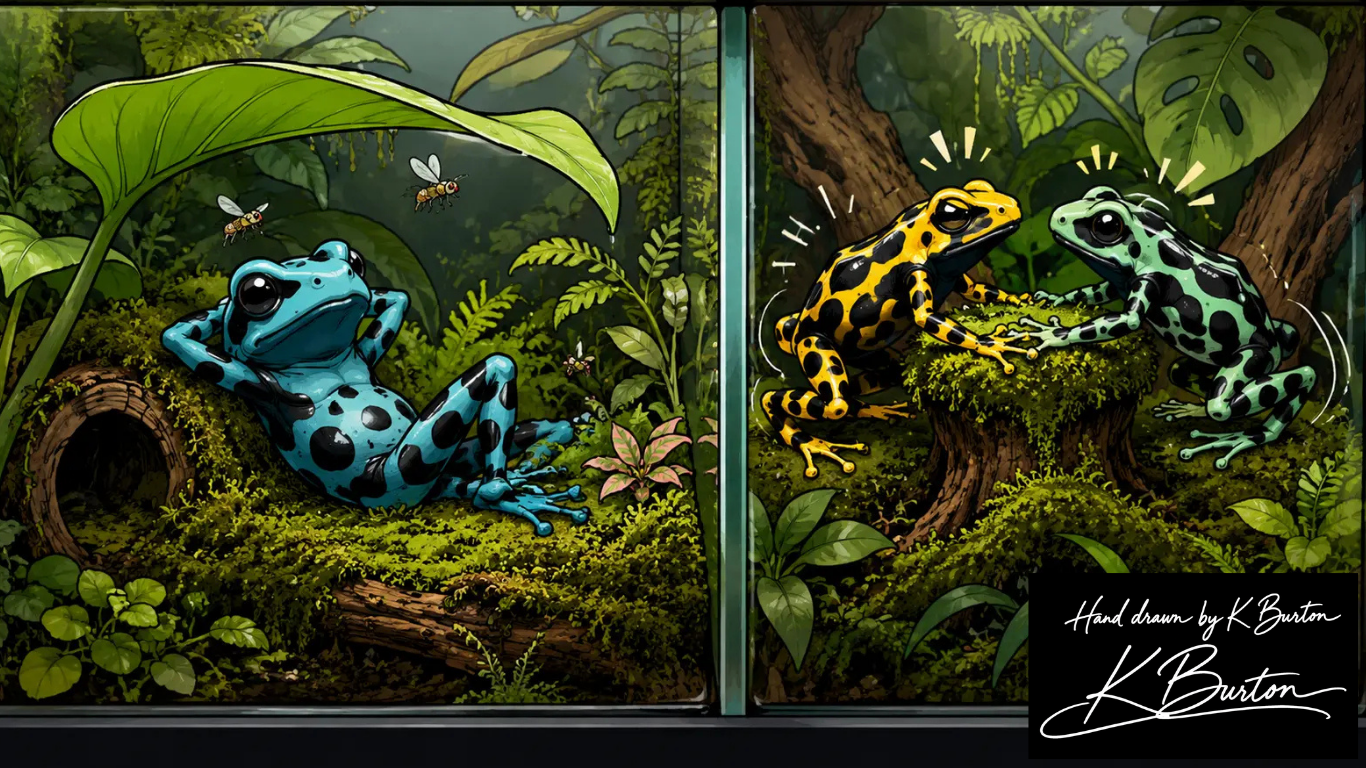

Husbandry & Evidence Review – 5 September 2026
This older grow-out guide has been corrected to remove fixed 80–100% RH, ‘stress-free’, escape-proof and best-possible-start claims. Grow-out design should prioritise feeding access, moisture, ventilation, hygiene, observation and secure containment.
🟢 3D Vivarium for Isopods, Spiders & Froglets – Sliding Door, Lit & Vented – 25×30×25cm
This enclosure can be used for grow-out where the animal, vent size and door tolerances are appropriate. Check every opening; no enclosure is described as universally escape-proof.
Water Area Setup: Let Froglets Absorb Their Tails Safely
Newly morphed dart frogs need access to water as they finish absorbing their tails. You can achieve this in three ways:
- A small shallow water cup with a slope they can walk into
- A corner pond built into the substrate
- A sloped filter foam ramp that dips into a water area
I personally use filter foam cut at a 45° angle, covering about 75% of the tub’s base and dipping into a water pool. This ensures:
- Constant access to moisture
- A walk-in water zone
- Easy substrate moisture control
Use reverse osmosis (RO) water with added minerals or mineral water. Avoid tap water unless properly dechlorinated.
To enrich the water, drop in a kibosha leaf or Indian almond leaf—this releases tannins that prevent bacterial build-up and mimic natural conditions.
Substrate and Bioactive Foundation
On top of the foam base, add a layer of quality substrate like ABG mix, coco fibre, or your favourite bioactive blend. Then:
- Inoculate with springtails and dwarf isopods
- Sprinkle a tiny amount of fish flakes to feed microfauna
- Let the tub sit for 2–4 weeks to allow populations to establish
This pre-seeding ensures your cleanup crew is ready to deal with froglet waste and uneaten food, keeping your enclosure healthy and odour-free.
Leaf Litter: Shelter and Microfauna Food
Cover the substrate with a thick layer of leaf litter. This provides:
- Hiding places
- Moisture retention
- Additional food for springtails and isopods
✅ Recommended Product:
🍂 Ficus Messelina Leaf Litter – UK Grown, 1L Bag
A clean, pesticide-free option that supports your bioactive cycle and makes the tub feel more natural.
You can also add small cork bark pieces, moss clumps, or a cutting of hardy terrarium plants like Philodendron, Syngonium, or Pothos.
Ventilation Without Escapes
One of the biggest challenges with a frog growout tub is balancing airflow with containment. Fruit flies and springtails will escape through anything larger than 1mm mesh.
Solutions:
- Use a jeweller’s drill bit (0.5–1mm) to hand-drill tiny air holes
- OR install screw-in 3D-printed mesh vents for a professional finish
✅ Recommended Product:
🛠️ 3D-Printed Screw-In Vents
These printable vent inserts are easy to install and designed specifically for fruit fly containment and airflow control.
Feeding Froglets in the Tub
Your froglets will mainly eat:
- Springtails (constantly present)
- Flightless fruit flies (fed 1–2x per day)
- Microfauna leftovers, like isopod nymphs or biofilm
Dust flies with:
- Use one coherent supplementation system and follow the exact product directions rather than a universal calcium+D3 / vitamin-A rotation.
Ensure fruit flies don’t drown by providing climbing surfaces—leaf litter works great, or use a 3D-printed fruit fly feeding platform if available.
How Long Should Froglets Stay in the Growout Tub?
Most dart froglets stay in grow-out for 3 to 6 months, depending on:
- Species
- Growth rate
- Group size
- Enclosure conditions
Once they’re confident, feeding well, and hitting 1.5–2cm (depending on species), they can be transitioned into a permanent vivarium.
Maintenance Tips
| Task | Frequency |
|---|---|
| Mist tub lightly | Daily |
| Check water level | Daily |
| Change water (if cup) | Every 2–3 days |
| Wipe lid condensation | As needed |
| Feed microfauna | Weekly (flakes) |
| Replace leaf litter | Monthly |
| Full clean (if needed) | Every 3–6 months |
🧪 Summary Checklist: Frog Growout Tub Essentials
- ✅ Sealed tub or sliding-door vivarium
- ✅ Fine mesh vents or tiny drilled holes
- ✅ Moist filter foam base, 45° cut into water
- ✅ Clean RO or mineral water + tannins
- ✅ Bioactive substrate with springtails and isopods
- ✅ Leaf litter and optional live plants
- ✅ Daily access to food (springtails and fruit flies)
- ✅ Use a species-appropriate temperature and provide moist refuges plus ventilation; do not manage froglets around a permanent 80–100% RH target.
Build It Like a Pro
At Frogfather we have raised many clutches using variations of these methods. They are practical approaches, not proof of a single best grow-out design, and containment/stress must still be monitored in the finished setup.