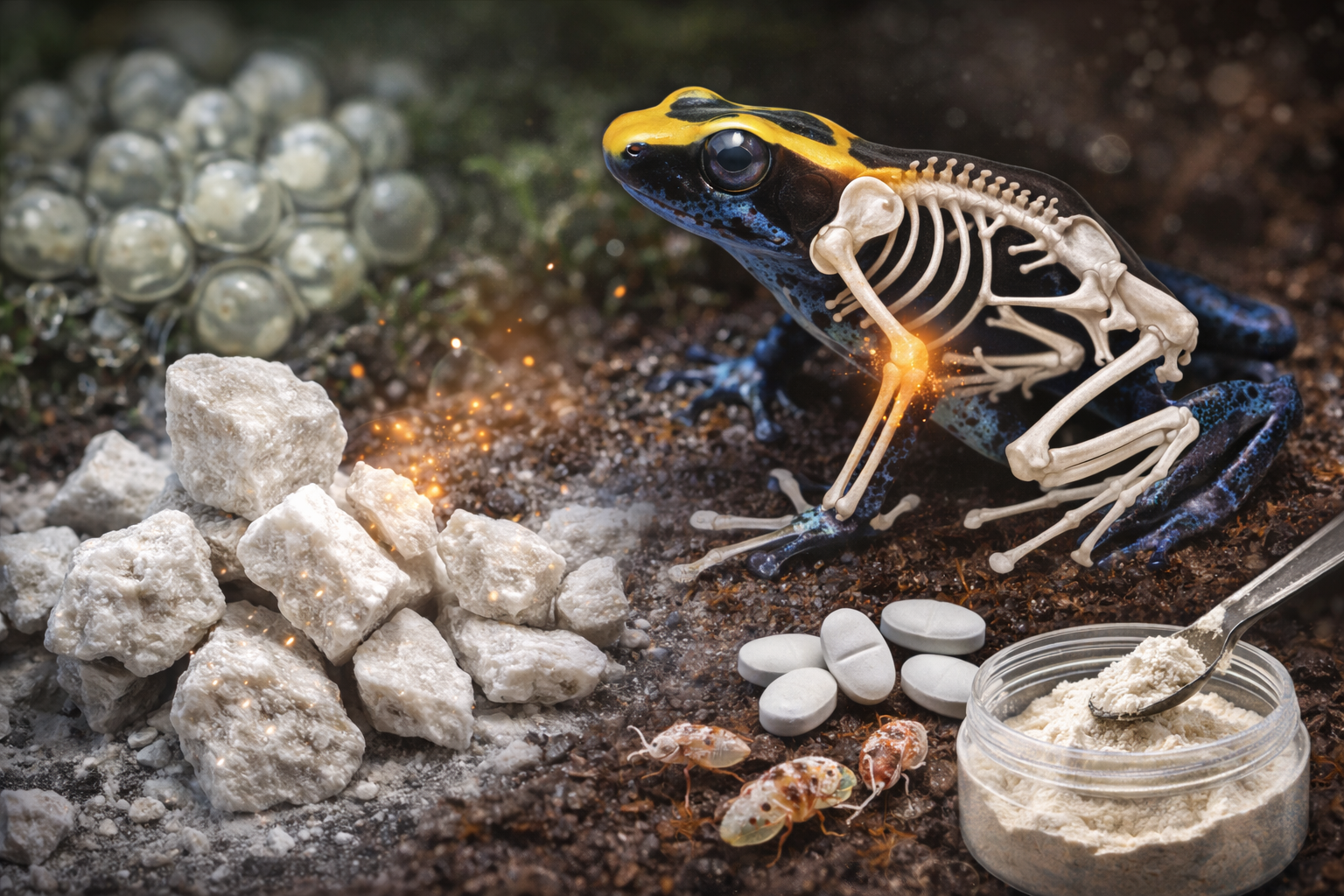
Calcium is the most talked-about mineral in dart frog keeping — and one of the least properly understood.
Most advice stops at: “Dust your flies with calcium.”
But calcium metabolism in amphibians is a complex physiological process involving:
- Intestinal absorption efficiency
- Vitamin D3 regulation
- Renal filtration
- Parathyroid hormone signalling
- Bone remodelling dynamics
- Reproductive demand
If you want to breed consistently, raise strong froglets, and avoid metabolic bone disease (MBD), you need to understand what is actually happening inside the animal.
Why Calcium Matters in Amphibians
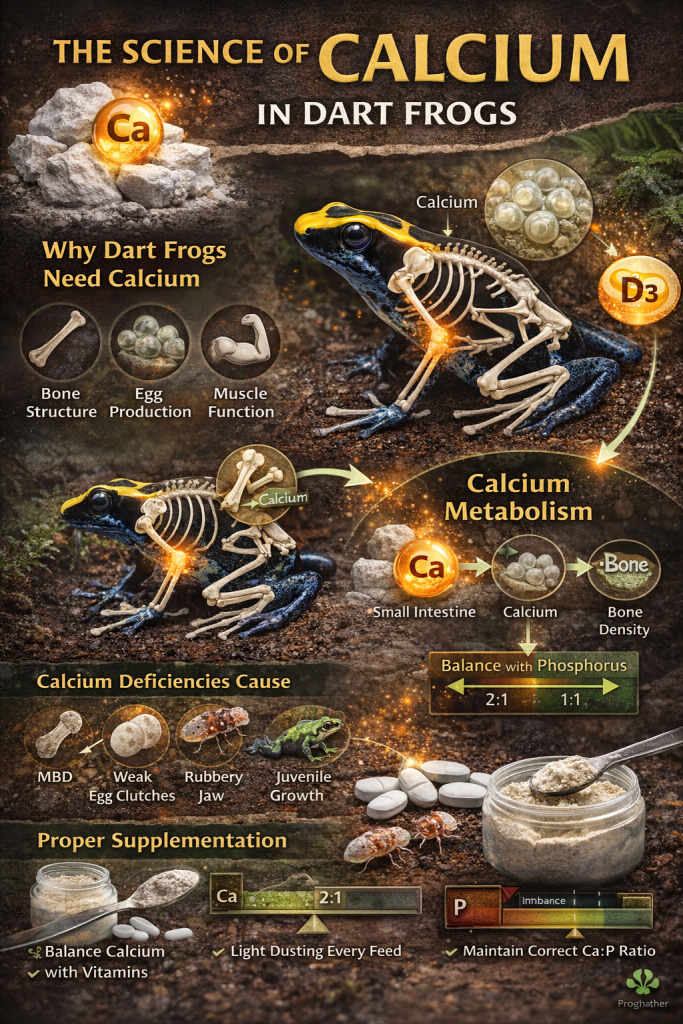
In dart frogs, calcium is required for:
- Bone mineralisation
- Neuromuscular function
- Cardiac contraction
- Oocyte (egg) formation
- Skeletal growth in froglets
Unlike mammals, amphibians are highly sensitive to mineral imbalance because they:
- Have permeable skin
- Regulate ions through both gut and skin
- Operate within tightly balanced hydration systems
This makes both deficiency and excess problematic.
How Calcium Is Actually Absorbed
Calcium absorption occurs primarily in the small intestine and is regulated by active Vitamin D3 (calcitriol).
Without adequate D3 levels, dietary calcium passes through unabsorbed.
This interaction is well documented in amphibian physiology research, including studies on mineral metabolism and endocrine regulation in anurans:
Role of Vitamin D in Amphibian Calcium Metabolism – PubMed
Calcium Homeostasis in Amphibians – PubMed
The key point: calcium dust alone is not enough if D3 balance is wrong.
The Calcium : Phosphorus Ratio Problem
Fruit flies (Drosophila melanogaster) naturally have an inverted calcium-to-phosphorus ratio.
High phosphorus intake without calcium correction drives hypocalcaemia.
This leads to:
- Bone demineralisation
- Muscle tremors
- Jaw softening
- Spinal deformity
Correcting the Ca:P ratio through supplementation is not optional — it is fundamental.
Metabolic Bone Disease (MBD) in Dart Frogs
MBD is not dramatic at first. It is slow, progressive, and often misdiagnosed.
Early signs:
- Subtle limb weakness
- Reduced hunting precision
- Thin hips in juveniles
- Reduced jump strength
Advanced cases show:
- Spinal curvature
- Rubber jaw
- Fractures
By the time skeletal deformity is visible, the imbalance has been present for weeks or months.
Froglets: The Highest Risk Stage
Froglets grow rapidly. Bone mineralisation during the first 8–12 weeks is intense.
Calcium demand at this stage is significantly higher than in stable adults.
Inconsistent dusting during grow-out stages is one of the most common silent causes of poor structural development.
Reproductive Females: Hidden Calcium Drain
Egg production requires substantial calcium allocation.
Repeated clutches without mineral repletion can:
- Reduce clutch size
- Produce soft or infertile eggs
- Deplete skeletal stores
In breeding females, calcium support must be consistent and bioavailable.
Can You Over-Supplement?
Yes.
Excessive D3 can cause hypercalcaemia and renal stress.
Excess calcium without balance can contribute to mineral precipitation in soft tissues.
Balance is key. Not volume.
Why Supplement Quality Matters
Not all supplements are equal.
Effective supplementation should:
- Provide balanced calcium and vitamins
- Contain stable D3 levels
- Disperse evenly on feeder insects
- Resist rapid wash-off in humid conditions
A consistent, balanced option such as our All-in-1 Vitamin & Mineral Dust supports stable mineral intake without overloading.
Consistency beats overcorrection.
Environmental Factors That Influence Calcium Use
- Chronic over-misting (supplement wash-off)
- Poor gut loading of feeder insects
- High stress states (increased metabolic demand)
- Low food intake due to environmental imbalance
Calcium metabolism does not operate in isolation. Husbandry precision matters.
Research-Backed Amphibian Mineral Insights
Further reading for those who want primary literature:
Mineral Metabolism in Amphibians – PubMed
Endocrine Regulation of Calcium in Anurans – PubMed
These studies reinforce that amphibian calcium regulation is hormonally controlled and environmentally influenced.
Practical Calcium Protocol for Dart Frogs
Based on experience and physiology:
- Light dusting every feed or every second feed
- Monthly Vitamin A support (carefully dosed)
- Monitor breeding females more closely
- Ensure feeders are consumed before misting
Simple. Consistent. Balanced.
FAQ
Do dart frogs need UVB for calcium absorption?
Most captive dart frogs rely on dietary D3 rather than UVB-driven synthesis, though low-level UVB may provide supplementary benefit.
Can I use pure calcium carbonate only?
Occasionally, but long-term success requires a balanced vitamin profile alongside calcium.
How often should I dust fruit flies?
Light, consistent dusting is more effective than heavy intermittent dusting.
Is metabolic bone disease reversible?
Early-stage MBD may improve with correction. Structural deformities are typically permanent.
Final Thoughts
Calcium is not just a supplement.
It is a biological system interacting with hormones, diet, hydration, and environment.
If you want strong bones, viable eggs, and healthy froglets, supplementation must be consistent, balanced, and bioavailable.
Guesswork is not good enough at this level.