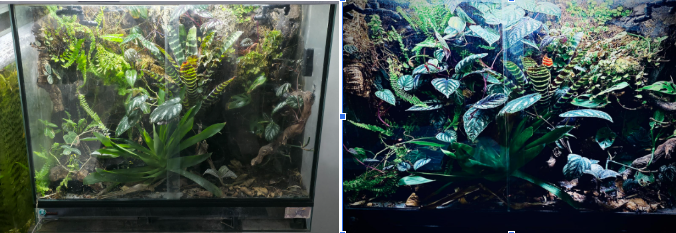

Looking for a bioactive terrarium background clay in the UK that behaves more like real rainforest substrate than a sealed plastic wall? A natural vivarium background builder clay (sometimes called “terrarium goo”) can hold moisture, support plant establishment, and create a more believable planted background than foam + silicone + substrate methods.
If you’ve built vivarium backgrounds the classic way, you’ll know the trade-offs: carved foam can look impressive, but it’s messy, staged-looking, and often needs a full carve/coat/seal routine; coco fibre can be quick, but it relies heavily on wicking and can dry unevenly up top. For real-world planted builds, we’ve found a better middle ground: bioactive background clay that behaves like a moisture-active surface from day one.
Our go-to product is: Terrarium Goo & Vivarium Clay (Dart Frog Safe Background Builder).
What Is “Terrarium Goo” (Natural Background Builder Clay) & Why UK Keepers Are Switching?
Terrarium goo is best described as a clay-based bonding and sculpting material designed for bioactive terrarium and vivarium backgrounds. Instead of building a background out of expanding foam and then trying to “make it natural” with coatings, this approach starts natural: dark, earthy, moisture-active, and far more plant-friendly in practice.
In simple terms: if you’re searching for bioactive terrarium background clay UK, plant-ready vivarium background clay, or a natural terrarium wall builder, this is what you mean.
Here’s the exact product we’re referring to: Terrarium Goo & Vivarium Clay | Dart Frog Safe Background Builder.
Why Natural Background Builder Clay Outperforms Foam + Silicone + Substrate
1) A More Natural Finish (No “Artificial Wall” Effect)
Foam backgrounds can be spectacular — carved rock faces, cliffs, ledges, the lot. But even when they’re done well, they often read as “constructed scenery”. A clay-based wall reads as mud, soil, root banks, and damp forest surfaces — which is far closer to how tropical microhabitats actually look in a planted vivarium.
2) Cleaner Builds With Less Mess
Expanding foam builds can be a full-on project: foam, carve, seal, silicone, press in substrate, tidy up, cure… then repeat. A natural vivarium background clay is a more controlled workflow because you apply it only where you want it, and you can refine contours and texture as you go.
3) Better “Habitat Function” for Planted Bioactive Vivariums
Foam is fundamentally inert. It can be made to look natural, but it doesn’t naturally behave like a moisture-buffering habitat surface. A moisture-active terrarium background helps create a more stable humid feel across the wall — particularly valuable in planted builds where the top half of the enclosure can otherwise dry out faster than the base.
Long-tail keyword fit: this is why people searching for a plant-ready terrarium background builder clay (especially in the UK) end up preferring clay-based systems over sealed foam walls.
Why It Beats Coco Fibre Backgrounds (Especially for Planted Walls)
It Doesn’t Rely on Wicking Alone
Coco fibre backgrounds can be a solid budget option, but they’re heavily reliant on wicking. In real vivariums, this often means the lower section stays wetter while the upper wall becomes patchy or inconsistent unless you constantly adjust misting.
A clay-based wall behaves differently: it absorbs moisture and releases it gradually, helping smooth out humidity swings and reducing the classic “dry at the top” issue that wicking-only backgrounds often struggle with.
Plant Establishment Is Simpler
If you keep epiphytes, moss, or climbing plants, you’ll know how fiddly it can be to get them to stay put on coco fibre. A bioactive background builder clay is designed to be more plant-supportive, making it easier to establish a lush wall that stays put over time.
The “No Faff” Advantage: Pressing Shinglers & Climbers Straight Into the Background
One of the biggest practical wins with clay-based backgrounds is how they handle plants — especially climbers and “shinglers”. Instead of pins, hooks, fishing line, or awkward ties, you can often press plants directly into the surface to hold them in place while they establish.
That includes popular climbers like Marcgravia (often misspelled as “Mark Rivia”). The end result is a planted wall that looks intentional and natural — without a week of temporary fixes before the roots take over.
This is the natural background builder we’re talking about: Terrarium Goo & Vivarium Clay.
Comparison Table: Vivarium Background Options at a Glance
Here’s a straight comparison of the most common vivarium background approaches. Ticks show where each method genuinely shines in day-to-day use.
| Feature / Result | Foam + Silicone + Substrate | Coco Fibre Background | Gorilla Glue + Silicone + Substrate | Clay-Based Background (Natural Background Builder Clay) |
|---|---|---|---|---|
| Natural “rainforest mud” look | ✓ | ✓ | ✓ | ✓✓✓✓ |
| Moisture-active wall (absorbs + releases moisture) | ✗ | ✗ | ✗ | ✓ |
| Doesn’t rely on wicking to work | ✓ | ✗ | ✓ | ✓ |
| Easy to anchor plants without pins/hooks/string | ✗ | ✗ | ✗ | ✓ |
| Cleaner build workflow | ✗ | ✓ | ✗ | ✓ |
| High control: apply only where needed | ✗ | ✓ | ✗ | ✓ |
| Suitable for realistic planted, bioactive backgrounds | ✓ | △ | ✓ | ✓ |
| Closest overall “habitat feel” for dart frog-style builds | ✗ | △ | ✗ | ✓ |
Note: “△” = can look natural, but often depends heavily on wicking and can be less consistent across a vertical wall long-term.
Why We’re Moving Away From Carved Foam Backgrounds (Unless You Specifically Ask)
We’re not saying carved foam is “bad” — it can be stunning. But for the majority of planted terrariums and bioactive vivariums, we’ve found it’s more work, more mess, and often less natural in function than a natural terrarium background builder clay that starts off behaving like a real habitat surface.
So unless you specifically want that carved, sculpted look, we’re leaning into clay-based background building as our standard approach. If you want to build the same way, start here:
Terrarium Goo & Vivarium Clay (UK) — Natural Bioactive Background Builder
FAQs: Bioactive Terrarium & Vivarium Background Clay (UK)
What is bioactive terrarium background clay (natural background builder clay)?
It’s a clay-based bonding and sculpting material designed for naturalistic, bioactive terrarium backgrounds. It’s used to attach hardscape, shape planting pockets, build ledges, and create a more organic-looking planted wall than foam-based methods.
Is Terrarium Goo & Vivarium Clay safe for dart frogs?
Yes — it’s designed for bioactive enclosures and is described as dart frog safe once fully cured. Always allow adequate curing time and ventilation before introducing animals.
How long do clay-based vivarium backgrounds last?
In a stable, humid vivarium, clay-based backgrounds are typically a long-term solution. Most “failures” are due to mechanical damage (heavy hardscape shifting, big rescapes) or a rebuild decision — not because the material “expires”.
Can you plant directly into a clay background?
Yes — this is one of the main reasons people choose a plant-ready vivarium background clay. Planting pockets, moss patches, and epiphyte zones are easier to establish because the surface is more supportive than inert foam.
Is this better than expanding foam backgrounds for planted vivariums?
For most planted, bioactive vivariums: yes. Clay-based backgrounds give more control, a more natural finish, and avoid the typical foam workflow (over-expansion, carving dust, sealing, re-coating).
What does natural background builder clay stick to?
It’s intended to bond to common vivarium materials such as glass, cork bark, wood, and hardscape (on clean, dust-free surfaces). Good prep makes a big difference: wipe down surfaces, remove dust, and avoid applying over loose debris.
Where can I buy bioactive terrarium background clay in the UK?
Even if you’re out of the UK You can get it here.
Final Word
If your priority is a vivarium that looks alive, stays planted, and behaves more like a rainforest wall than a “decor panel”, a bioactive terrarium & vivarium background clay is one of the biggest upgrades you can make — especially in UK homes where heating cycles can dry out the upper wall.
Ready to build a plant-ready background without foam? Shop Terrarium Goo & Vivarium Clay (UK).