
If you’re trying to learn dart frog care in the UK, the first problem isn’t a lack of information. It’s the opposite. There’s too much of it, and half of it clashes.
One keeper says you need a drainage layer. Another says you don’t. One says UVB is pointless. Another says it’s essential. One person swears by constant heavy misting. Someone else is wondering why their vivarium smells like a swamp and their frogs have vanished into the leaf litter.
Most of that confusion comes from people keeping frogs in completely different conditions, in completely different countries, with completely different rooms, routines, and expectations.
UK dart frog setups behave differently.
Our homes are cooler. Our seasons shift harder. Ambient light is weaker than many people realise. Window light is not the same as natural tropical exposure. A vivarium that works brilliantly in one part of the world does not automatically translate to a spare room in Nottingham, Leeds, Glasgow or Bristol.
That’s why this page exists.
This is the Frogfather hub for dart frog care in the UK — not a vague “start here” page, but a proper map of what actually matters if you want to build a vivarium that works, keep frogs healthy long-term, and avoid the slow mistakes that cause stress, mould, crashes and wasted money later.
If you’re completely new, start here and work through the sections in order. If you already keep dart frogs, use this page as a reference point and jump to the bit you’re trying to tighten up.
What good dart frog care actually looks like
People often make dart frog keeping sound either impossibly technical or laughably simple.
It’s neither.
Good dart frog care comes down to a handful of things done consistently:
- a stable vivarium, not a constantly fiddled-with one
- the right humidity and airflow balance, not just “keep it wet”
- reliable feeding and supplementation
- good planting and cover so frogs feel secure
- clean, balanced bioactive function underneath the surface
- spotting problems early, before they become expensive
That’s the thread running through everything on this page.
Start here if you’re brand new
If this is your first serious look at dart frogs or bioactive vivariums, don’t jump straight into the fiddly stuff. Start with the foundations.
The best place to begin is the ultimate vivarium setup guide for dart frogs in the UK. That gives you the broad picture first: enclosure thinking, structure, planting, humidity, practical setup choices, and what a stable system is supposed to feel like.
From there, read the beginner dart frog species guide so you’re choosing frogs that actually suit your experience level and your room, not just whatever looks good in a photo.
Then read the guide to the most common bioactive vivarium issues. That article saves people a lot of grief because most failures don’t happen dramatically. They build quietly.
If you want the fastest possible grounding before you buy anything else, the free Frogfather course is still a strong starting point. It works well as your first overview, then this page becomes the place you come back to once the basics start clicking.
Building a bioactive vivarium that actually works
This is where most people either create a brilliant long-term system… or accidentally build a damp ornament that looks good for six weeks and then starts fighting back.
A proper bioactive vivarium is not just soil, plants and a few springtails thrown together. It’s a functioning environment where the top layer, substrate, clean-up crew, airflow, moisture and planting all support each other.
If one part is off, everything feels harder than it should.
Plants are not decoration
Plant choice is where a lot of vivariums quietly fail, especially in the UK where light levels and room conditions are less forgiving than people expect. A plant can be technically “safe” and still be completely wrong for your setup.
Read how to choose the right plants for dart frog vivariums if you want a proper UK-safe list and a realistic view of what actually survives. If you’re specifically using bromeliads, follow that with the Frogfather bromeliad guide.
Leaf litter is one of the most underrated parts of the system
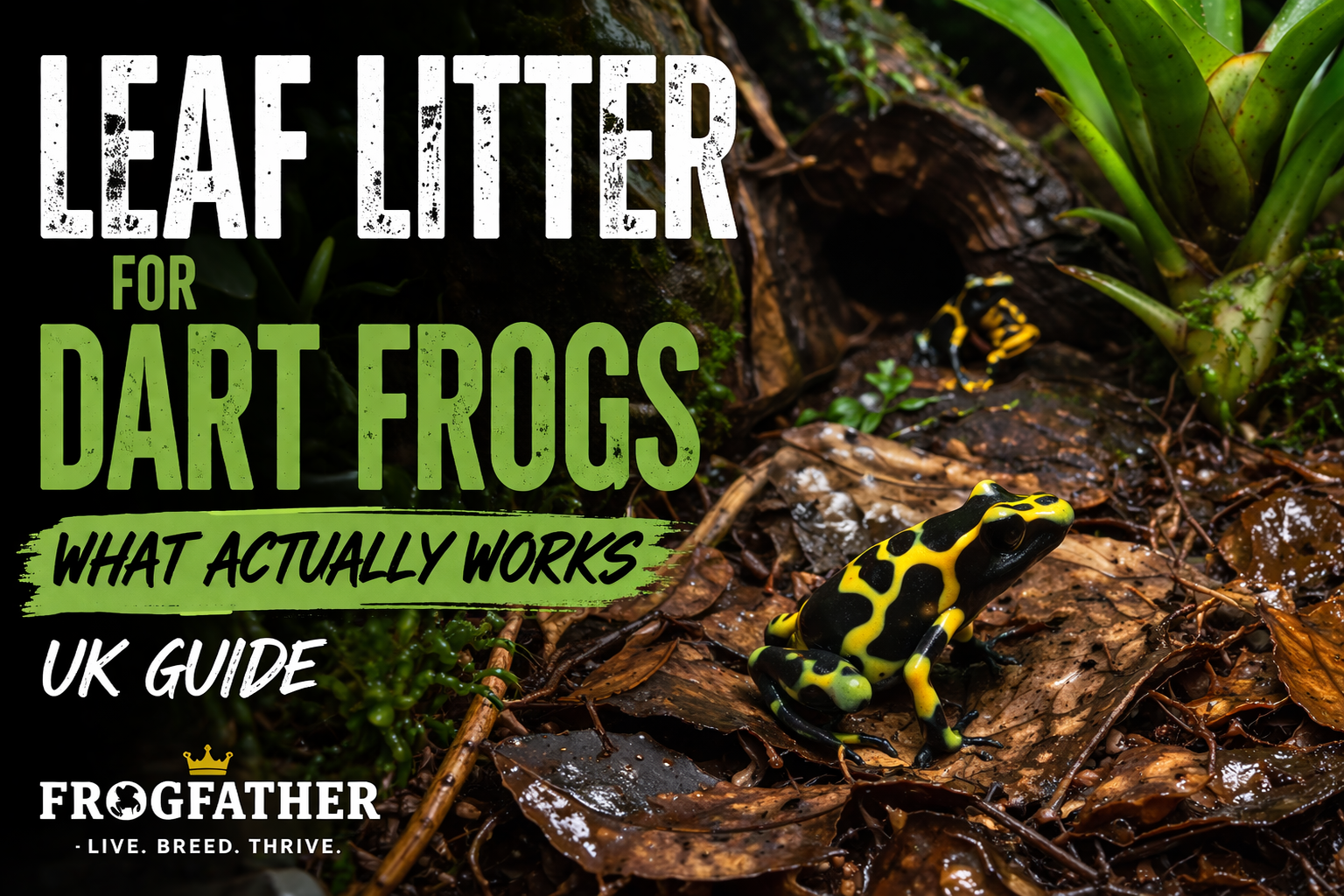
People treat leaf litter like a finishing touch. It isn’t. It supports microfauna, gives frogs security, buffers moisture, and makes the forest floor behave like a forest floor instead of bare exposed substrate.
Read the leaf litter guide if you want to get this layer right from the start.
Drainage layers are not mandatory in every build
This is one of the most copied parts of the hobby, and also one of the least understood. Some setups benefit from a drainage layer. Others are just hiding overwatering underneath the substrate.
If you want the honest version rather than the copy-and-paste internet version, read vivarium drainage layers explained.
Misting matters, but over-misting causes more problems than under-misting
A lot of UK keepers run into trouble because they’re trying to keep the tank “humid” by keeping it constantly soaked. That’s how you end up with stagnant smells, dead spots, mould flare-ups and frogs that don’t seem quite right.
Read the guide to dart frogs and misting systems to get a more balanced view of humidity management.
Quarantine plants before they go in
One of the easiest ways to contaminate a clean build is by rushing the planting stage. Pests, residues and unwanted hitchhikers often arrive with new plants, not with the frogs.
Before adding anything to a fresh vivarium, read why you should quarantine plants before adding them to a vivarium.
Lighting for dart frogs in the UK
Lighting advice online is all over the place for a reason. A keeper in a brighter part of the world may be getting more ambient natural light than they realise. Someone else may have used vitamin D3 supplementation successfully without UVB and assumed that means UVB has no benefit at all.
Those experiences are real. They’re just not automatically transferable to UK homes.
In the UK, UVB is not something I’d treat as a gimmick. Used properly, it’s beneficial. The important part is getting the level right.
Dart frogs are understory animals, so this is not a case for blasting a vivarium with intense output. The relevant framework is Ferguson Zone 1: low-level UVB for species that would naturally spend most of their time beneath dense canopy. That same principle applies across other understory species too, including certain geckos and small lizards kept in shaded jungle-style setups.
For the full breakdown, read dart frog lighting explained: do you actually need UVB in the UK?
Feeding, supplements and the boring bits that keep frogs alive
This part of the hobby is less photogenic than planting and hardscape, but it matters more.
Dart frogs need regular access to appropriately sized live food, and that food needs to be supplemented sensibly. Not obsessively. Not randomly. Consistently.
If you’re using Frogfather products, you can browse supplements and foods for microfauna and bioactive systems, but the bigger point is understanding what you’re actually trying to support: long-term health, proper calcium use, and reliable feeding behaviour over time.
If fruit flies are part of your routine, the practical side matters just as much as the frogs themselves. Crashed cultures, poor airflow, over-wet media and badly timed production cycles create avoidable stress later in the chain. That’s why feeding and husbandry can’t really be separated.
How to tell if your dart frogs are actually doing well
This is where keepers either develop good instincts or miss early warning signs.
Dart frogs don’t shout when something is wrong. Problems usually show up as behaviour changes first.
A healthy frog should feel settled and predictable in the enclosure. It should feed with confidence, use the space, move naturally through cover, and not behave like it’s constantly under pressure.
That’s why the dart frog behaviour guide is one of the most useful articles on the site. It helps you separate normal behaviour from red flags before the issue gets bigger.
If your frogs are hardly ever visible, don’t just shrug and assume that’s how dart frogs are. Read why your dart frog is hiding all the time. Poor visibility is often a husbandry clue, not just a personality trait.
Keeping a vivarium healthy long-term
The real test of a setup is not whether it looks good on week one. It’s whether it still feels stable months later.
That means:
- no nasty smell building underneath the surface
- no constant mould drama
- no frogs disappearing into permanent stress mode
- no repeated need to strip the whole tank back and start again
If your vivarium smells wrong, pay attention to it. A healthy vivarium should smell like damp forest floor, not rot or stale swamp water. Read why your vivarium smells and how to fix it without ruining bioactive if that sounds familiar.
If the broader system seems off, go back to the common vivarium issues guide and work through it properly instead of guessing.
Quarantine is dull, but it saves collections
No one gets excited about quarantine because it doesn’t look impressive. It’s a plain setup, a bit of restraint, and a lot of observation.
It’s still one of the smartest things you can do.
New frogs can look completely fine on arrival and still not be ready for a planted display enclosure or an existing group. Quarantine gives you a controlled way to observe feeding, droppings, body condition and behaviour before the frogs disappear into leaf litter and bromeliads.
Read how to quarantine dart frogs properly in the UK before introducing new animals into any established system.
Can dart frogs live together?
This is where nuance matters.
Keeping compatible frogs in the right setup is one thing. Overcrowding, poor social combinations, or mixing different species is another.
If you want the social side of the topic, start with the guide to dart frogs living in groups.
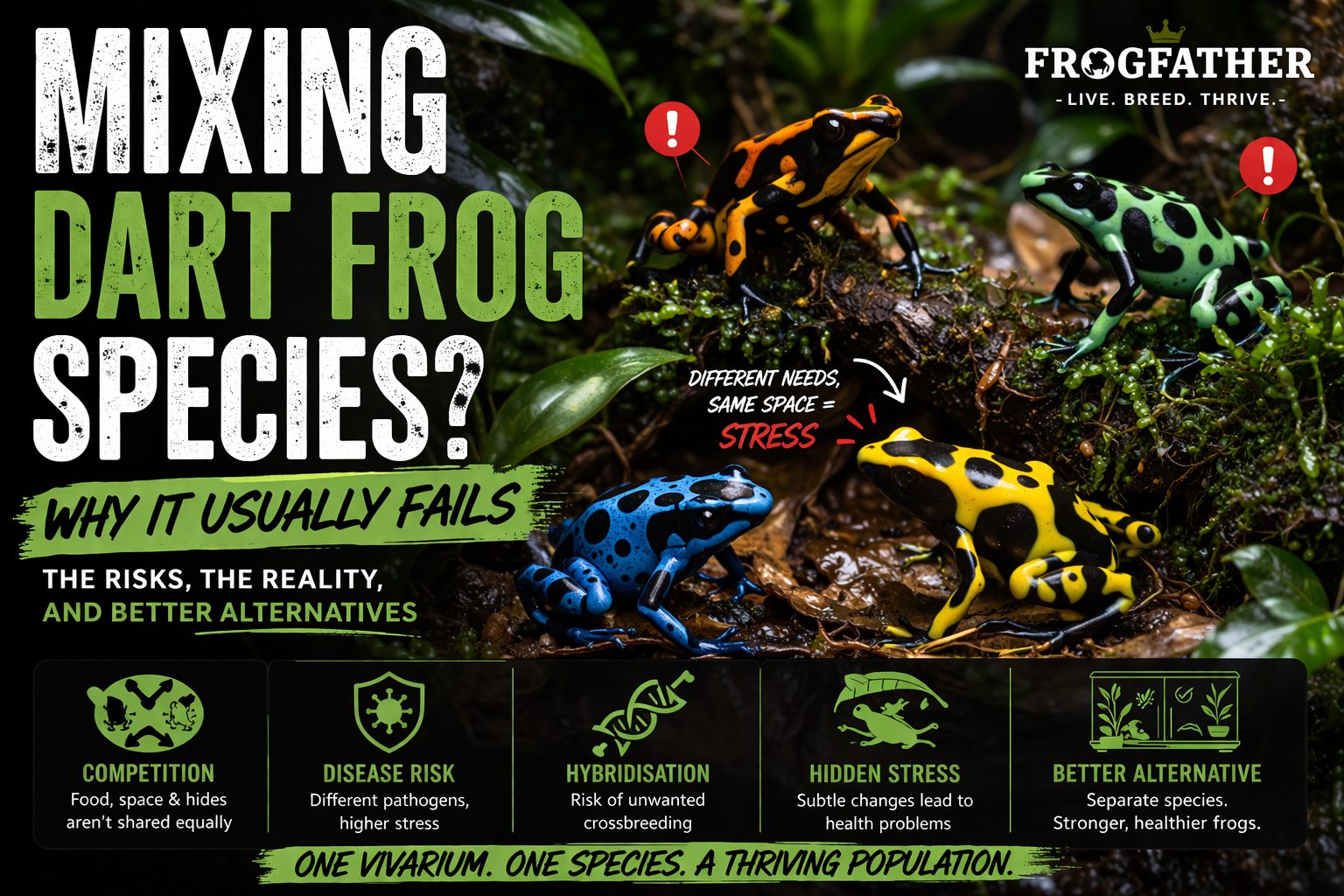
If you’re tempted by a mixed-species display because it looks exciting on paper, read can you mix dart frog species? before you do anything else. Most of the time, it adds risk, hidden stress and long-term complication without adding much real benefit.
Moving, shipping and transport
Transport is one of those areas that people underestimate because it sounds simple. It isn’t.
Temperature swings, poor containers, too much space, unnecessary handling and repeated disturbance all create stress that often shows up later rather than immediately.
If you’re moving frogs between setups, selling, buying, collecting, or planning a house move, read how to move or transport dart frogs safely in the UK.
If the whole house is moving, then also read the moving house with dart frogs checklist.
How long do dart frogs live?
Dart frogs are not a short-term novelty when they’re kept well.
In captivity, many will live ten to fifteen years, and some can go longer with consistently good care. That makes lifespan one of the clearest measures of whether a setup is genuinely working long-term or just limping along.
If you want the full breakdown, read how long dart frogs live and how to help them reach it.
If you want to breed dart frogs later
Breeding sits much further down the road than most people think. It only really becomes straightforward once your husbandry is already stable.
If you’re aiming in that direction, start with why your dart frogs aren’t breeding and then work into your breeding-specific content from there.
Trying to breed frogs in a setup that still has unresolved husbandry problems is a brilliant way to frustrate yourself.
Use the shop properly, not impulsively
The Frogfather shop makes more sense once you already understand what each category is actually doing in the system.
- Plants are for cover, structure, shade and long-term growth
- Supplements are for nutritional consistency, not random dusting routines
- Microfauna foods support the clean-up crew that keeps bioactive systems working underneath the surface
- The main shop is where you can browse the wider setup, habitat and accessory range
Buy with a plan. Bioactive vivariums reward understanding far more than impulse.
What actually makes Frogfather useful
There are plenty of sites that show pretty vivariums. There are plenty that repeat generic care sheets. There are even plenty that make simple parts of the hobby sound more complicated than they need to be.
What matters here is practical husbandry.
Frogfather is built around systems that work in real UK homes, with real time constraints, real seasonal shifts, and real long-term keeping experience behind the advice. The aim is not hype, not gatekeeping, and not pretending there is only one acceptable way to do everything.
The aim is to help you build a stable, healthy, naturalistic system that keeps frogs thriving instead of keeping you in constant troubleshooting mode.
The simplest way to use this page
- Start with the vivarium setup guide
- Read the beginner species guide
- Work through plants, leaf litter, drainage and lighting
- Then read behaviour, quarantine and vivarium smell troubleshooting
- Use the shop and course to support the plan, not replace it
If you do that, you’ll avoid most of the expensive, frustrating mistakes people make early on.
And more importantly, you’ll end up with a vivarium that feels calm, stable and enjoyable to keep — which is the whole point.
Start Here: The Frogfather Knowledge Map
If you’re new to dart frogs or bioactive vivariums, these four guides will take you from beginner to confident keeper. Each guide brings together our best articles and practical experience.
🐸 Dart Frog Care Guide
The complete guide to keeping dart frogs healthy in captivity — feeding, supplementation, humidity, behaviour, and avoiding common mistakes.
Read the Dart Frog Care Guide →
🌿 Bioactive Vivarium Guide
Learn how to build a stable bioactive vivarium step-by-step — drainage layers, substrates, microfauna, plants, airflow, and long-term maintenance.
Explore the Bioactive Vivarium Guide →
🧬 Dart Frog Species Guide
Understand the different dart frog species, their behaviour, size, care requirements, and which species are best for beginners.
Browse the Dart Frog Species Guide →
🥚 Dart Frog Breeding Guide
From eggs to froglets — breeding setups, tadpole care, grow-out systems, and raising healthy young frogs.
If you’re new to bioactive vivariums, you’re in the right place.
Bioactive setups can feel overwhelming at first — substrates, drainage, microfauna, plants, feeding, supplements, lighting… and everyone online seems to do it differently. Frogfather exists to simplify that process with a clear path you can follow.
This page will guide you to the right place (and help you avoid the common mistakes that cause problems later).
Complete Dart Frog Care Guide (UK) – Bioactive Vivariums, Setup & Long-Term Success
Step 1: Learn the fundamentals (free, UK-focused)
Bioactive Vivariums & Dart Frog Husbandry – Professional Fundamentals (Free Course)
If you’re new — or even fairly experienced — the course is the best place to start. It’s designed as a practical introduction and a quick reference guide you can come back to.
Start the free Bioactive Vivariums & Dart Frog Husbandry course
The course will help you understand:
- What “bioactive” actually means (and what it doesn’t)
- Substrate layers and drainage explained properly
- The role of microfauna (springtails and isopods) in keeping the system stable
- Supplement basics — what matters, what’s optional, and how to keep it simple
- The common early mistakes that lead to mould, crashes, and stressed animals
If you want one reliable starting point that’s written for UK keepers, the course is it.
Step 2:Build a stable bioactive system
Microfauna: the engine of every bioactive vivarium
Springtails and isopods aren’t optional extras — they’re what keep a bioactive vivarium alive. They help break down waste, control mould, and support long-term soil health.
Shop microfauna, microfauna foods, and supplements
If you’re choosing your first clean-up crew, the course will help you pick species that are beginner-friendly.
Step 3: Feeding & supplements (simple, not overcomplicated)

Supplements shouldn’t be confusing — but they often are. Calcium, vitamins, gut-loading, rotation schedules… it’s easy to overthink.
The goal is simple: support long-term health without stacking unnecessary overlap. If you’re new, use the course as your quick reference, and keep your routine consistent.
Browse supplements and food for microfauna and bioactive systems
Step 4: Plants, habitat items, and the shop
Plants for real bioactive setups
Not all “terrarium plants” thrive long-term in bioactive conditions. The right plant choices help with cover, humidity stability, and a more natural, confident environment.
Explore vivarium and terrarium plants for bioactive setups
Shop by category
If you already know what you’re looking for, head straight to the shop and browse by category.
Browse the Frogfather shop (enclosures, accessories, and habitat gear)
Not sure where to start?
If you’re feeling unsure, do this:
- Start the free course and learn the fundamentals
- Come back to this page when something clicks
- Build gradually — bioactive systems reward patience
This page exists so you don’t have to piece everything together from dozens of conflicting sources.
Why Frogfather?
Frogfather is built around practical husbandry and systems that work — without hype, shortcuts, or gatekeeping. The aim is to make bioactive setups easier to build, easier to maintain, and easier to enjoy.
New to bioactive vivariums? Start the free course here and use it as your quick reference as you build.