
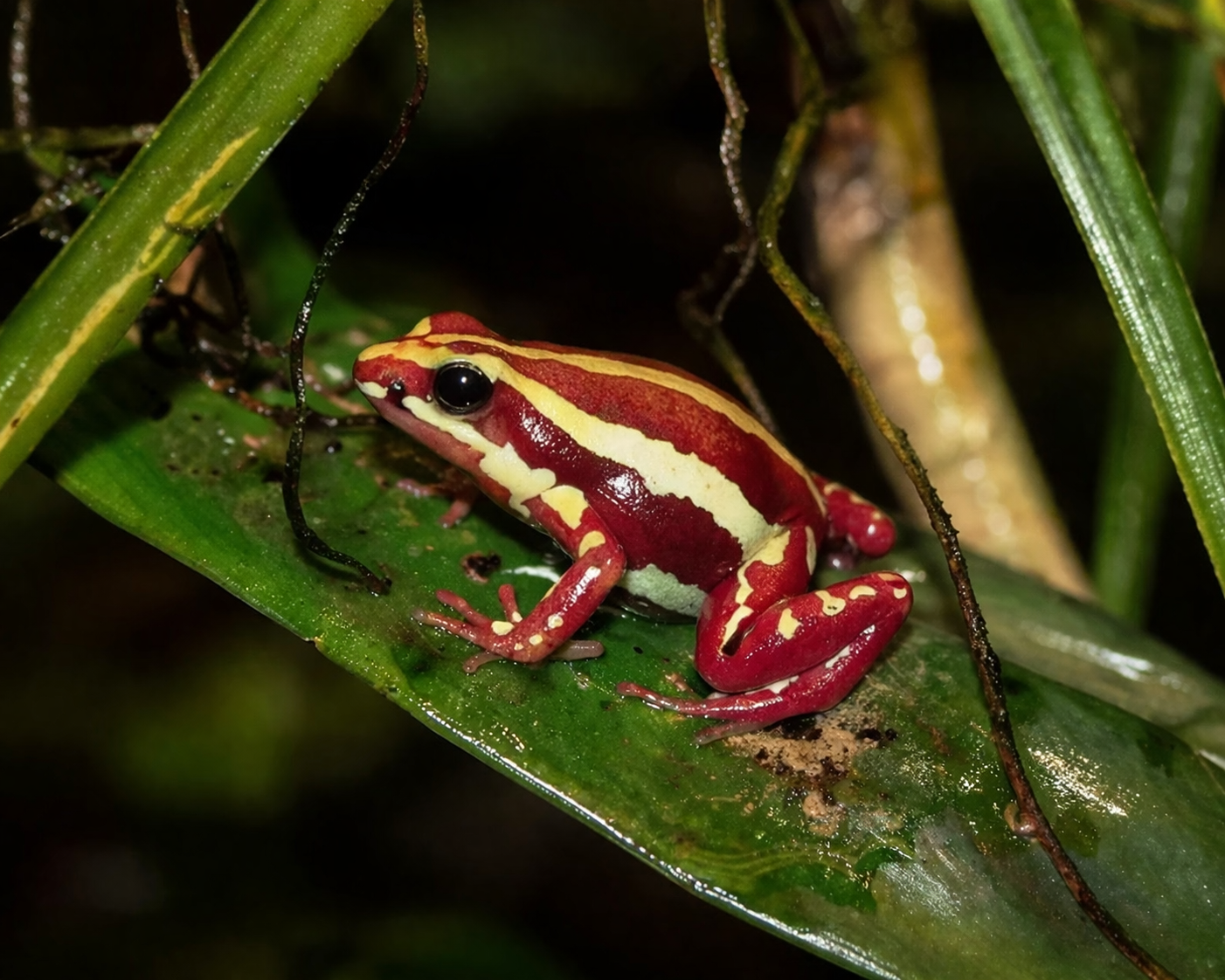
Description
Phantasmal Dart Frog – Epipedobates anthonyi – UK Captive Bred
Captive-bred Epipedobates anthonyi, a small, active poison frog known for its attractive longitudinal striping, daytime activity and fascinating behaviour.
This species has been established in the dart frog hobby for many years and can make a rewarding choice for both newer and experienced keepers prepared to provide an appropriately designed vivarium, suitably sized live food and consistent supplementation.
🐸 Species Information
- Scientific name: Epipedobates anthonyi
- Family: Dendrobatidae
- Breeding origin: Captive bred
- Activity: Diurnal
- Adult size: Small dart frog, approximately 2–3 cm
Taxonomy note: The accepted scientific name is Epipedobates anthonyi. This species has a complicated taxonomic history and has historically been confused with the closely related Epipedobates tricolor, so older literature and hobby material may use different names.
🌎 Natural Distribution
Epipedobates anthonyi occurs naturally west of the Andes in southwestern Ecuador and northwestern Peru, across a considerable elevational range.
Rather than attempting to recreate a stereotypical permanently saturated “rainforest”, captive husbandry should focus on providing appropriate moisture, ventilation, cover and environmental stability.
🎨 Appearance
Epipedobates anthonyi are characterised by contrasting longitudinal markings running along the body. Colour and pattern can vary between populations, captive lines and individual animals.
Individual frogs should therefore be expected to show some natural variation rather than being selected against a single rigid colour description.
🌿 Vivarium & Environment
Provide a secure, mature and well-structured vivarium with substantial usable floor area, leaf litter, planting, refuges and visual barriers.
Although primarily terrestrial, these frogs will make use of low-level climbing structures, plants, cork and other features, so a structurally varied enclosure is preferable to an open floor-only setup.
A properly constructed drainage layer can help manage excess water within a bioactive enclosure, while leaf litter and planting provide cover and support useful microfauna.
💧 Moisture & Ventilation
Maintain an appropriately moist environment while providing effective ventilation. Relative humidity readings can be useful for monitoring trends, but should not be treated as a single fixed target that must remain constant throughout the enclosure.
Substrate and leaf-litter moisture, airflow, temperature, planting and misting all influence the microclimates available to the frogs. Avoid prolonged overheating, persistently stagnant saturated conditions and rapid environmental swings.
🌡️ Temperature
Stable, moderate temperatures are appropriate for Epipedobates anthonyi. Avoid prolonged overheating and rapid temperature fluctuations.
Where additional heating is required, it should be appropriately controlled and temperature should be monitored within the enclosure at animal level.
🪰 Feeding
Feed appropriately sized live prey as part of a consistent supplementation programme. Suitable foods can include:
- Flightless fruit flies
- Springtails
- Other appropriately sized live invertebrate prey
Established springtail populations are particularly useful within bioactive vivariums, but enclosure microfauna should complement rather than replace deliberate feeding.
Feeder insects should be supplemented appropriately to provide nutrients that are not reliably supplied by cultured feeder insects alone.
🐸 Behaviour & Social Housing
Epipedobates anthonyi are diurnal and can be active and visible within a well-established enclosure, although individual behaviour naturally varies.
Multiple animals can sometimes be maintained successfully where sufficient space, structure and resources are provided. Compatibility should nevertheless be monitored rather than assumed.
Social behaviour can change as animals mature and enter breeding condition. Provide visual barriers, multiple retreats and feeding opportunities, and be prepared to separate animals if persistent aggression, exclusion from resources or deterioration in body condition develops.
🥚 Breeding Behaviour
Like many dendrobatid frogs, Epipedobates anthonyi display fascinating reproductive behaviour. Males advertise vocally, eggs are deposited terrestrially, and hatched tadpoles are subsequently transported to water.
Breeding activity should be regarded as part of the natural behaviour of established adults rather than an indication that every group or pairing will necessarily reproduce successfully.
👤 Suitable For
- Keepers looking for a small, active dart frog species
- Newer keepers prepared to research and establish appropriate dart frog husbandry
- Experienced keepers interested in Epipedobates
- Planted and bioactive vivarium setups
No dart frog should be regarded as maintenance-free or automatically “beginner proof”. Success depends on stable husbandry, appropriate feeding and supplementation, enclosure design and regular observation of the animals.
🧼 Handling & Captive Alkaloids
Dart frogs are best observed rather than routinely handled. Their permeable skin makes unnecessary handling undesirable, and sensible amphibian hygiene should always be followed.
Wild poison frogs obtain defensive alkaloids from components of their natural diet. Captive-bred frogs maintained on conventional cultured feeder insects do not have access to the same dietary alkaloid sources, but this does not remove the need for sensible hygiene and minimal handling.
🐸 Live Animal Disclaimer
This product is a live amphibian and is available for UK legal purchase only.
Live-animal courier delivery is temporarily paused. Please check the current Live Animal Policy / FAQ before ordering for the latest collection and future delivery options.
By purchasing, you confirm that you are aged 18 or over and that keeping this species is legal in your location.
Learn more in our Live Animal Policy.
Live-Animal Husbandry Review
Last reviewed: September 2026
Temperature, moisture, enclosure structure and social compatibility should be matched to the species, life stage and individual animals. Relative humidity readings are most useful when considered alongside ventilation, temperature, substrate moisture and the different microhabitats available within the enclosure.
Social compatibility can change with maturity and breeding condition. Monitor individual animals and retain the ability to separate incompatible frogs when necessary.
Evidence & Further Reading
- Amphibian Species of the World – Epipedobates anthonyi
- St Claire et al. – The husbandry and care of dendrobatid frogs


