
Description
Dendrobates tinctorius ‘Citronella’ – Probable Male
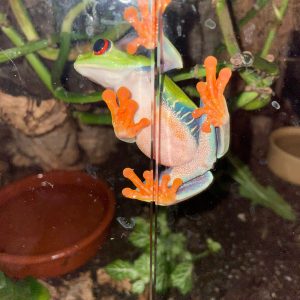
A well-started captive-bred Citronella Dendrobates tinctorius, feeding independently on appropriately sized live prey.
Sexing
This individual is currently assessed as probably male from a combination of size, morphology and observed behaviour. The earlier “around 90% certainty” wording should be understood as a husbandry assessment rather than a laboratory measurement or guarantee.
Social housing
We have removed the suggestion that a probable male is automatically “ideal for balancing a group”. Adult D. tinctorius can show significant same-sex aggression, and compatibility can change with maturity. Pairing decisions should be based on the particular animals, with a separate suitable enclosure available if persistent aggression or exclusion develops.
Environment
Provide substantial usable floor area, leaf litter, cover, visual barriers and useful ventilation. We have removed the fixed 70–100% humidity prescription. Maintain a humid enclosure with wetter and drier microhabitats rather than a permanently saturated RH target.
Feeding
Offer appropriately sized live prey such as fruit flies and other suitable micro-feeders with an appropriate supplementation programme. Springtails or isopods present in the enclosure should not be relied upon as the sole food supply.
Live-Animal Husbandry Review
Last reviewed: 5 September 2026
Temperature, moisture, enclosure structure and social compatibility should be matched to the species, life stage and individual animals. Frogfather therefore avoids fixed humidity-as-law, automatic pair/group formulas and claims that an animal is suitable for a keeper simply because it is described as “hardy”.
Evidence & further reading
- St Claire et al. – The husbandry and care of dendrobatid frogs
- Rojas & Pašukonis – natural history and aggression in Dendrobates tinctorius