
Husbandry & Evidence Review – 6 September 2026
This article has been checked against Frogfather’s current evidence-led husbandry guidance. Specific older statements have been corrected or qualified below while unrelated content is preserved.
If you’ve ever stared into the neon glare of a Phyllobates terribilis, you’ll know they’re not your average dart frog. They’re chunky. They’re bold. And yes, they’re technically the most poisonous animal on Earth—in the wild. But in UK captivity? These golden powerhouses are surprisingly chill.
Are They Actually Dangerous?
Wild Phyllobates terribilis can carry potent batrachotoxins acquired through their natural food web. Captive-bred animals maintained on conventional cultured feeders are not expected to retain that wild alkaloid profile, but Frogfather avoids absolute ‘safe/non-toxic’ language and still recommends minimal handling and good hygiene.
Why Keep Phyllobates terribilis?
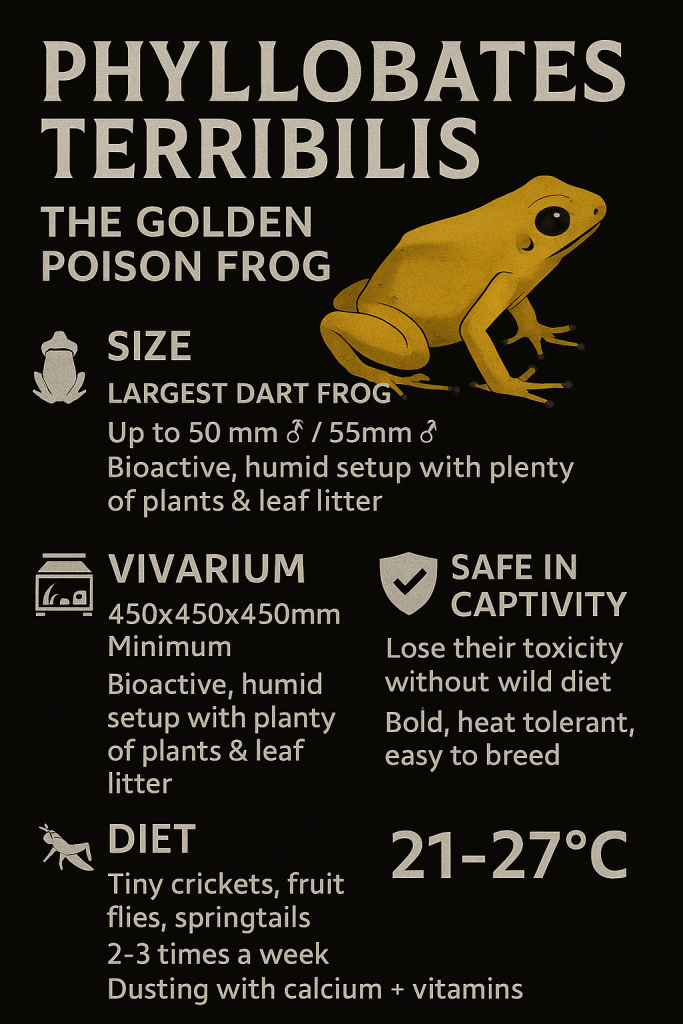
- Size: They’re absolute units compared to Ranitomeya or standard tinctorius. Adults reach 5–6 cm.
- Boldness: They’re visible all day—great for display tanks.
- Calls: Males have a soft, cricket-like buzz that’s oddly relaxing.
- Group Dynamics: Peaceful enough for small groups if space allows.
Golden, Mint, and Orange – Terribilis Morphs
UK hobbyists generally come across three morphs:
- Golden (Yellow): The classic neon banana look.
- Mint: Pale green with bluish tones – oddly calming.
- Orange: Rich, deep fire tones – a bit less common.
They’re all the same species, just different colours. Care is identical across morphs.
Vivarium Setup in the UK
These frogs thrive in a bioactive setup with good ventilation, plenty of horizontal floor space, and consistent humidity. Unlike climbers like Ranitomeya, terribilis are mostly ground dwellers but will appreciate the odd root or low perch.
- Size: 45x45x45 cm minimum for a trio.
- Heating: Keep it 22–26°C. Don’t let it creep above 27°C, especially in UK heatwaves.
UVB: dedicated UVB is not always essential where dietary vitamin D3 is reliably supplied, but controlled UVB can be used. Bulb percentage or brand alone does not define exposure; assess what reaches the animal and provide complete shade.
Humidity: do not manage dart frogs or other amphibians to one universal percentage band. Provide species-appropriate moisture, useful ventilation, humid refuges and normal drying/re-wetting cycles, and interpret RH alongside surface moisture and temperature.
Make sure to include a drainage layer like hydroclay topped with a proper ABG mix and leaf litter for moisture retention and microfauna support.
Diet: Big Frogs, Big Appetites
Terribilis love a good hunt. In the UK we’ve got easy access to suitable livefoods:
- Large fruit flies (D. hydei)
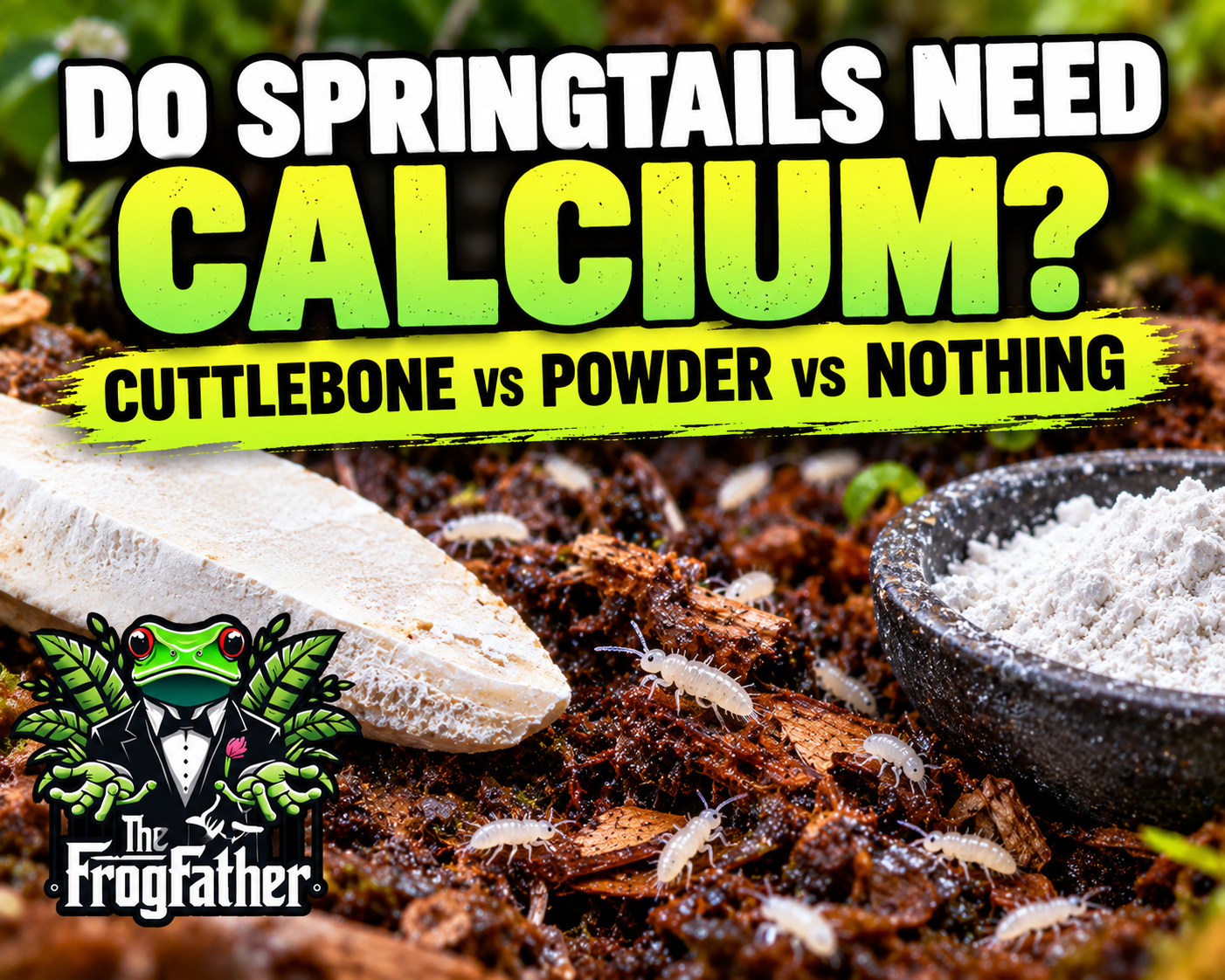
- Springtails – great for froglets and bioactive cleanup
- Isopods – dwarf white preferred
- Bean weevils
- Small crickets (very occasionally)
Supplementation: use one coherent, formulation-specific system appropriate to the exact product, feeder, life stage and UVB/D3 strategy. Fixed universal weekly/monthly rotations are not supported across all species and products.
Social Structure & Breeding
Unlike some other species, terribilis do alright in groups if they’re well fed and have space. Don’t crowd them. A trio or quartet in a large tank is ideal.
Breeding’s not hard either. Mature males will call daily, and females often lay in film canisters, coconut huts, or under leaves. Raise tadpoles in clean, dechlorinated water with regular changes.
Want a full breeding setup? Check out our tadpole rearing kits.
Common Questions from UK Keepers
- Q: Do I need a heat mat in winter?
A: If your room drops below 18°C, yes. Use a thermostat! - Q: Are they safe for kids?
A: Yes, just don’t let kids handle them. Observation only. - Q: Can I mix morphs?
A: You can, but don’t cross-breed unless you’re confident in lineage purity.
UK-Specific Notes
Humidity is usually your biggest battle in British homes. Dry central heating will suck the life out of your viv. Use a sealed glass-top enclosure, mist regularly, and consider live moss or high-humidity bromeliads. And don’t forget the cleanup crew – they’re your unsung heroes.
Infographic: Phyllobates terribilis Care Summary

Conclusion? These Frogs Rule
If you want a bold, beautiful, and surprisingly beginner-friendly dart frog, you can’t go wrong with terribilis. Whether you’re drawn to their size, their easygoing nature, or the wild fact that their wild cousins could take out a jungle predator with a smirk—these frogs have personality in spades.
And the best bit? You get all the cool factor, with none of the deadly side effects.