Husbandry & Evidence Review – 5 September 2026
This article’s practical warning remains reasonable: mixed isopod populations often change in relative abundance over time. The consequences for whole-vivarium ‘balance’ are less certain, so mixing decisions should focus on species husbandry, lineage management and whether each culture can be monitored.
Can You Mix Isopods in a Dart Frog Vivarium? What Actually Happens Over Time
If you keep dart frogs, you have probably thought about building the perfect clean-up crew. On paper, mixing isopods sounds brilliant. Why keep one species when you could combine a few? A fast-breeding species for waste processing, a colourful species for visual interest, and maybe a rarer species for the sheer enjoyment of keeping something special.
The problem is that mixed isopod colonies often look far better in theory than they do in practice.
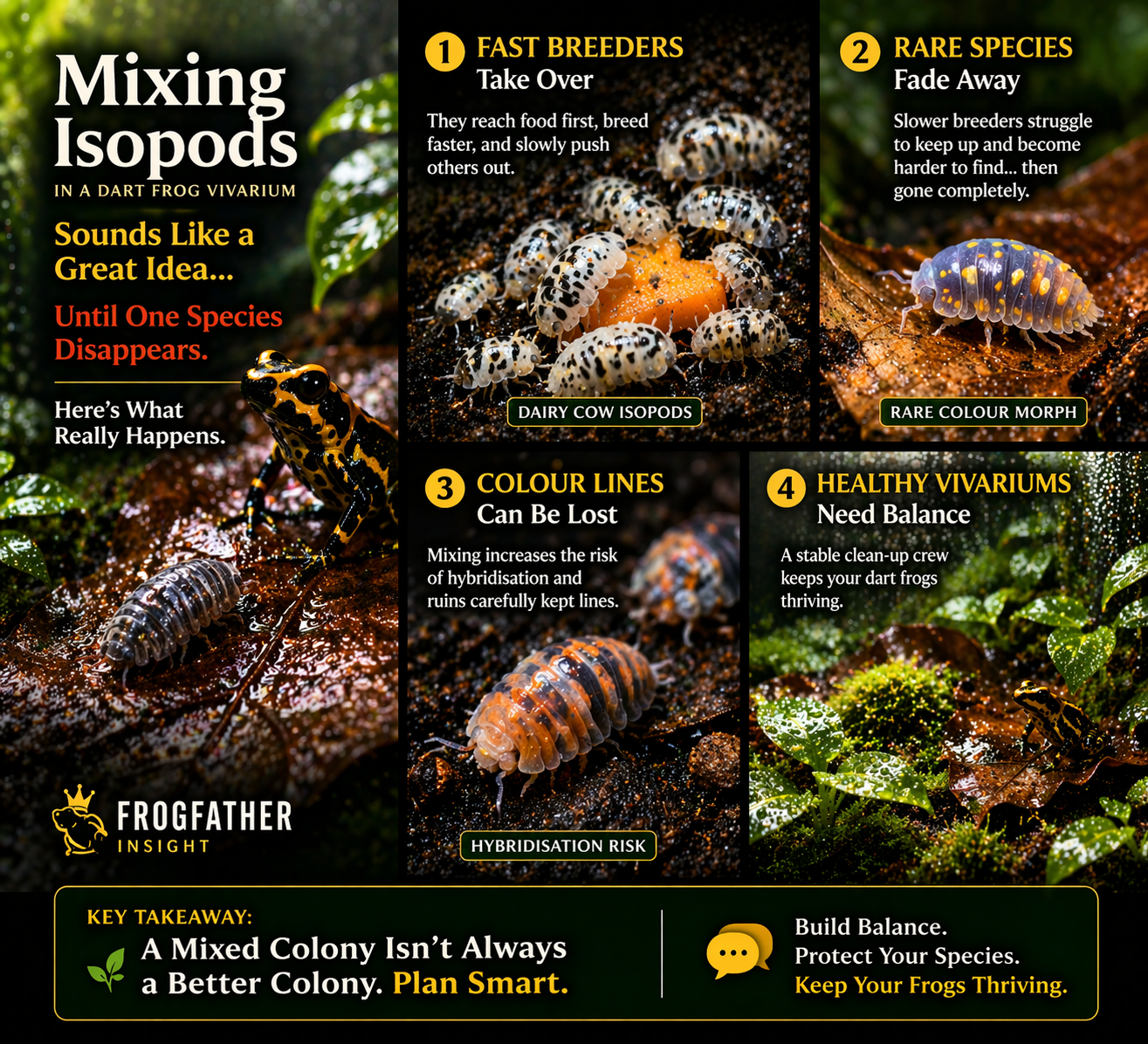
In a dart frog vivarium, especially a warm, moist, bioactive setup, one species usually starts to dominate. It may not happen in a week. It may not even happen in a month. But over time, the balance shifts. Fast breeders expand. Slower species struggle. Colour lines become muddied. Rare isopods disappear so gradually that many keepers do not realise what has happened until the colony is effectively gone.
This matters even more in a dart frog setup because your enclosure is not just an ornamental terrarium. It is a living system. Your substrate, leaf litter, plants, springtails, isopods, and frogs all influence one another. If your clean-up crew becomes unbalanced, the whole vivarium can begin to drift away from the stable, thriving ecosystem you were aiming for.
So, can you mix isopods in a dart frog vivarium? Sometimes, yes. But most of the time, it is far riskier than people expect, and the better question is whether you should.
Why Dart Frog Keepers Want to Mix Isopods in the First Place
The idea is easy to understand. Dart frog keepers are often trying to achieve several things at once:
- Build a more efficient bioactive clean-up crew
- Create better waste breakdown in moist substrate
- Add visual interest to the enclosure
- Keep rare or attractive isopods alongside a functional colony
- Experiment with surface-active and burrowing behaviour types
That sounds sensible. In practice, though, those goals often conflict with one another.
A species that is excellent at exploding in numbers and processing waste is often exactly the species most likely to outcompete slower, more delicate, or more expensive isopods. Likewise, a visually striking species may be the least suited to heavy competition, constant frog activity, and the damp, food-rich conditions that favour more aggressive breeders.
In other words, the qualities that make an isopod species attractive to keep are not always the qualities that make it suitable for a mixed colony in a dart frog vivarium.
What Usually Happens in a Mixed Isopod Colony
Most failed mixed colonies do not fail dramatically. That is part of the problem.
You do not usually see one species physically attacking another. You do not open the vivarium one morning and find a clear disaster. Instead, you get slow displacement.
One species breeds faster. It reaches food first. It fills hiding spaces. It colonises the leaf litter more effectively. It reproduces so consistently that, over time, the slower colony cannot maintain numbers. Eventually, the slower species becomes harder to spot. Then it seems rare. Then it is functionally gone.
For many keepers, this happens with no obvious warning beyond a vague feeling that they have not seen the expensive species for a while.
That is why mixed colonies can be misleading. They can appear stable during the early phase, while the long-term trend is already moving in the wrong direction.
Fast Breeders Usually Win
This is the single biggest reason mixed colonies fail.
Some isopod species are simply built to reproduce quickly in rich, moist conditions. Give them warmth, food, leaf litter, and consistent humidity, and they take off. In a dart frog vivarium, that can sound useful, because dart frogs create regular feeding activity, microfauna-rich environments, and a lot of organic input.
But a fast breeder does not just process waste. It also puts pressure on every slower species sharing the same enclosure.
Fast-breeding isopods tend to:
- Reach food patches first
- Occupy space more densely
- Produce more young in less time
- Recover from losses more quickly
- Exploit favourable moisture zones faster than delicate species
In a single-species colony, those traits are useful. In a mixed colony, they often become the reason your slower species loses ground.
If your goal is a reliable dart frog clean-up crew, a vigorous breeder can be a smart choice on its own. If your goal is to preserve multiple species in one enclosure, it can be exactly the wrong move.
Why Rare Isopods So Often Disappear
Many of the species people most want to mix are the ones least suited to the experiment.
Rare, colourful, slower-growing isopods often have one or more of the following traits:
- Slower breeding cycles
- Lower litter sizes
- More specific moisture preferences
- Greater reliance on secure hiding zones
- Less tolerance for constant competition
That does not mean they are weak. It means they are often adapted to a narrower style of living than the generalist, fast-breeding species people tend to pair them with.
In a dart frog vivarium, where humidity is high, the substrate is biologically active, and food sources are patchy but regular, these rare species can survive for a time without truly holding their ground. That distinction matters. Survival is not the same as success.
If a colony is not maintaining numbers, it is already declining, even if you still see occasional individuals.
Surface Dwellers and Burrowers Do Not Always Balance Nicely
A common argument for mixing isopods is that different behaviour types should complement each other. One species stays near the surface, another spends more time in the substrate, so surely they are using different niches.
Sometimes there is some truth in that. But keepers often overestimate how cleanly those niches separate.
In a real dart frog vivarium, there is overlap everywhere:
- Food ends up in multiple layers
- Moisture gradients shift day to day
- Leaf litter breaks down and changes structure
- Plants alter shade, airflow, and cover
- Frog movement disturbs resting zones
That means surface dwellers and burrowers are not living in sealed, independent worlds. Their lives overlap around food, shelter, humidity, and breeding space. One species does not have to occupy the exact same layer all the time to create pressure on another.
This is why mixed colonies that look logical on a care sheet can still drift badly over time in a real enclosure.
The Hidden Risk: Losing Colour Morphs and Pure Lines
For many keepers, this is the most painful part.
If you are working with unusual, attractive, or premium isopods, mixing can threaten the very thing that made them desirable in the first place.
Depending on what is mixed, you may be risking:
- Loss of visual consistency
- Dilution of selected traits
- Confusion over lineage
- Hybridisation in inappropriate pairings
- Reduced value from both a breeder and collector perspective
Even where outright hybridisation is not the main risk, visual degradation can still happen in the keeper’s perception of the colony if the showier species becomes rare and the enclosure ends up dominated by the more ordinary one.
That is one reason I usually advise dart frog keepers to separate their goals. If you want a dependable clean-up crew, build a dependable clean-up crew. If you want to preserve, enjoy, and grow a premium isopod colony, give that colony its own setup.
Does Mixing Isopods Affect Dart Frogs Directly?
Usually, the issue is indirect rather than dramatic.
Most dart frogs will not care whether your clean-up crew is one species or two. What they do care about, whether directly or indirectly, is the condition of the vivarium they are living in.
If your isopod colony becomes imbalanced, you may eventually see consequences such as:
- Uneven waste processing
- Patchy breakdown of leaf litter
- Compaction or neglect in some substrate zones
- Reduced biodiversity in the enclosure floor
- A less resilient bioactive system overall
Dart frogs do best in stable, layered environments. If your microfauna is working well, the enclosure feels alive, buffered, and forgiving. If one colony has pushed the system into a less diverse state, the vivarium can become more prone to swings in cleanliness, moisture handling, and decomposition.
So while mixed isopods are not usually a direct threat to dart frogs, a poorly planned mix can make the vivarium a worse habitat over time.
When Mixing Isopods Can Work
There are situations where mixing does not immediately go wrong, and it would be too simplistic to pretend every mixed colony is doomed.
In general, the best chance of success comes when the keeper is very deliberate about pairing species with:
- Similar breeding speed
- Similar robustness
- Low risk of lineage confusion
- No meaningful concern over preserving a premium line
- Compatible environmental preferences
Even then, I would still treat it as an experiment rather than a default strategy.
If you try it, the key is to monitor properly. Do not assume that because you see both species today, the colony is balanced. Watch numbers over time. Watch juvenile presence. Watch where each species is actually thriving. Watch whether one species starts appearing everywhere while the other becomes occasional.
A mixed colony is only working if both species are genuinely maintaining themselves.
A Better Strategy for Dart Frog Vivariums
If your main priority is dart frog husbandry, the simplest and most reliable route is usually this:
- Choose one dependable isopod species for function
- Build the rest of the clean-up crew around springtails and substrate health
- Keep rare or premium isopods in separate, dedicated setups
- Optimise your dart frog enclosure for long-term balance, not novelty
This approach is less exciting on social media, but much more effective in real life.
Your dart frog vivarium does not need to be a species showcase for every invertebrate you enjoy. It needs to be stable. It needs to process waste. It needs layered humidity. It needs healthy leaf litter turnover. It needs a floor that supports plants, microfauna, and frogs equally well.
That is how you build a bioactive system that still works months down the line.
How This Links Back to Dart Frog Success
It is easy to think of isopods as a side issue, but they are part of a bigger picture.
If you are trying to improve your results with dart frogs, whether that means better behaviour, cleaner vivariums, healthier plant growth, or a more stable enclosure floor, your clean-up crew matters. The more thoughtfully you build the ecosystem, the easier it is to maintain the habitat your frogs actually need.
That is also why it makes sense to think about the whole enclosure rather than just the frogs in isolation. If you are planning a new setup, upgrading an existing enclosure, or choosing your next species, browse our dart frogs for sale in the UK to see species and morphs suited to properly built bioactive vivariums.
Different frogs use space differently. Different vivarium footprints create different floor dynamics. Different keeper goals call for different supporting systems. But the principle stays the same: stable habitats outperform gimmicks.
Final Thoughts: Should You Mix Isopods in a Dart Frog Vivarium?
If you want the honest answer, here it is.
You can mix isopods in some dart frog vivariums. But for most keepers, and especially for anyone trying to preserve premium species, rare lines, or long-term colony quality, it is usually a poor trade.
The likely outcome is not a richer, more balanced system. It is slow domination by the faster species, gradual loss of the slower one, and a colony that ends up less interesting and less valuable than what you started with.
If your aim is function, choose function. If your aim is preservation, separate your colonies. If your aim is long-term dart frog success, build the vivarium around stability first.
That is the difference between a setup that looks good for a while and a setup that genuinely works.
Frequently Asked Questions
Can you mix isopods with dart frogs?
Yes, isopods are commonly kept in dart frog vivariums as part of the clean-up crew. The bigger question is whether you should mix multiple isopod species together in the same enclosure. In many cases, one species eventually dominates.
What is the best isopod strategy for a dart frog vivarium?
For most keepers, the best strategy is to use one dependable isopod species for function and support it with healthy springtail populations, good leaf litter, and stable substrate conditions.
Why do rare isopods disappear in mixed colonies?
Rare species often breed more slowly, compete less aggressively, and struggle to maintain numbers when housed with faster, more prolific isopods in rich bioactive environments.
Do dart frogs eat isopods?
Dart frogs may occasionally take very small isopods, especially mancae or tiny juveniles, but isopods are primarily used as part of the bioactive clean-up crew rather than a staple food source.
Can mixing isopods ruin colour morphs?
It can. Depending on the species involved, mixing may risk lineage confusion, visual inconsistency, or hybridisation concerns. That is one reason many keepers separate premium colonies from functional vivarium colonies.
Are isopods enough on their own for a bioactive dart frog vivarium?
No. A stronger system includes springtails, appropriate substrate, leaf litter, moisture gradients, and plant health. Isopods are one useful part of the wider ecosystem, not the whole answer.