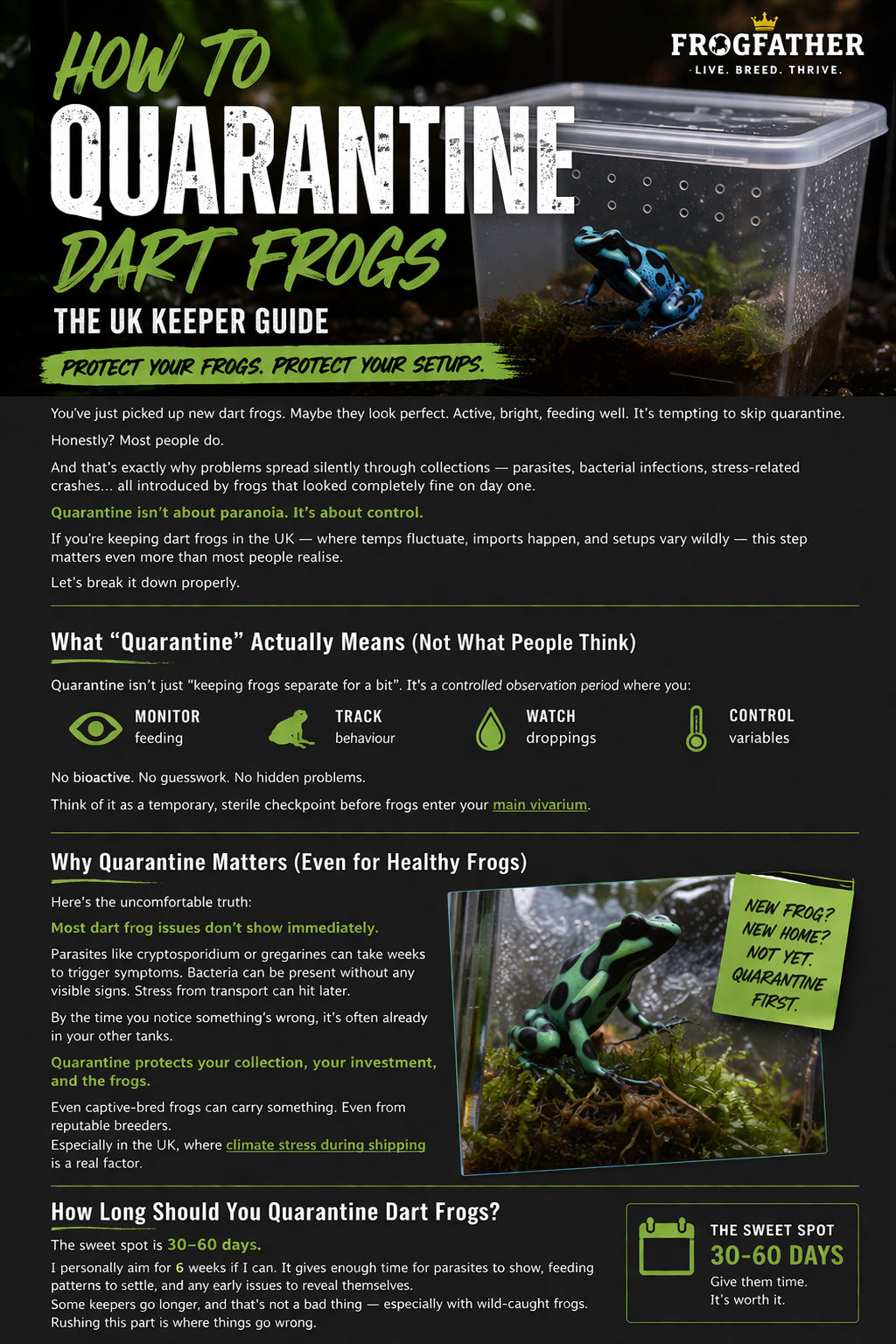

Mixing dart frog species sounds like a great idea… right up until you actually try it.
Different colours, different patterns, more movement, more variety — one tank that looks like a proper slice of rainforest.
It’s one of the most common ideas people have once they’ve kept frogs for a bit.
And it’s also one of the quickest ways to create problems you didn’t see coming.
This isn’t one of those topics where there’s a neat, balanced “sometimes yes, sometimes no” answer.
The honest answer, from experience, is simple:
You can mix dart frog species… but you almost always shouldn’t.
There are a few very specific scenarios where people get away with it. Most of the time, it causes stress, competition, or long-term issues that slowly build rather than explode.
If you’ve already read your group housing guide, this is the next step — not just multiple frogs, but multiple species.
Why people want to mix dart frog species
There are a few reasons this comes up again and again:
- More visual variety in one vivarium
- Saving space instead of running multiple tanks
- Seeing different behaviours in one setup
On paper, it makes sense.
In practice, dart frogs aren’t built for shared environments like that — even if they look calm on the surface.
The biggest problem: competition you don’t see
Dart frogs don’t always fight in obvious ways.
You’re not looking at dramatic battles. You’re looking at subtle pressure.
- One species feeding faster than the other
- One using the best areas of the tank consistently
- One becoming more confident while the other pulls back
Over time, this turns into:
- Uneven feeding
- Weight loss in weaker individuals
- Increased hiding
This is exactly the kind of slow drift you see in behaviour before anything obvious happens — the same patterns covered in your behaviour guide.
Different species, different needs
Even if two species look similar, they don’t always use the vivarium the same way.
Some are:
- More terrestrial
- More arboreal
- More aggressive
- More shy
Trying to force them into one shared environment means one species usually ends up compromising more than the other.
And that compromise shows up in behaviour first, then condition.
Disease and contamination risks
This is the part that often gets ignored because you can’t see it.
Different frogs from different sources can carry different parasite loads or bacteria — even if they look perfectly healthy.
When you mix species:
- You remove any control over exposure
- You increase stress, which lowers resistance
- You make treatment far more complicated later
This is exactly why quarantine exists in the first place. If you’re skipping separation at the species level, you’re undoing that protection.
Hybridisation (yes, it matters)
This gets brushed off more than it should.
Some species or morphs can interbreed.
That leads to:
- Unwanted hybrids
- Loss of clean bloodlines
- Confusion in the hobby long-term
If you’re keeping dart frogs seriously, this isn’t something to ignore.
“But I’ve seen mixed tanks that work”
You will have.
And here’s the reality behind most of them:
- They’re large, heavily planted vivariums
- They’re run by experienced keepers
- They’re monitored constantly
Even then, “working” often just means problems haven’t shown up yet — or aren’t obvious to someone looking in from the outside.
It’s very easy to mistake “no visible conflict” for “no issue”.
When mixing might work (rarely)
If you’re determined to try it, these are the conditions where people have the most success:
- Large vivariums with plenty of space (not just visually, but functionally)
- Species with clearly different niches (floor vs climbing, for example)
- Very controlled feeding routines
- Close monitoring of behaviour and condition
Even then, it’s not risk-free.
It’s managed risk.
A better alternative
If the goal is variety, there’s a much better way to get it.
Run multiple smaller setups instead of one mixed one.
You’ll get:
- Cleaner behaviour
- Better feeding control
- Zero cross-species issues
And honestly, it’s more enjoyable to watch.
Each tank develops its own rhythm.
Why most experienced keepers avoid mixing
It’s not because it’s impossible.
It’s because it adds complexity without adding real benefit.
More variables. More risk. More things to monitor.
For what is, realistically, just visual variety.
Once you’ve dealt with even one issue caused by mixing, the appeal drops off quickly.
So should you mix dart frog species?
If you want the straight answer:
No.
Not because it can’t be done.
Because it usually creates more problems than it solves.
If you want stable, predictable, long-term success with dart frogs, keeping species separate is the cleaner, safer, and more reliable way to do it.
Frequently Asked Questions
Can you keep different dart frog species together?
It’s possible, but generally not recommended due to stress, competition, and health risks.
Will dart frogs fight each other?
Not always visibly. Competition is often subtle and shows through behaviour and feeding differences.
Can dart frogs hybridise?
Yes, some species and morphs can interbreed, which is usually undesirable in the hobby.
What is the safest way to keep multiple dart frogs?
Keep the same species together in a properly sized vivarium designed for their behaviour.
Why do mixed dart frog tanks fail?
Usually due to hidden competition, stress, and mismatched environmental needs between species.