
Written by Tony Burton, The Frogfather | UK dart frog keeper, breeder and bioactive vivarium specialist | Last reviewed: 13 August 2026.
Quick answer: Captive dart frogs should receive appropriately supplemented live prey. Cultured fruit flies and other captive-reared insects do not reliably provide the complete balance of calcium, vitamin D3, vitamin A and other micronutrients required for long-term health.
The safest routine is not necessarily the one involving the most tubs. It is a balanced system that matches the chosen product’s directions, is applied lightly and consistently, and avoids accidentally combining several complete supplements.
At The Frogfather, I use one complete All-in-1 Vitamin & Mineral Dust lightly at every scheduled feed. I have used this approach across my own collection for approximately five to six years, including growing froglets and breeding adults. That long-term experience is valuable, but it is still collection experience—not a controlled trial proving that one formulation or schedule is ideal for every amphibian.
This guide explains what the important nutrients do, what scientific evidence can genuinely tell us, how I supplement my own frogs and where apparently precise hobby advice goes beyond the available evidence.
Contents
- Quick supplementation guide
- Why dart frogs need supplements
- Supplementation is a complete system
- Calcium and phosphorus
- Vitamin D3
- UVB and dietary D3
- Vitamin A
- Carotenoids and colour
- Other vitamins and trace minerals
- All-in-one or supplement rotation?
- My routine at The Frogfather
- How to dust fruit flies properly
- Fruit-fly nutrition and gut loading
- Froglets, adults and breeding frogs
- Storage and replacement
- Possible warning signs
- Common supplementation mistakes
- Troubleshooting table
- Evidence and limitations
- Frequently asked questions
- Final checklist
Quick supplementation guide
| Question | Practical answer |
|---|---|
| Do dart frogs need supplements? | Yes. Captive cultured prey alone should not be assumed to provide complete nutrition. |
| Should every feed be dusted? | If using an every-feed complete supplement, apply it lightly at every scheduled feed. Other products may require a different rotation, so follow their directions. |
| Does “every feed” mean every day? | No. It means whenever that frog is fed. Froglets may eat daily, whereas established adults may be fed several times per week. |
| How much powder should be used? | Enough to give the feeders a light, even coating—not enough to bury them or leave large piles in the vivarium. |
| Can several complete supplements be combined? | Not casually. This can duplicate calcium, D3, vitamin A and other fat-soluble vitamins. |
| Does UVB replace supplementation? | No. UVB may contribute to vitamin D3 production, but it does not supply calcium, vitamin A or the rest of the diet. |
| Can symptoms identify a deficiency? | Not reliably. Weakness, poor feeding and abnormal growth can have nutritional, environmental, infectious or other causes. |
Why dart frogs need supplements
Wild dart frogs consume a varied range of small invertebrates. Captive frogs usually receive a much narrower selection centred on cultured fruit flies, springtails and occasional alternative feeders.
That difference matters. Captive-reared feeder insects can be relatively low in important nutrients, particularly calcium and vitamin A. Their nutritional composition is also affected by species, life stage, culture medium, storage and feeding method.
Supplementation is therefore not a magical extra added to an otherwise complete diet. It is one of the methods used to correct predictable limitations in captive feeder insects.
Good supplementation can support:
- skeletal development;
- normal muscle and nerve function;
- growth after metamorphosis;
- skin and mucous-membrane health;
- reproductive condition;
- egg production; and
- general metabolic function.
This does not mean that increasing every nutrient will produce a healthier frog. Both deficiency and excess are possible, particularly with fat-soluble vitamins.
Supplementation is a complete system
The amount printed on a supplement label is not necessarily the amount a frog consumes.
Delivery is affected by:
- how heavily the prey is coated;
- how long the feeders remain uneaten;
- whether they groom or shed powder;
- the number of insects the individual frog catches;
- competition within a group;
- the frog’s appetite and health;
- the condition and age of the supplement; and
- how frequently the animal is actually fed.
A dominant frog taking most of the dusted flies may receive considerably more supplement than a shy frog living in the same enclosure. This is why body condition and individual feeding opportunities matter alongside the powder itself.
For the wider feeding system, including prey size and feeding frequency, use the Dart Frog Feeding Guide UK.
Calcium and phosphorus
Calcium is required for much more than bone formation. It contributes to normal muscle contraction, nerve signalling, cardiac function and reproduction.
Many commonly cultured feeder insects contain considerably more phosphorus than calcium. Supplementation helps improve the overall dietary calcium-to-phosphorus balance, although the precise calcium ultimately consumed still depends on the feeder, powder and dusting method.
What can happen when calcium metabolism fails?
Long-term problems involving calcium, phosphorus, vitamin D3 or UVB can contribute to nutritional metabolic bone disease. Possible signs include:
- weakness or reduced jumping ability;
- poor grip or abnormal movement;
- tremors or muscle spasms;
- soft or misshapen jaws;
- curved limbs or spine;
- fractures; and
- poor skeletal development in froglets.
These signs are not exclusive to calcium deficiency. A frog showing weakness or abnormal movement needs a complete assessment rather than an immediate heavy dose of calcium.
Can dart frogs receive too much calcium?
The practical risk is usually not a single lightly dusted feed. Concern increases when keepers heavily coat food, use several overlapping calcium products or combine high calcium with unmeasured vitamin D3.
Calcium metabolism cannot be understood in isolation from D3, phosphorus, hydration, renal function, diet and UVB exposure. More calcium is not automatically more protective.
Vitamin D3
Vitamin D3 helps regulate calcium absorption and metabolism. Supplying calcium without an appropriate route for vitamin D3 can leave the frog unable to use that calcium effectively.
Captive frogs may obtain vitamin D3 through:
- a suitably formulated dietary supplement;
- cutaneous production following appropriate UVB exposure; or
- a combination of both.
The complication is that scientifically established species-specific D3 requirements are unavailable for most dart frogs. Dietary intake also cannot be judged from the label concentration alone because the amount retained on each feeder and consumed by each frog varies.
Vitamin D3 is fat-soluble. It should therefore be supplied through a considered system, not added from several products “just in case”.
UVB and dietary D3
UVB and dietary D3 should not be treated as two completely separate subjects.
Research into amphibian UVB requirements remains limited and shows that species can differ in their behaviour and exposure. Excessive ultraviolet exposure can also cause harm.
My own dart frog systems use carefully arranged low-level UVB, commonly involving a 6% ShadeDweller lamp above mesh with plants and shaded areas below. I also use a complete supplement containing a controlled amount of D3.
The “6%” printed on a lamp is not the exposure received by the frog. Distance, reflector, mesh, foliage, lamp age and positioning all change the resulting UV Index. The enclosure must allow the frogs to move into cover.
Using UVB does not remove the need for calcium, vitamin A and other micronutrients. Equally, the presence of dietary D3 does not make unlimited UVB exposure safe.
Read the dedicated Dart Frog UVB Guide before adding or changing a lamp.
Vitamin A
Vitamin A supports epithelial tissue, skin, vision, mucous membranes, immune function, growth and reproduction.
Deficiency has been associated in captive amphibians with epithelial squamous metaplasia and feeding problems sometimes described as “short tongue syndrome”. Affected frogs may repeatedly miss prey because the tongue and associated tissues are not functioning normally.
However, a frog missing a fruit fly does not automatically have vitamin A deficiency. Similar behaviour may result from:
- prey that is too large or too fast;
- poor vision;
- neurological or musculoskeletal problems;
- injury;
- low temperature;
- stress;
- general weakness; or
- infectious disease.
Preformed vitamin A and beta-carotene are not identical
Preformed vitamin A, such as retinol or retinyl compounds, can be used directly by the body. Beta-carotene is a precursor that must first be converted.
Research has not demonstrated that every amphibian species and life stage converts beta-carotene into vitamin A efficiently enough to meet its needs. A product containing carotenoids should therefore not automatically be assumed to provide dependable vitamin A unless its complete formulation also addresses that requirement.
Preformed vitamin A must still be used carefully. Because it is fat-soluble, adding a separate high-strength vitamin A product on top of a complete supplement can create an unnecessary risk of excess.
If the chosen complete supplement already contains an appropriate form of vitamin A, do not introduce a separate vitamin A schedule without checking the combined formulation or obtaining specialist advice.
Carotenoids and colour
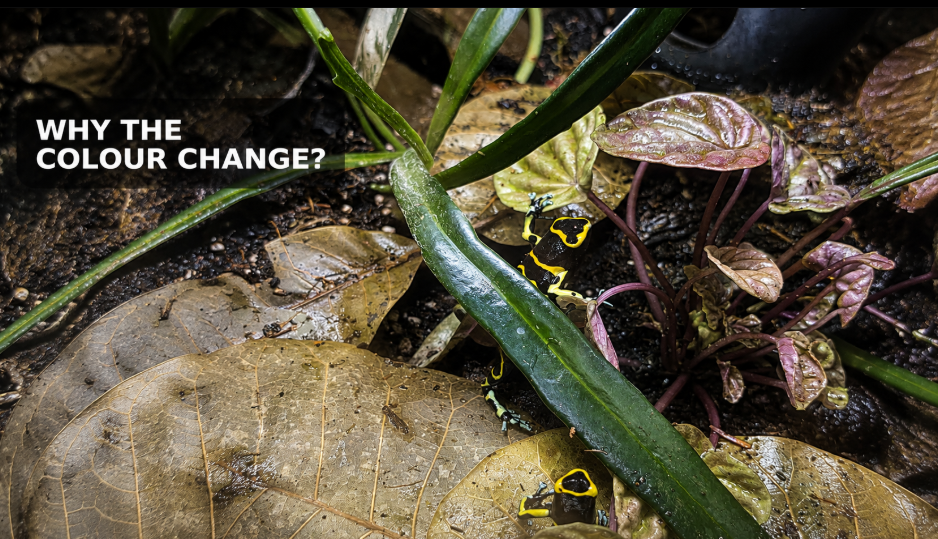
Carotenoids are pigments found throughout natural food webs. They can contribute to the yellow, orange and red colouration seen in many amphibians and may perform wider antioxidant and physiological roles.
Captive feeder insects may contain a different carotenoid profile from wild prey. This is why some supplements include carefully controlled carotenoid sources.
There are two important cautions:
- colour enhancement is not proof of complete nutrition; and
- carotenoids should not automatically be treated as a guaranteed replacement for preformed vitamin A.
A frog can look brightly coloured while still experiencing a different nutritional or husbandry problem. Colour is one observation, not a health test.
Other vitamins and trace minerals
Calcium, D3 and vitamin A receive most of the attention, but complete nutrition also involves other vitamins and minerals supporting metabolism, tissue maintenance, antioxidant systems and reproduction.
The challenge is that precise dietary requirements have not been established for most dart frog species. Product formulation must therefore draw on available amphibian evidence, feeder-insect analysis, broader insectivore nutrition and careful practical use.
A longer ingredient list does not automatically mean a better product. The source, concentration, balance, stability and intended dosing method all matter.
All-in-one supplement or traditional rotation?
Both systems can work when they are appropriately formulated and followed correctly.
| System | Potential advantage | Main risk |
|---|---|---|
| Complete every-feed supplement | Simple, consistent and easier to track | Using it alongside other complete products can duplicate nutrients |
| Separate calcium, multivitamin, D3 and vitamin A rotation | Individual components can be adjusted | Missed doses, accidental double-dosing and an increasingly complicated schedule |
| Veterinary or collection-specific protocol | Can address a diagnosed or documented requirement | Copying it to unrelated healthy frogs without the same evidence |
The important rule is to choose one coherent system. Do not use a complete every-feed supplement and then casually add a second multivitamin, calcium/D3 powder, concentrated vitamin A and colour enhancer.
What to check when choosing a supplement
- Is it intended for amphibians or small insectivores?
- Does it provide calcium and a wider vitamin-and-mineral profile?
- Does it state whether vitamin D3 is included?
- Does it identify a usable vitamin A source rather than relying on vague wording?
- Are its directions based on every-feed use or a rotation?
- Is there a batch, expiry or best-before date?
- Are storage instructions supplied?
- Can you realistically follow the routine consistently?
My supplementation routine at The Frogfather
I previously used a traditional rotation involving several products. It worked when followed correctly, but it became increasingly easy to lose track as the collection grew.
I therefore commissioned a complete formula for my own frogs containing calcium, controlled vitamin D3, a small amount of preformed vitamin A, carotenoids, other vitamins and trace minerals.
My routine is:
- Collect only the live food needed for that feed.
- Add a small amount of Frogfather All-in-1 Vitamin & Mineral Dust.
- Swirl gently until the feeders have a light, even coating.
- Offer them immediately.
- Use the same complete formula at every scheduled feed.
- Do not add separate calcium, D3, vitamin A or carotenoid powders routinely.
I have used this approach exclusively across my own collection for approximately five to six years. It is used with froglets, established adults and breeding frogs, alongside good feeder cultures and low-level UVB.
This history provides useful real-world evidence of consistency and practicality. It does not establish an exact nutrient requirement for every Dendrobates, Ranitomeya, Oophaga or Ameerega species, and it does not mean a keeper should ignore individual condition or veterinary findings.
“Every feed” also does not mean every frog is fed every day. It means the supplement is applied whenever food is offered according to that frog’s age, condition and feeding routine.
How to dust fruit flies properly
- Tap the required fruit flies into a clean, dry dusting cup.
- Add a small quantity of supplement.
- Gently swirl or tap the cup.
- Check that the flies are lightly and evenly coated.
- Offer them straight away.
The insects should look dusted, not entombed. Large piles of loose powder on leaves or substrate do not guarantee that the frog receives a more appropriate dose.
Dusting immediately before feeding matters because insects move, groom and lose supplement over time. Offer only a sensible quantity so most feeders are caught during the main feeding period.
Feed before misting where practical
A heavy misting cycle can wash supplement from prey and surfaces. Where the routine allows, offer freshly dusted food when the frogs are active and before the next heavy misting event.
Do not withhold necessary moisture merely to preserve powder. Suitable hydration and humidity remain fundamental husbandry requirements.
Fruit-fly nutrition and gut loading
Fruit flies are not nutritionally fixed objects. Their development and composition are influenced by the culture medium and culture conditions.
However, trying to “gut load” adult fruit flies immediately before use should not be treated as a substitute for a complete dusting routine. Much of the fly’s development has already occurred during its larval stage.
A stronger feeding system combines:
- productive, uncontaminated cultures;
- appropriate culture media;
- correctly sized and healthy adult flies;
- some prey variety where practical; and
- fresh supplement applied immediately before feeding.
Springtails and other microfauna provide valuable background foraging, particularly for small froglets, but their uncontrolled consumption makes them an unreliable sole delivery method for a measured supplementation system.
Supplementation at different life stages
Newly metamorphosed froglets
Froglets are growing rapidly while eating extremely small meals. They require regular access to suitably sized prey and consistent supplementation.
A heavy coating is not required. The goal is to avoid repeated unsupplemented meals while ensuring the froglet is actually catching enough food.
Read the complete guide to raising dart frog froglets for the wider grow-out process.
Juveniles
Juveniles usually continue to feed frequently. Monitor individuals within groups because rapid growth in one frog can hide poor access for another.
Established adults
Healthy adults may eat less frequently than froglets. If a complete supplement is intended for every-feed use, apply it at each of those scheduled feeds rather than adding extra unscheduled vitamin doses.
Breeding females
Egg production increases nutritional demand, but this does not automatically justify heavily dusting every feeder or stacking several products.
Watch feeding access, body condition, clutch pattern and recovery between clutches. Persistent weight loss, weakness or reproductive problems require a wider review rather than an assumption that calcium alone is responsible.
Recently transported or unwell frogs
A frog eating poorly will also consume less supplement. Adding more powder to feeders it does not catch will not solve the underlying problem.
Repeated food refusal, weight loss, poor coordination or other concerning changes should be investigated using the Dart Frog Health Guide.
Storing and replacing supplements
Supplement quality depends on more than the original formulation. Moisture, heat, light, contamination and prolonged storage can affect powders and sensitive vitamins.
- Follow the manufacturer’s storage directions.
- Keep the lid securely closed.
- Use a clean, dry utensil or dusting cup.
- Do not pour used powder back into the main container.
- Write the opening date on the container.
- Retain the original label, batch information and expiry date.
- Replace powder that becomes wet, contaminated, badly clumped or abnormal in smell or appearance.
- Do not combine the remains of old and new batches.
Refrigeration is appropriate for some products but not automatically for all of them. Repeatedly opening a cold container in humid air can introduce condensation. Follow the instructions supplied with the particular formulation.
Possible signs of a nutritional problem
| Observation | Possible nutritional relevance | Important limitation |
|---|---|---|
| Poor growth or skeletal deformity | Calcium, phosphorus or D3 imbalance may contribute | Development, water, feeding and genetics must also be reviewed |
| Weak grip, tremors or abnormal movement | Calcium metabolism may be involved | Neurological, infectious, traumatic and environmental causes are also possible |
| Repeatedly missing prey | Vitamin A deficiency can affect tongue tissues | Prey size, temperature, vision and general illness can produce similar signs |
| Poor skin or mucous-membrane condition | Vitamin A status may be relevant | Humidity, irritation, infection and water quality must be considered |
| Poor body condition in a group | Insufficient food or supplementation may contribute | Competition, parasites, stress and unsuitable husbandry may be responsible |
| Reduced breeding or poor eggs | Overall nutritional condition may play a role | Age, compatibility, temperature, stress and other factors are equally important |
None of these observations establishes a diagnosis. Do not respond to an unexplained symptom by adding several concentrated supplements at once. Record the existing diet and husbandry, isolate where appropriate and seek an amphibian-experienced veterinary surgeon when the frog is weak, deteriorating or showing persistent abnormalities.
Common supplementation mistakes
- Feeding cultured insects without any dependable supplementation system.
- Assuming that microfauna alone provides a complete diet.
- Using a complete every-feed powder alongside a second complete multivitamin.
- Adding separate vitamin A without checking whether the main supplement already contains it.
- Treating beta-carotene as a guaranteed vitamin A replacement.
- Applying so much powder that flies become buried.
- Dusting feeders long before they are offered.
- Allowing only the dominant frogs to reach the food.
- Using an old, damp or contaminated supplement.
- Assuming that UVB replaces calcium and other nutrients.
- Assuming that a “6%” lamp produces the same exposure in every enclosure.
- Trying to treat unexplained illness by dramatically increasing supplements.
- Copying another keeper’s rotation without checking the products and concentrations involved.
Troubleshooting your supplementation routine
| Problem | Checks | Sensible response |
|---|---|---|
| Flies will not coat evenly | Moisture, powder texture and dusting-cup cleanliness | Use a clean, dry cup and fresh powder |
| Most powder is left in the enclosure | Amount used and number of feeders offered | Use a lighter coating and offer a more appropriate quantity |
| One frog is losing condition | Competition, appetite, prey size, stress and health | Observe individual feeding and investigate the frog rather than increasing powder for the whole group |
| Keeper cannot remember the rotation | Number of products and conflicting schedules | Write a clear schedule or use one complete system as directed |
| UVB has been added | Lamp, distance, mesh, foliage, exposure and dietary D3 | Review the whole system rather than automatically stopping or doubling D3 |
| Several froglets develop abnormalities | Parents, water, food, supplement batch, temperature and development | Document common factors and obtain specialist veterinary input |
| Powder has clumped or become damp | Storage, condensation and contamination | Do not rely on the affected powder; replace it and correct storage |
What the evidence does—and does not—tell us
Amphibian nutritional research is much less complete than nutritional research for major domestic species. Requirements can differ between species, life stages, diets and environments.
Published evidence supports several broad conclusions:
- cultured feeder insects can be low in important nutrients, including calcium and vitamin A;
- dusting and gut loading can improve nutrient delivery, but the result is affected by many variables;
- metabolic bone disease remains an important problem in captive amphibians;
- vitamin A deficiency has been associated with epithelial disease in managed frog populations;
- beta-carotene should not be assumed to satisfy the vitamin A requirement of every amphibian;
- UVB and D3 requirements remain poorly established for many species; and
- nutrition must be evaluated alongside water, environment, food intake and complete husbandry.
Useful scientific reading:
- Challenges with effective nutrient supplementation for amphibians
- Causes of mortality in anuran amphibians from an ex situ survival assurance colony
- Nutrition and Health in Amphibian Husbandry
- The effects of preformed vitamin A and provitamin A carotenoids in amphibians
- Meeting ultraviolet B radiation requirements of amphibians in captivity
These studies do not establish one universal dart frog dusting dose. They support a measured, balanced and well-documented approach while highlighting how much remains species-specific or uncertain.
Frequently asked questions
Do dart frogs need calcium at every feed?
They need a consistent dietary calcium system. If the chosen complete product is designed for every-feed use, apply it lightly at every scheduled feed. A traditional rotation may work differently and should follow its own directions.
Does every feed mean every day?
No. Froglets may be fed daily or nearly daily, while healthy adults are often fed several times per week. “Every feed” describes which meals are supplemented, not how often the frog must eat.
Can I use Frogfather All-in-1 with another multivitamin?
It is designed as a complete routine and should not normally be combined with another complete multivitamin, calcium/D3 or separate vitamin A product. Combining them makes the total intake harder to judge.
Can I use plain calcium alongside an all-in-one powder?
Do not add it routinely unless the complete system specifically calls for it or a veterinary assessment identifies a reason. More calcium is not automatically safer.
Do dart frogs need separate vitamin A?
Not necessarily. Check whether the complete supplement already contains an appropriate preformed vitamin A source. Adding a concentrated separate product can duplicate a fat-soluble vitamin.
Is beta-carotene the same as vitamin A?
No. Beta-carotene is a precursor that must be converted into vitamin A. That conversion should not be assumed to be equally effective in every amphibian species or life stage.
Can UVB replace vitamin D3?
Appropriate UVB may provide a route for D3 production, but requirements are not well established for every dart frog. UVB also cannot supply calcium, vitamin A or other nutrients. Review lighting and diet together.
Can I use a 6% UVB lamp with a supplement containing D3?
I do so in my own collection, but “6%” alone does not define the frog’s exposure. Lamp distance, mesh, reflector, foliage and shaded retreat areas must all be considered.
Should springtails be dusted?
Springtails placed in the vivarium are generally treated as background microfauna rather than individually dusted. Use controllable feeders such as fruit flies as the main route for consistent supplementation.
Can I diagnose vitamin deficiency from a photograph?
No. Nutritional disease can resemble environmental, infectious, traumatic and developmental problems. A photograph can reveal a warning sign but cannot establish the cause.
Should supplements be refrigerated?
Follow the particular manufacturer’s instructions. Refrigeration may help some products, but condensation can damage powder if a cold container is repeatedly opened in humid air.
Can supplement powder cure metabolic bone disease?
Simply adding more powder is not a safe treatment plan. Suspected metabolic bone disease requires assessment of diet, UVB, D3, calcium, phosphorus, husbandry and the frog’s physical condition, ideally with veterinary involvement.
Final supplementation checklist
- Choose one coherent supplementation system.
- Check whether the product is complete or intended for rotation.
- Do not casually combine multiple complete products.
- Confirm that vitamin A and vitamin D3 are addressed.
- Treat carotenoids as useful nutrients, not guaranteed vitamin A replacements.
- Dust feeders lightly and evenly immediately before feeding.
- Use healthy, appropriately sized live food.
- Make sure every frog in a group has an opportunity to feed.
- Store powder according to its instructions and track when it was opened.
- Review UVB and dietary D3 together.
- Adjust feeding frequency for age and condition—not powder quantity by guesswork.
- Investigate persistent weakness, poor feeding or abnormal development properly.
My own preference is intentionally simple: healthy feeder cultures, a light coating of one complete supplement at every scheduled feed, measured low-level UVB, and close observation of the frogs themselves.
Continue with the Dart Frog Feeding Guide UK, the Froglet Guide or the Complete Dart Frog Care Guide.