Husbandry & Evidence Review – 5 September 2026
This older article has been retained for useful context, but its husbandry claims have been checked and corrected where necessary. For Frogfather’s current evidence-led position on UVB and lighting, use Do Dart Frogs Need UVB? (2026 Guide).
Lighting is one of the most confusing parts of dart frog keeping.
Ask five people whether dart frogs need UVB and you’ll get five different answers — all delivered like they’re absolute fact.
Some will tell you it’s essential. Others will say it’s completely unnecessary. Then there’s the middle ground where people say “optional” without really explaining why.
The reason this gets messy isn’t because people are wrong.
It’s because they’re talking about completely different setups… in completely different parts of the world.
If you’re keeping dart frogs in the UK, the answer is a bit more specific — and a lot more practical.
Why UVB advice is so contradictory
Most of the conflicting advice comes down to context.
For example:
- Keepers in bright, naturally lit environments may get ambient UV exposure without realising it
- Others rely heavily on supplementation (vitamin D3) and have success without UVB
- Some setups are heavily planted and shaded, others are much more open
So when someone says “you don’t need UVB”, what they often mean is:
“I haven’t used it, and my frogs are doing fine in my setup.”
That doesn’t automatically translate to your setup.
The D3 vs UVB debate (what’s actually going on)
Dart frogs need vitamin D3 to properly use calcium.
That’s not optional.
The question is how they get it.
There are two main routes:
- Supplementation (dusting feeders with D3)
- UVB exposure (allowing natural D3 synthesis)
Plenty of keepers have raised healthy frogs using supplementation alone.
That’s why the “UVB isn’t needed” argument exists.
But that doesn’t mean UVB has no benefit.
It just means it’s not the only way to meet the requirement.
UVB in the UK: the reality
This is where things shift.
UK homes are not naturally bright tropical environments.
Even in well-lit rooms:
- Window glass filters out most UVB
- Light intensity drops quickly indoors
- Seasonal changes affect ambient light levels
So unlike some keepers in sunnier regions, you can’t rely on incidental exposure.
If your frogs are getting UVB, it’s because you’ve provided it.
So… do dart frogs need UVB?
If you want a clean, honest answer for UK setups:
No — but it is beneficial, and there’s a strong argument for using it properly.
That’s the difference most articles miss.
It’s not about survival.
It’s about optimisation.
Using UVB correctly (this is where people go wrong)
UVB isn’t a case of “more is better”.
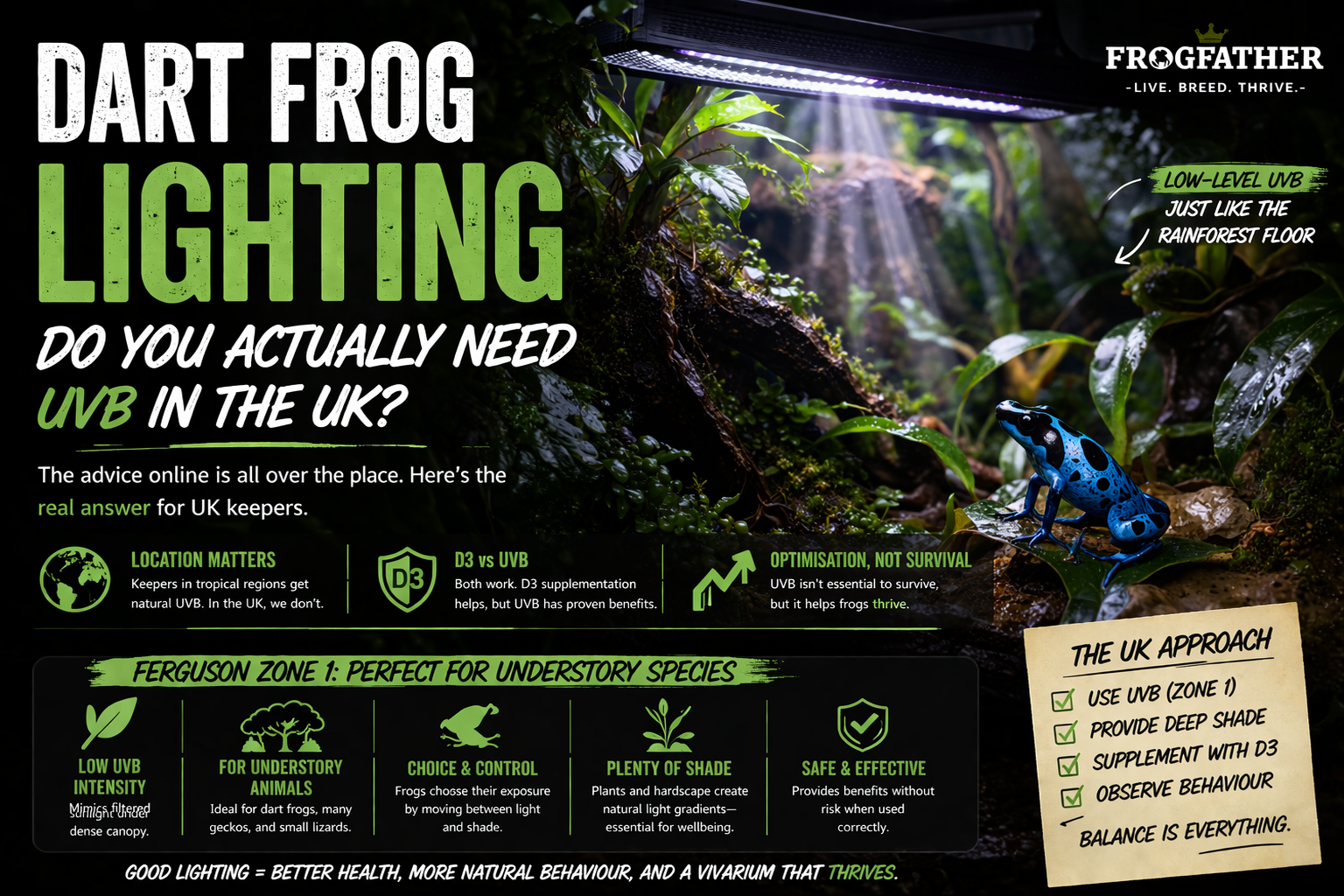
Dart frogs are understory species.
In the wild, they spend most of their time under dense canopy, receiving low, filtered UV exposure.
Low-UVI frameworks such as Ferguson Zone concepts can be useful as comparative reptile-husbandry tools, but dart frogs should not automatically be assigned to Ferguson Zone 1 as though that were a species-specific experimentally validated requirement.
Using low-UVI frameworks cautiously
This applies to species that naturally experience low UVB levels.
That includes:
- Dart frogs
- Many geckos
- Other understory reptiles and amphibians
In practical terms, this means:
- Low-output UVB lighting
- Plenty of shaded areas
- No forced exposure
The frogs choose their exposure — not you.
How to add UVB safely to a dart frog vivarium
- Use low, measured exposure appropriate to the species and installation, with complete shade
- Mount above mesh or glass appropriately (account for filtering)
- Create shaded areas with plants and hardscape
- Never expose the entire enclosure evenly
This ties directly into your planting guide — good planting isn’t just aesthetic, it creates light gradients.
Common UVB mistakes
Using high-output bulbs
Too intense for dart frogs. Leads to avoidance behaviour or stress.
No shaded areas
Removes the frog’s ability to regulate exposure.
Assuming brighter = better
Dart frogs are not basking reptiles.
What about no UVB at all?
Plenty of keepers still run setups without UVB.
And yes — it can work.
But if you go this route, supplementation becomes more important.
You’re replacing one system with another.
Not avoiding the requirement entirely.
Behaviour changes with lighting
Lighting affects more than just health.
It influences:
- Activity levels
- Visibility
- Confidence
If lighting is off, behaviour often reflects it.
This links directly back to your behaviour guide.
So what should you actually do?
If you’re keeping dart frogs in the UK and want a balanced approach:
- Use controlled UVB only where the installation can provide appropriate exposure and complete shade
- Provide shade and structure
- Continue sensible supplementation
That combination covers all bases without pushing things too far in either direction.
It’s not about copying one extreme or the other.
It’s about building a system that makes sense in your environment.
Frequently Asked Questions
Do dart frogs need UVB in the UK?
Not strictly, but UVB is beneficial and often recommended when used correctly at low levels.
What UVB level do dart frogs need?
If UVB is used, aim for low controlled exposure with shade and verify what reaches the frogs. Do not infer the correct dose from a Zone label or bulb percentage alone.
Can dart frogs live without UVB?
Yes, with proper supplementation, but UVB can offer additional benefits.
Is UVB dangerous for dart frogs?
Only if used incorrectly. High output or lack of shade can cause stress.
Do UK homes provide natural UVB?
No. Window glass blocks most UVB, so indoor setups rely on artificial lighting.