Description
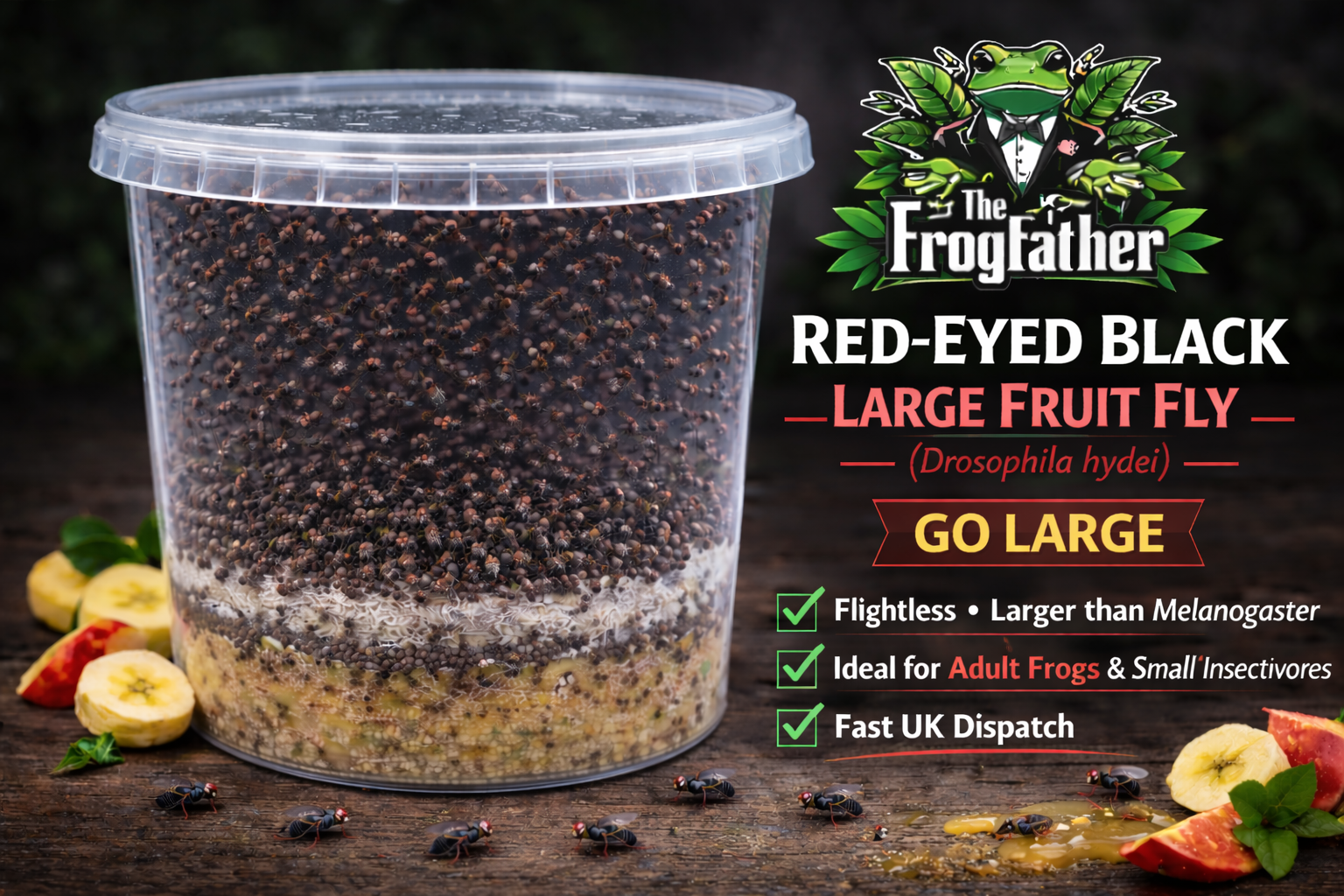
Red-Eyed Black Large Fruit Fly – Drosophila hydei Go Large Culture
A large-bodied flightless Drosophila hydei culture supplied in Frogfather’s larger Go Large format.
Why choose D. hydei?
- Larger adult body size than D. melanogaster.
- Useful for suitable adult dart frogs and other small insectivores able to take the larger prey size.
- Flightless culture strain for easier handling.
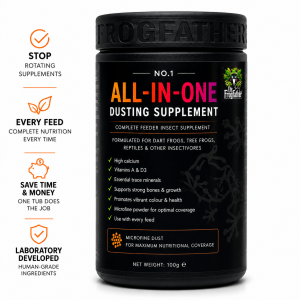
- Can be dusted immediately before feeding with an appropriate supplement.
Nutrition wording corrected
We previously said that D. hydei has “higher feeding value per individual” and that fewer flies are therefore needed per feed. A larger fly is not automatically a nutritionally superior fly, and feeding quantity should be based on the animal’s body condition, prey size, life stage and overall diet rather than a fixed fly-count conversion.
Go Large culture
The larger culture format contains more media and culture volume than our standard tubs and is intended to provide a useful production window for keepers running several enclosures. Production rate and lifespan vary with temperature, culture age, strain, media and handling, so longer lifespan or higher yield is not guaranteed for every culture.
Culture management
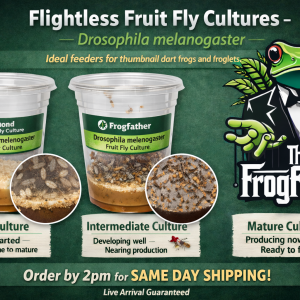
Keep cultures in a stable room-temperature environment appropriate for the strain. Frogfather commonly keeps fruit-fly cultures around normal warm room temperatures; exact production speed varies, so use the visible culture stage rather than temperature alone to decide when to feed from it.
Feeder-Insect & Nutrition Review
Last reviewed: 5 September 2026
Different feeder insects can increase prey variety, but variety alone does not make a captive diet nutritionally complete. Published amphibian-nutrition reviews show that feeder insects vary considerably in calcium, vitamins and other nutrients, and that dusting/gut-loading are commonly used to improve nutrient delivery.
Unless a batch-specific nutrient analysis is available, Frogfather does not describe an individual feeder species or colour strain as nutritionally “balanced”, “complete” or inherently superior.
Evidence & further reading
- Latney & Clayton – amphibian nutrition and common feeder insects
- Livingston et al. – nutrient supplementation for amphibians
- Ferrie et al. – Nutrition and Health in Amphibian Husbandry