Keeping arrow frogs successfully isn’t about mastering one single element of care. It’s about understanding how nutrition, habitat, and supplementation work together as a system.
When poison dart frogs struggle in captivity, the cause is rarely dramatic. More often, it’s the slow accumulation of small compromises — feeding that’s technically “correct” but incomplete, supplements used inconsistently, or environments that look good but don’t function the way a frog expects.
This article pulls together everything we’ve covered in this series and explains how healthy arrow frogs are built from the ground up.
Related: Dart frog care, guidance, and resources
Arrow frogs evolved for complexity
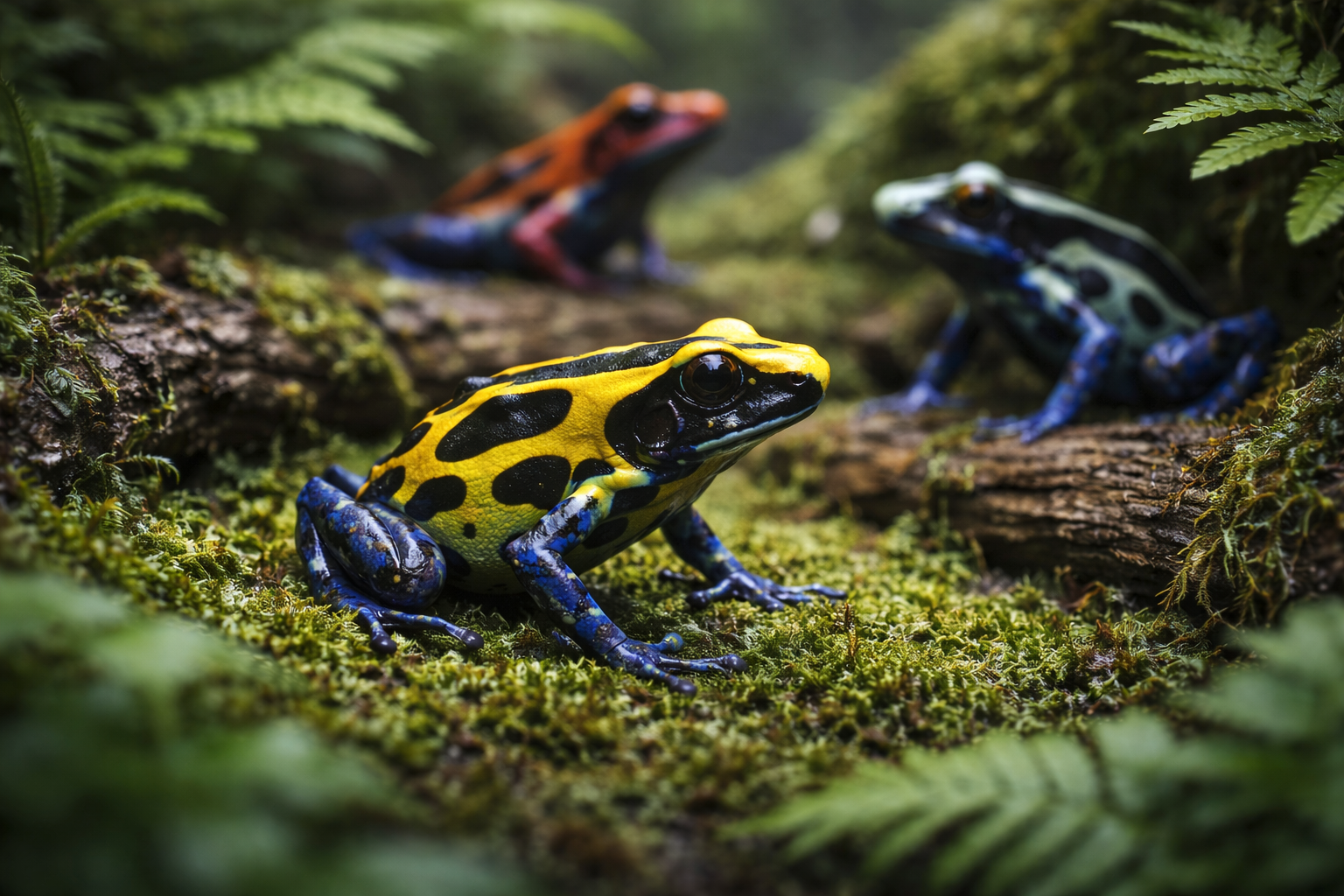
In the wild, poison dart frogs live in environments that are anything but uniform. They move through a mosaic of microhabitats — damp moss, leaf litter, shaded roots, and plant bases — feeding constantly on tiny prey.
This lifestyle shaped how their bodies work:
- fast metabolism
- high reliance on skin hydration
- continuous low-level feeding
Captive care succeeds when it respects this complexity rather than trying to simplify it away.
Nutrition is more than “what they eat”
Earlier in this series, we explored what arrow frogs eat. But nutrition isn’t just about feeder insects — it’s about access, frequency, and consistency.
Healthy feeding looks like:
- frequent small meals
- constant access to microfauna
- prey sized appropriately for the frog
Fruit flies form the backbone of most captive diets, but they are only effective when supported by microfauna and proper supplementation.
Explore: Microfauna, foods, and supplements for dart frogs
Microfauna: the invisible support system
Springtails and other microfauna play a role that’s easy to underestimate.
They:
- provide constant low-level feeding
- support juveniles and froglets
- clean excess food and waste
- stabilise the enclosure ecosystem
In enclosures without microfauna, feeding becomes episodic and artificial. In bioactive systems, it becomes continuous and natural.
Why supplements matter — and when they fail
Supplements exist to replace what captivity removes.
Even the best feeder insects lack the nutritional diversity of wild prey. Without supplementation, deficiencies develop slowly and quietly.
As covered in our guide to dart frog supplements, success depends on:
- balanced formulations
- light but regular use
- avoiding extremes
Overuse and underuse are both problematic. The goal is stability, not intensity.
Learn more: All-in-1 vitamin and mineral dust for dart frogs
Habitat makes nutrition work
Nutrition doesn’t function in isolation. It depends on environment.
Arrow frogs rely on humidity and microhabitats to:
- hydrate through their skin
- regulate body temperature
- forage naturally between feeds
Moss-based environments buffer humidity at ground level and provide structure that frogs instinctively use.
This is why bare or overly minimal setups often lead to feeding and health problems — even when diets look correct on paper.
Related: Why moss and microhabitats matter for arrow frogs
Establishing a functional foundation
Healthy arrow frog setups share common traits:
- live or well-established moss
- leaf litter and textured surfaces
- stable humidity without waterlogging
- active microfauna populations
These elements create a foundation where feeding and supplementation actually work as intended.
Explore: Paint-on tropical moss starter for vivariums
Precision beats shortcuts
Arrow frogs are often labelled as “difficult”, but that reputation usually comes from shortcuts taken early on.
When nutrition, supplements, and habitat are treated as separate problems, results are inconsistent. When they’re treated as a single system, results stabilise.
This is the difference between keeping frogs alive and keeping them well.
Pulling it all together
Healthy poison dart frogs don’t happen by accident.
They are the product of:
- appropriate feeding
- balanced supplementation
- functional, humid microhabitats
Get the foundation right, and everything else becomes easier.
Read the full series
- Arrow Frogs vs Poison Dart Frogs: Names, History, and Care Explained
- What Do Arrow Frogs Eat?
- Do Poison Dart Frogs Need Supplements?
- Why Moss and Microhabitats Matter for Arrow Frogs
Key takeaway: Healthy arrow frogs start from the ground up. When nutrition, supplements, and habitat work together, poison dart frogs don’t just survive — they thrive.