Husbandry & Evidence Review – 6 September 2026
This care sheet is retained as practical Bombina orientalis guidance. UVB can contribute to vitamin-D3 status in this species, but enclosure size, social grouping and climate remain husbandry ranges rather than absolute rules.
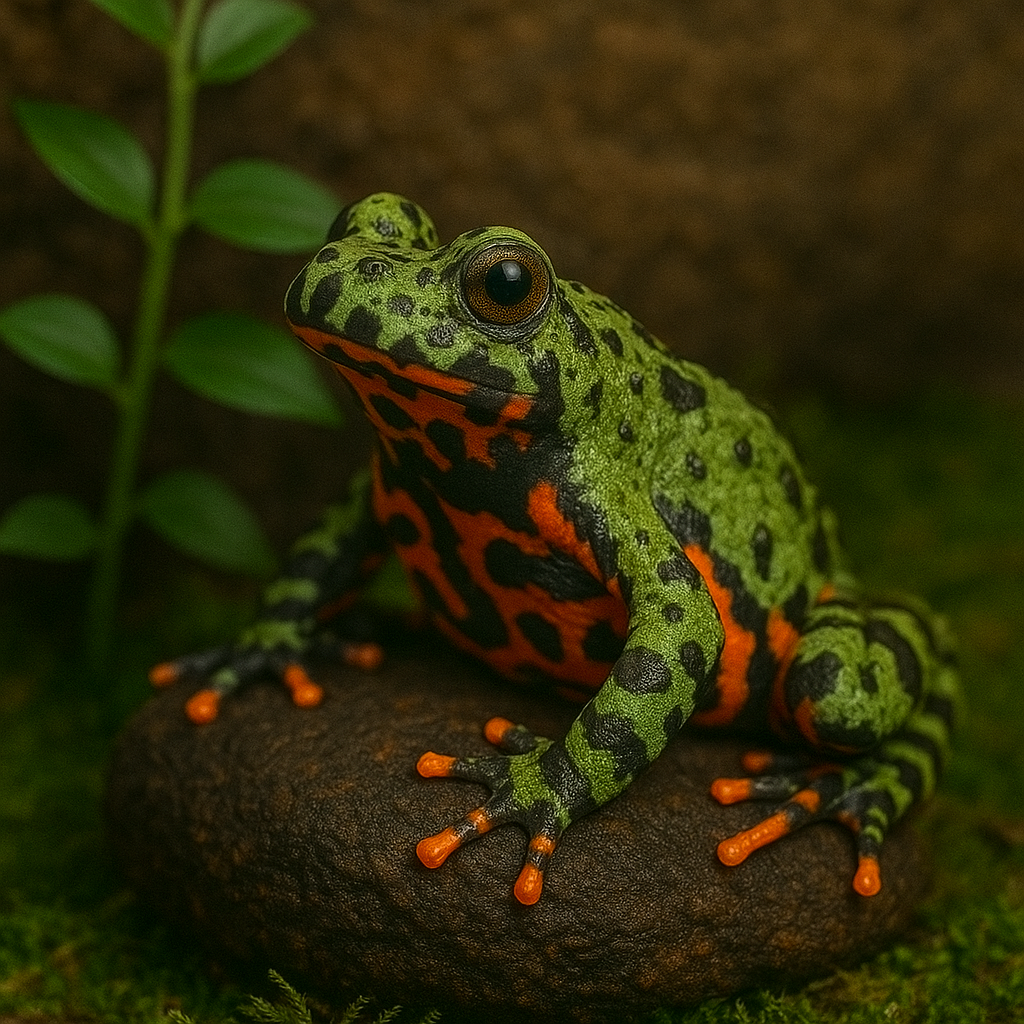
Oriental fire-bellied toads are hardy, semi-aquatic amphibians with bright green backs and vivid orange bellies. They’re among the most popular “starter” amphibians in the UK thanks to their bold colours, active behaviour and straightforward care, provided you can offer both land and water areas.
Quick Facts
- Common names: Oriental fire-bellied toad, fire-bellied newt (incorrectly), fire-belly
- Scientific name: Bombina orientalis
- Adult size: 4–6 cm
- Lifespan: 10–15 years
- Difficulty: Beginner to intermediate
- Activity: Diurnal; often visible in the water or on basking areas
Natural History
Fire-bellied toads come from cool, temperate parts of China, Korea and surrounding regions. They live in ponds, marshes and slow-moving water with lots of vegetation. They are more tolerant of cooler conditions than many tropical frogs and do not need high temperatures.
Enclosure & Setup
- A 60 cm or larger enclosure may suit some small groups depending on footprint, water/land design and animal number. Fire-bellied toads can be maintained socially, but ‘do best in groups’ should not be treated as a proven welfare requirement.
- Type: Semi-aquatic paludarium — roughly half water, half land.
- Water side: 10–20 cm depth is plenty, with sloping ramps or cork bark so they can easily haul out.
- Land side: Moist soil, bark and moss with hides and live or artificial plants.
Use a secure lid; they are surprisingly good at climbing and escaping.
Temperature & Humidity
- Temperature range: 18–24 °C is ideal; they do not need intense heat.
- Heating: Often room temperature in a UK home is enough; in cooler rooms, use a small, thermostatted heat source.
- Humidity: Naturally high thanks to the large water area and moist land section.
Lighting
Provide a low-level UVB strip across part of the tank and a normal day/night light cycle. Fire-bellied toads do not bask like reptiles, but UVB supports their bone health and helps create a naturalistic environment.
Water Quality
- Use dechlorinated water in the aquatic section.
- Fit a gentle filter to keep water clean, but avoid strong currents.
- Perform regular partial water changes to keep nitrate levels low.
Diet & Feeding
- Main foods: Small crickets, fruit flies, small roaches, bloodworms and other aquatic invertebrates.
- Feeding frequency: 3–4 times per week in small amounts.
- Supplements: Dust land-based insects with calcium and multivitamin according to manufacturer’s directions.
Many keepers feed partly in water (e.g. bloodworms) and partly on land. Remove uneaten food so it doesn’t foul the water.
Behaviour & Handling
Fire-bellied toads are active, social and vocal. They’re great to watch but not suitable for frequent handling:
- Their skin secretes mild toxins that can irritate human skin or eyes.
- Handling removes protective mucus and can stress the toads.
- If handling is unavoidable, wear clean, powder-free gloves and wash hands afterwards.
Common Health Issues
- Water quality issues: Ammonia or nitrite spikes from poor filtration or infrequent water changes.
- Skin problems: From dirty water, rough handling or inappropriate substrates.
- Obesity: If overfed; maintain a sensible schedule and portion size.
Is an Oriental Fire-Bellied Toad Right for You?
If you like the idea of a planted semi-aquatic setup and want small, colourful toads that are active and visible in the daytime, fire-bellies are a brilliant choice. They’re better as display animals than “pets to hold”, but they reward good care with natural behaviours, calling and group interactions.