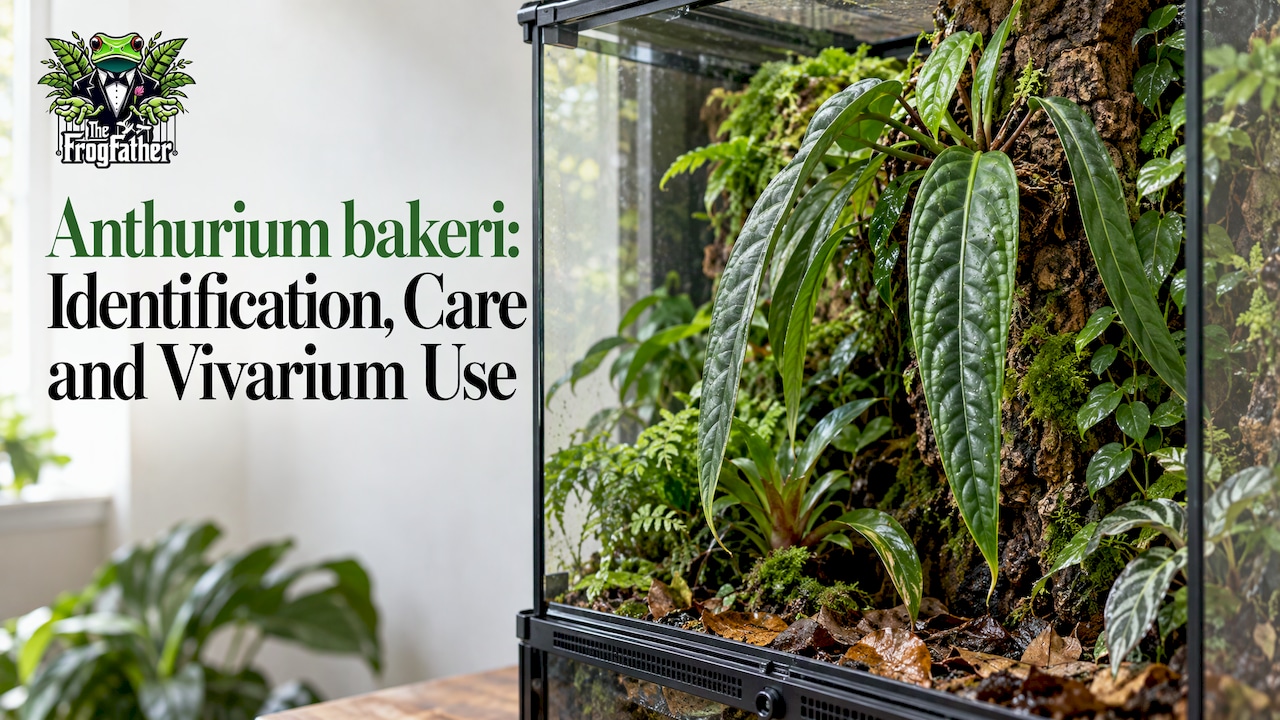
Anthurium bakeri is a clumping, strap-leaved anthurium from Central and northern South America. It grows well in warm, humid, bright-but-not-sunny conditions, which is why it appeals to keepers of tropical vivariums and to houseplant growers alike. In the UK it needs steady humidity, indirect light and a free-draining, airy substrate. It also needs a sensible plan if it is going into an enclosure with animals, because the plant is toxic if chewed. This guide covers what it is, how to grow it, how to propagate it and where it does and does not suit a dart frog setup.
TL;DR
- Anthurium bakeri is an epiphytic subshrub with narrow, strap-like leaves and a short stem, accepted by Kew and native from Chiapas in Mexico to Guyana and Ecuador.
- Give it bright, indirect light, 18 to 30°C, high humidity and a loose, well-drained mix. Direct summer sun scorches leaves and wet compost rots roots.
- Propagate in the growing season by division or cuttings. In Britain, that means roughly April to August.
- All parts of anthuriums contain calcium oxalate crystals, so keep plants away from pets that chew and treat any ingestion as a vet matter.
- In a bioactive vivarium it is a foliage feature for larger, well-ventilated setups, not a plant to drop into any tank without thinking about space and placement.
Table of Contents
- What Anthurium bakeri is and how to recognise it
- Where it comes from and why that matters for your setup
- Care: light, temperature, humidity, water and substrate
- Can you use Anthurium bakeri in a dart frog vivarium?
- Is Anthurium bakeri toxic?
- Common problems and what to do
- Propagating Anthurium bakeri
- Our view on Anthurium bakeri
- Plants, microfauna and setups from Frogfather
- FAQ
- Sources
What Anthurium bakeri is and how to recognise it
Kew’s Plants of the World Online accepts Anthurium bakeri Hook.f. as an epiphytic subshrub of wet tropical biomes, first published in 1876. It belongs to the arum family, Araceae, like the better-known flamingo flowers sold as flowering houseplants.
The trick with bakeri is that it looks nothing like the glossy, red-flowered anthuriums in supermarkets. The same Kew entry gives the features that identify it:
- Very short stems, under 10 cm.
- Narrow leaves with reddish-brown dots on the underside and a sunken collective vein.
- A pale yellow-green spathe with a creamy-white spadix.
- Pointed red berries after flowering.
The overall effect is a tidy, arching tuft of long, narrow, leathery leaves. You will see it sold under names like strap-leaf anthurium or Baker’s anthurium. If a plant has broad heart-shaped leaves, it is something else, however it is labelled.
Where it comes from and why that matters for your setup
Kew records the native range as Chiapas, Mexico, through to Guyana and Ecuador, and the associated catalogue data also lists Colombia and an elevation of 200 to 1900 m. That is a lot of rainforest, but the plant’s habits are consistent.
A 2021 peer-reviewed study in Costa Rican premontane rainforest found A. bakeri lower in the canopy in shaded positions, with photosynthetic traits of a shade-adapted understory epiphyte. In plain terms: it is built for dappled, humid shade, perched on trunks and branches, with its roots in airy debris rather than heavy soil.
That tells you three things about keeping it in the UK:
- It does not want strong light. Bright and indirect is the target.
- Its roots want air. A dense, soggy mix works against it.
- It copes with the kind of steady warmth and moisture a rainforest tank provides, as long as air still moves.
Care: light, temperature, humidity, water and substrate
Light
The RHS recommends bright, indirect light for anthuriums and warns that direct summer sun can scorch the leaves. A UK windowsill facing south in July is the classic way to ruin one. An east-facing window, or a spot a little back from a bright one, works better.
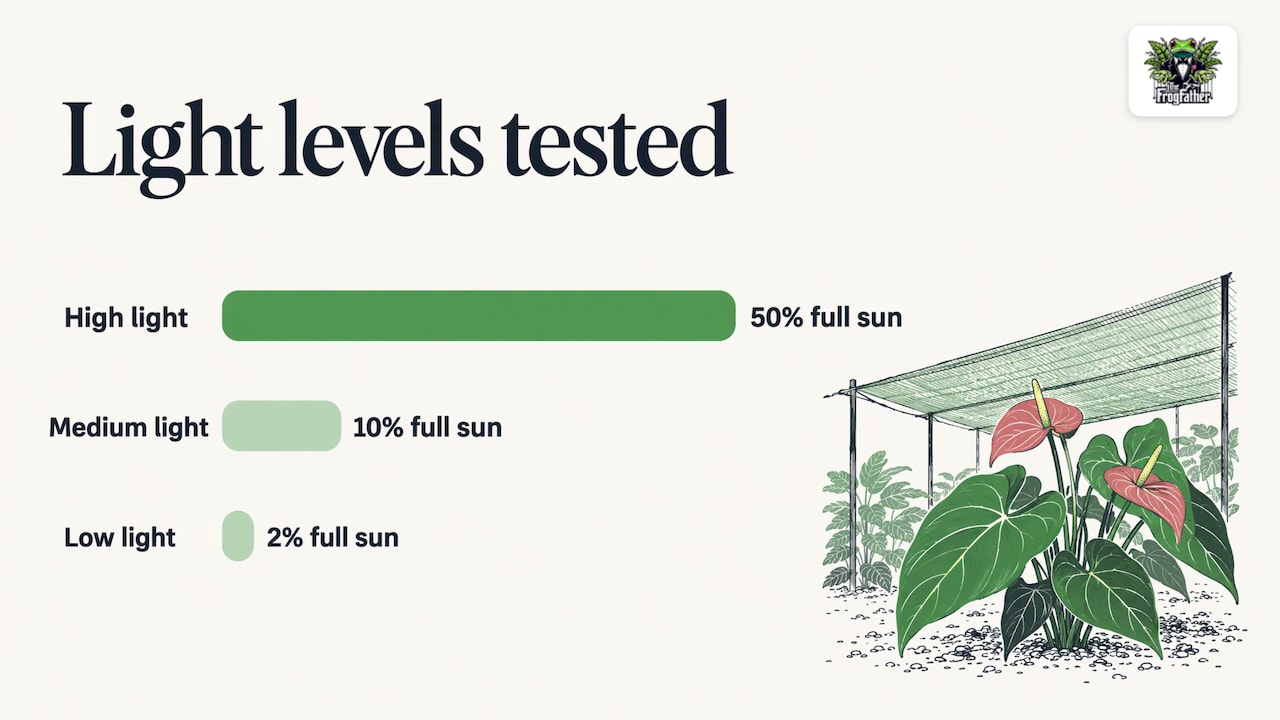
In a vivarium, the equivalent is an LED fixture that gives good plant light without cooking the foliage. The Costa Rican study tested high, medium and low light equivalent to 50%, 10% and 2% of full sun in shadehouse conditions. Treat that as a reminder that this is a plant of the shade, so aim for the moderate end of what your lighting can deliver rather than placing it right under the brightest part of the canopy.
Temperature
The RHS suggests keeping anthuriums at 18 to 30°C, away from cold draughts and direct heat sources. In a UK winter that means keeping houseplants off cold glass and away from radiators. Frog enclosures tend to sit comfortably within this range already, so temperature is rarely the issue for a vivarium plant.
Humidity
Dry air is the usual cause of browning leaf tips. The RHS lists browning leaves from dry air among the common problems and advises raising humidity. A closed or semi-closed glass vivarium does this for you. On a shelf in a centrally heated living room, you will need a humid microclimate, such as a terrarium, a glass cabinet or a humidity-tray arrangement, and you will need to watch the leaf tips.
Watering and substrate
The RHS names root rot from overwatering or wet compost as a risk. The practical answer is a mix that holds some moisture but drains quickly: bark, a little charcoal, coarse fibre and some leaf litter or sphagnum for moisture. Water when the top layer starts to dry rather than on a fixed day.
In a bioactive setup, the leaf litter and springtail and isopod clean-up crew help keep the surface healthy. They do not replace good drainage. A drainage layer, a sensible substrate depth and a ventilated design do that work, and none of it removes the need for regular maintenance. Our Complete Guide to Bioactive Vivariums walks through the layers.
Can you use Anthurium bakeri in a dart frog vivarium?
Yes, it can work, with caveats about size, placement and your frog species. We say this from keeping and building planted tanks, not from a trial specific to this species, so treat the following as practical judgement rather than a rule.
Where it suits
- Larger enclosures. The leaves are long and strap-like, and a mature clump will need room. In a small 45 cm tank it will quickly dominate. In a taller or wider build, it gives a strong vertical, architectural feature.
- Mid-level and background positions. Because it is a shade-adapted understory epiphyte, it suits a mounted or semi-raised position on a background or in a pocket of substrate, with other plants providing canopy cover above it.
- Setups with good airflow. Anthurium roots dislike stagnant, waterlogged conditions. A well-vented build helps; our guide to vents for vivariums and terrariums covers how to add airflow without losing humidity.
Where to think twice
- Very small or tightly planned layouts, where the clump will crowd egg-laying sites and bromeliad cups.
- Beneath your strongest light, where the leaves can burn.
- Anywhere you want a fast ground cover. Bakeri is a clumper, not a carpet. Pair it with moss, a creeping species or a vine such as Marcgravia. We cover how to propagate Marcgravia if you want to build that layer up.
Planting it so it lasts
- Choose a spot with moderate light, not the brightest point.
- Plant or mount it with the crown above the wet zone of the substrate, so the base is not sitting in water.
- Surround the roots with a chunky, airy mix and add leaf litter on top.
- Add companions at different heights. Our top 5 plants for a thriving dart frog habitat and the bromeliad guide are good starting points, and our scientific guide to selecting and maintaining vivarium plants covers the upkeep.
- Leave it alone for a few weeks. New plants often sulk before they settle, and fiddling with them rarely helps.
It also helps to think in microclimates. A humid lower zone and a drier, brighter upper zone let different plants sit where they are happiest, and our piece on replicating microclimates inside a UK dart frog vivarium shows how.
Is Anthurium bakeri toxic?
Treat it as toxic if chewed. A European peer-reviewed review of indoor plant poisoning states that all Anthurium parts contain insoluble calcium oxalates, which can cause oral irritation, swelling, salivation, vomiting and difficulty swallowing if ingested. The Merck Veterinary Manual likewise lists Anthurium among houseplants containing raphides, water-insoluble calcium oxalate crystals, and describes painful inflammation of the mouth after ingestion.
These sources concern companion animals such as cats and dogs, not amphibians. We are not aware of dart frogs eating anthurium leaves, as they are insectivores that do not graze on plants, but the sensible approach is the same either way:
- Keep plants out of reach of cats, dogs and children.
- Wear gloves or wash your hands after pruning, and avoid touching your eyes.
- Dispose of trimmings where pets cannot reach them.
- If a pet has chewed a plant, call your vet promptly and tell them the plant name.
If you keep frogs, watch how your animals behave around any new plant in the first weeks. If you see anything unusual, speak to an exotics vet.
Common problems and what to do
The RHS lists the usual anthurium troubles, and the fixes are consistent.
| Symptom | Likely cause | What to do |
|---|---|---|
| Brown, crispy leaf tips | Dry air | Raise humidity, move into a closed or semi-closed enclosure |
| Pale, bleached or scorched patches | Direct summer sun or lighting too close | Move back, diffuse the light, or lower the intensity |
| Yellowing, soft base, sour smell | Overwatering, wet compost, root rot | Cut back watering, improve drainage, lift and check roots |
| White cottony clusters in leaf axils | Mealybugs | Isolate the plant and treat it according to your setting (see below) |
In a houseplant setting, you can treat pests with standard horticultural advice. In a livestock enclosure, take the plant out first. Avoid spraying insecticides near frogs, microfauna or any bioactive substrate, because residues can harm both your animals and your clean-up crew. If you can, treat a plant outside the vivarium and rinse it well before it goes back.
Propagating Anthurium bakeri
The RHS says anthuriums can be propagated from stem or rhizome cuttings, stem pieces with leaves and aerial roots, or rooted divisions, and recommends a closed heated propagator at 21°C for rhizome cuttings.
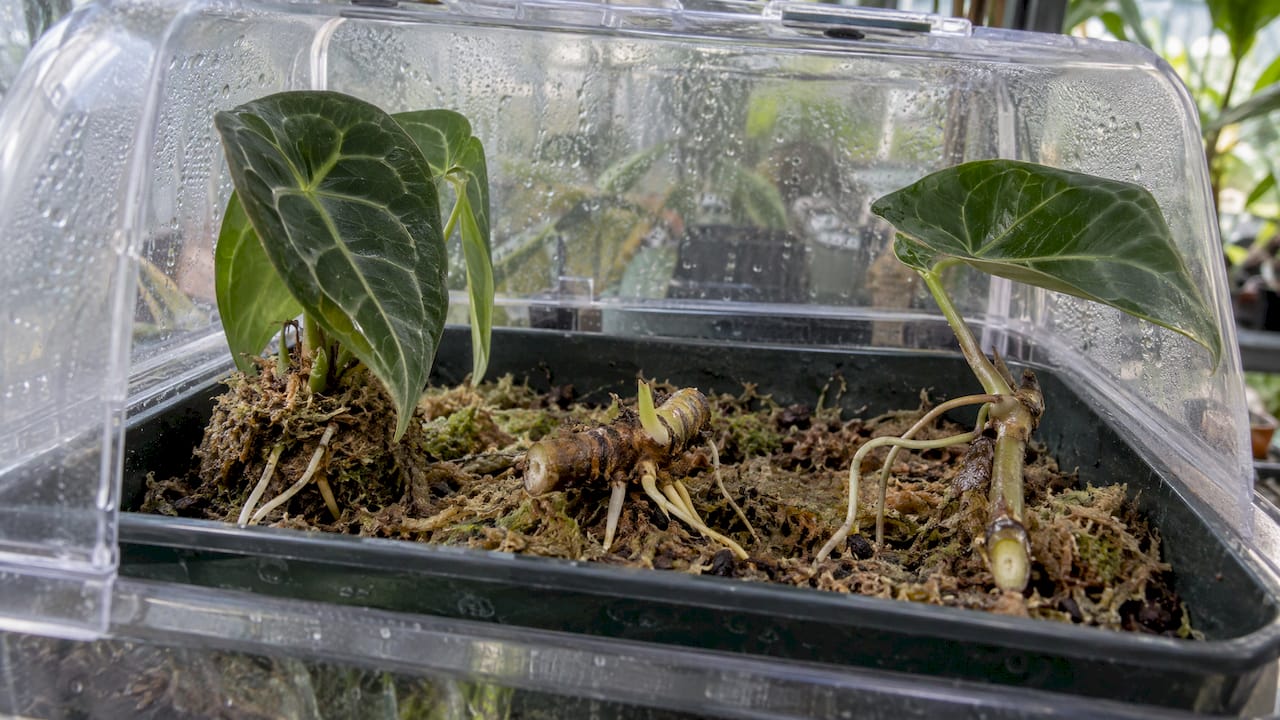
A UK propagation guide suggests propagating A. bakeri indoors during active growth, roughly April to August in Britain, with rooting commonly taking two to six weeks in the growing season. That fits what most UK growers see: spring and summer are when there is enough light and warmth to push new roots.
For a clumping plant, division is the easiest route:
- Water the plant lightly the day before.
- Ease it from its pot or mount and tease the clump into sections, each with healthy roots and at least a couple of leaves.
- Pot each section in a chunky, airy mix and keep it warm and humid, out of direct sun.
- Resist the urge to check roots every few days. Leave it until you see fresh growth.
The same patience applies to any propagation project. Our Marcgravia propagation guide follows the same logic of steady conditions and minimal fiddling.
Our view on Anthurium bakeri
We like Anthurium bakeri for the right tank. It gives a planted vivarium a bold, upright shape that most carpeting plants cannot, and it does it without needing intense light.
But we would never describe it as a plant you set and forget. Bioactive enclosures are living systems, and they need regular observation, trimming, watering adjustments and the occasional rethink of the layout. A plant that looks great at planting can outgrow its spot in a year.
Our approach, in our own frog rooms, is to plan the planting around the animals first: where they will hide, feed, lay eggs and climb. Then we choose foliage plants to fit those zones, with a clean-up crew of springtails and isopods underneath to keep the substrate healthy. We design our own 3D-printed accessories in the same spirit, built from day-to-day use rather than from theory.
If you are unsure whether a plant suits your enclosure, start with the basics and build slowly. Steady, boringly solid foundations beat clever shortcuts every time.
Frogfather
Plants, microfauna and setups from Frogfather
If you are planning a planted enclosure, we are a Nottingham-based UK specialist in dart frogs and bioactive vivariums. We supply tropical plants, springtails, isopods, live foods, supplements and enclosure supplies, and we build custom bioactive vivariums.
Browse the range on the Frogfather shop, or if you are ready to design a build from scratch, our free Bioactive Vivarium Fundamentals course is a good place to begin. Once frogs are in, our live food range includes fruit fly culture subscriptions.
FAQ
Is Anthurium bakeri easy to grow?
It is forgiving if you get the basics right: bright indirect light, warmth between 18 and 30°C, high humidity and a loose, fast-draining mix. It struggles in dry centrally heated rooms and in soggy compost. Beginners tend to do best with it in an enclosed, humid setup rather than on an open shelf.
Where should I put an Anthurium bakeri?
Put it somewhere bright but out of direct sun, such as back from an east-facing window or under moderate vivarium lighting. The RHS warns that direct summer sun can scorch anthurium leaves. Keep it away from radiators and cold draughts.
Is Anthurium bakeri safe for pets?
No. Anthuriums contain calcium oxalate crystals that irritate the mouth and throat if chewed, so keep the plant out of reach of cats, dogs and children. If a pet has eaten any, contact your vet straight away and tell them which plant it was.
When is the best time to propagate it in the UK?
During active growth, roughly April to August in Britain. Division of a mature clump is the simplest method, and rooting commonly takes a few weeks in the growing season.
Sources
- Anthurium bakeri Hook.f. | Plants of the World Online, Kew
- Distribution and photosynthetic assimilation of rosulate epiphytes in Costa Rican premontane rainforest (2021)
- How to grow anthuriums | RHS Growing Guide
- Indoor Companion Animal Poisoning by Plants in Europe (2020)
- Houseplants and Ornamentals Toxic to Animals | Merck Veterinary Manual
- Propagating Anthurium bakeri UK | Growli
Recommended
- Selecting And Maintaining Vivarium Plants: A Scientific Guide For Dart Frog Setups
- Bromeliads For Dart Frog Vivariums (UK Guide)
- Vents For Vivariums And Terrariums
- Top 5 Plants For A Thriving Dart Frog Habitat
Made with BabyLoveGrowth to reach people using AI search